Reducing booth waste without hiding your products, slowing setup, or losing control of budget takes more than a list of green materials. This guide is for exhibitors, marketing managers, procurement teams, and booth builders. It shows you how to plan a sustainable trade show booth, compare reusable and rented formats, check materials and claims, and decide which shows deserve your next investment.
The 30-second version
The 30-second version is five rules: reuse the structure, replace only what changes, compare total cost, verify claims, and plan the post-show route. The six decisions below explain what to ask first; the later sections expand them in the same order: show frequency, structural reuse, changing graphics, freight and storage, visitor action, and post-show ownership.
What Makes a Booth Sustainable Across Its Lifecycle?
A sustainable booth considers sourcing, design, production, freight, installation, show operation, dismantling, storage, reuse, repair, and end-of-life together. The EDPA/ESCA/EIC Sustainability Guidance for Exhibition Stand Construction encourages a hierarchy that includes refusing unnecessary elements, rethinking design, reducing inputs, reusing components, repairing damage, and recycling where appropriate.
Start with these six decisions
Before you review detailed drawings, write down:
- How many shows will use the booth?
- Which structural parts can you reuse?
- Which graphics or components will change?
- What freight, storage, venue, and access constraints apply?
- What must visitors do at the booth?
- Who owns post-show reuse, repair, donation, recycling, or disposal?
These six answers establish a priority order. They show whether a feature prevents waste, earns repeated use, or simply adds a green appearance.
Use a practical reduction order
For lower booth carbon, reduce unnecessary structure and decoration first; extend the life of the parts you keep; cut shipment weight and distance; test local rental or inventory; use efficient lighting for only the hours you need; and consider recycling after the higher-value options have been assessed. This is a decision sequence, not a claim that every project will have the same result.
Start With a Reuse-First Booth Brief
Map shows before choosing a system
List each planned show, footprint, open sides, audience fit, expected qualified conversations, products or demonstrations, message changes, and show rules. Use this section to decide whether repeated use is plausible; leave technical assembly and post-show handling to the later modules.
Before you commission a booth, rank shows by audience fit, likely business value, local logistics, and reuse potential. A show with weak audience fit and expensive freight may not justify a new build; a show sharing an audience and footprint with other events may deserve priority. This helps you decide whether a show is worth attending, not only how to decorate it.
Write a brief that another supplier can price
State which parts must work at more than one show, which content will change with language or campaign, what you already own, and who keeps each record. Messe Frankfurt’s official exhibitor sustainability guide also recommends setting goals with partners early and selecting designs that can serve several fairs.
Build the Long-Life Structural and Graphic System
Design structure and graphics as separate layers
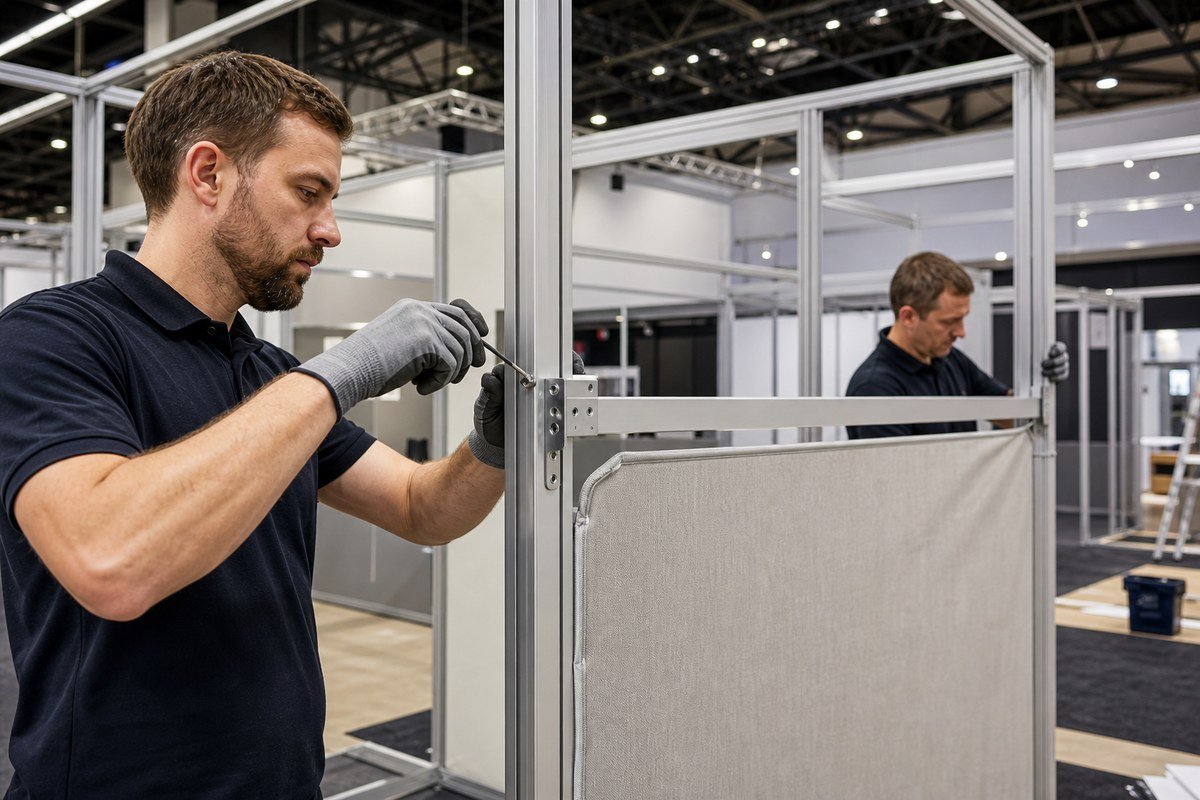
For a reusable trade show booth, check connectors, damage-free disassembly, configuration drawings for each planned footprint, compatibility with counters, shelving, lighting, screens, product mounts and storage, plus spare parts and repair instructions. This section is about how you assemble the system; it does not replace the post-show operating plan.
Treat a reuse claim as a proof question
Ask to see at least two future configurations, not one attractive rendering. A standard kit is not sustainable if it cannot fit your calendar or be maintained. A custom booth can also be demountable; ask for the assembly and maintenance assumptions instead of relying on the format name.
Example: A 20 × 20 ft booth used at four annual shows could retain its aluminium frame and storage counter while replacing only fabric graphics and product shelves. The four layouts, packing plan, storage owner, and repair route should be agreed before approval.
Choose Materials, Evidence, and Claims Together
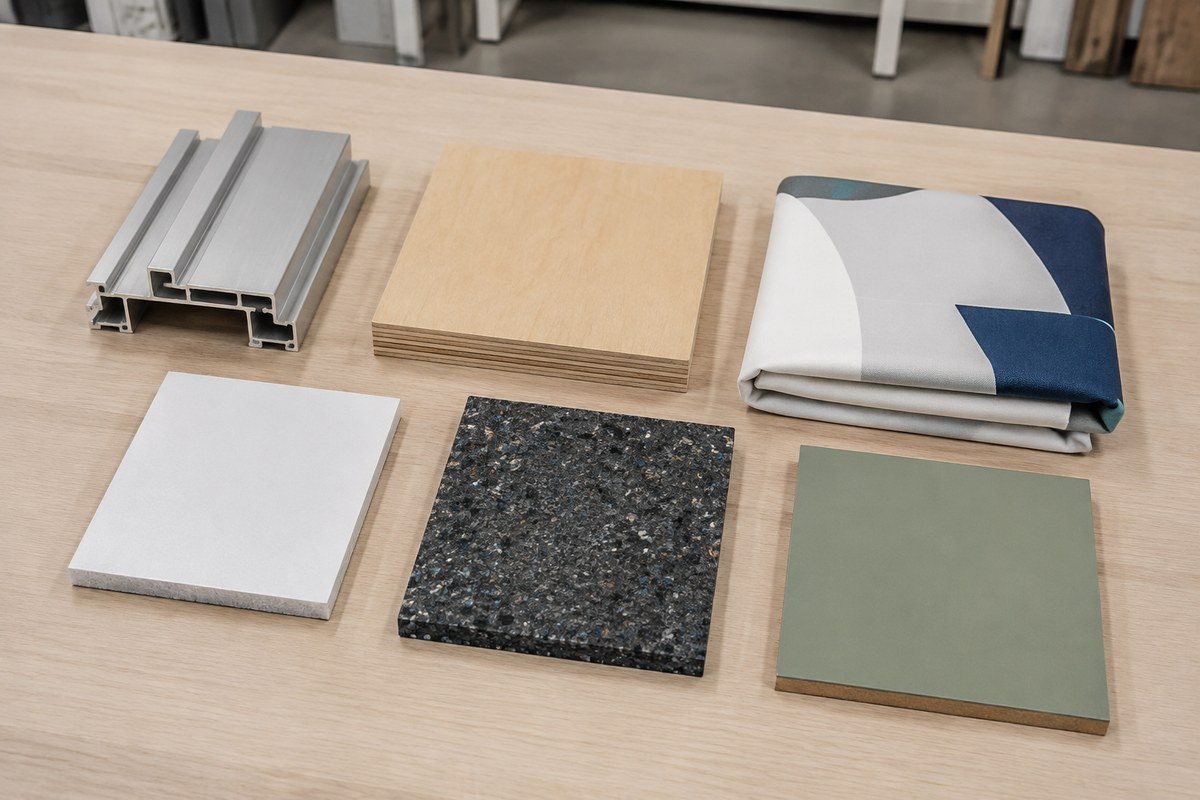
Compare the complete component
| Material or system | Useful when | Evidence to request | Trade-off to price |
|---|---|---|---|
| Aluminium or steel frame | Multiple shows and changing footprints | Alloy, connectors, durability, repair and source | Freight and storage weight |
| Timber or plywood panels | Warm finish or defined campaign | Source, coatings, separability and replacement parts | Tourability and recovery |
| Fabric graphics | Frequent message or language changes | Print process, attachment, cleaning, fire and end-of-life route | Local recovery may vary |
| Paper-based panels | Short campaign with a confirmed route | Composition, moisture resistance and local acceptance | Potentially shorter life |
| Reusable flooring | Repeated layouts and storage | Slip/access rules, cleaning, packing and venue acceptance | Weight and storage space |
Do not compare “green booth materials” by one attribute. Ask for composition, durability, separability, transport, maintenance, applicable certification or supplier declaration, and a realistic local end-of-life route. A material that fails after one handling cycle may be a poor choice for your program.
Check claims before they reach the graphic
Name the object, evidence source, date, geography, assumptions, and responsible party for every claim. ISO 20121:2024 is an event sustainability management systems standard for organizations involved in events; it is not a product label that certifies one booth. The Events Industry Council standards can shape your questions, but you still need project-specific evidence.
Avoid four common greenwashing errors: using “eco-friendly” without a boundary; treating “recyclable” as proof of recovery; treating a supplier management certification as certification of the whole booth; and claiming that a screen saves impact without checking its service life, power, freight, and replacement rate.
Reduce Packaging and Freight Impact
Design the pack and route together
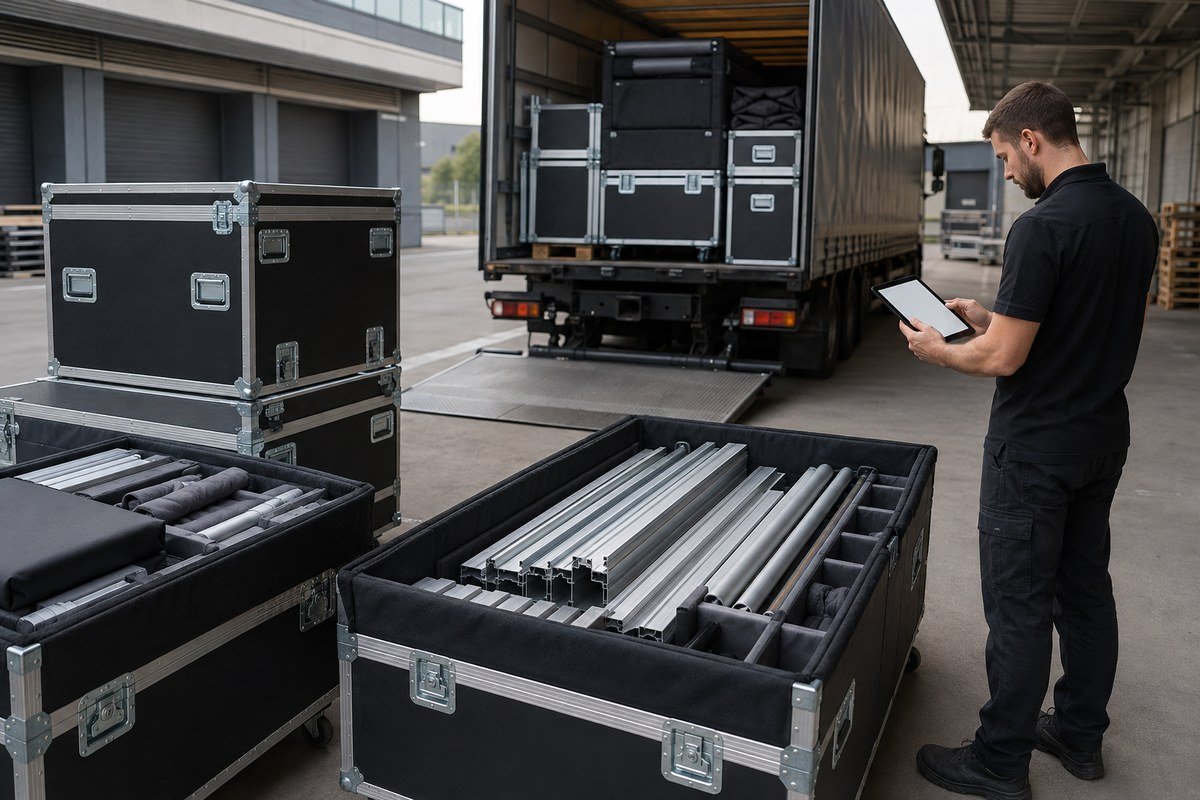
Record packed dimensions and weight by shipment unit, reusable cases or crates, replacement protection, origin transport, show receiving, material handling, storage, refurbishment, installation, dismantle, and return. Local rental can avoid a freight leg, but it may require new graphics or refurbishment. Compare the actual route, inventory condition, last-mile handling, and return route under the same show assumptions.
Plan Lighting and Digital Content Responsibly
LED fixtures can reduce operating energy compared with less efficient lighting. Digital signage can reduce repeated printing, but the EDPA/ESCA/EIC guidance also asks you to consider electronic production and lifespan. Record purpose, operating hours, power, controls, cable needs, update method, service life, repair or redeployment route, and a lower-material alternative.
Use a screen when its content is useful and the expected use justifies production, freight, power, and maintenance. A rarely used or frequently replaced screen may make reusable printed graphics the better choice.
Keep Product Demonstrations and Visitor Access Functional
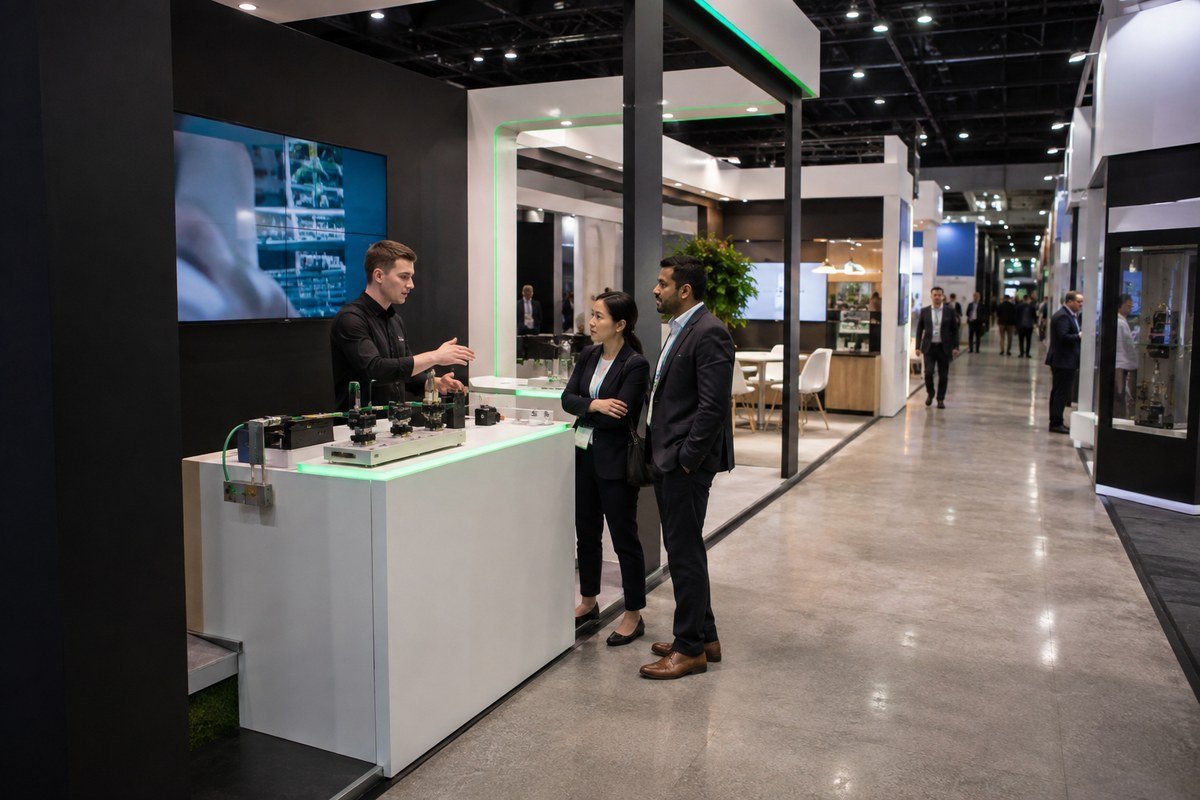
Decide whether your visitors must see a product, handle a sample, compare options, watch a demo, or begin a qualified conversation. Place products, screens, counters, seating, storage, and staff positions so the action works without rebuilding the booth. Keep the aisle edge open enough for the event’s access rules, and give every furnishing a real use case and a credible second life.
Assign a Post-Show Route to Every Component
Decide the route before the first build
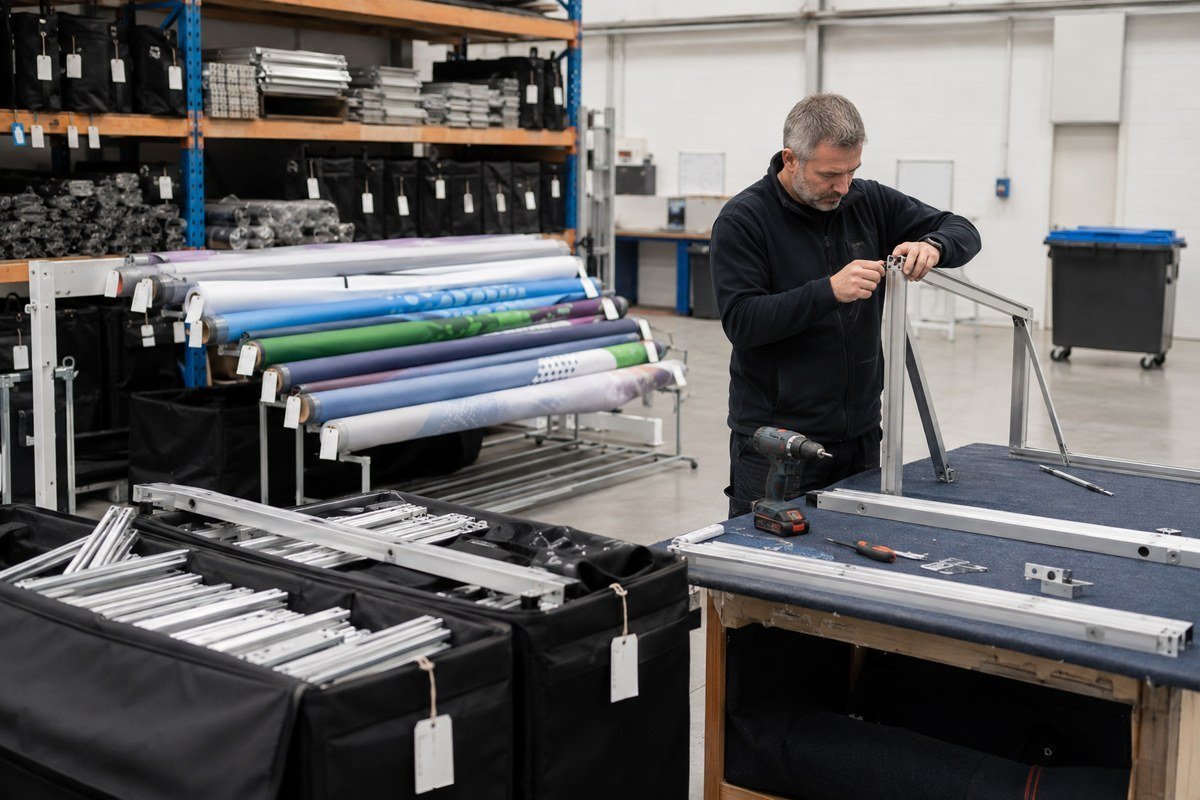
Mark each component as: return to inventory; clean, repair, or refurbish; donate or upcycle with a documented second use; send through a confirmed local recycling route; or dispose only after the other routes have been assessed. Disposal should be the last option after reuse, repair, donation, and verified recycling routes have been assessed.
Make the route credible
For recycling, confirm that materials can be separated, a local facility accepts them, and someone owns the transfer cost. Keep part number, condition, location, packaging position, repair history, owner, and next planned use in one asset record. This is the operating handoff after the build, not another design brief.
Match Format, Frequency, and Total Cost
Use frequency as an early filter
| Program pattern | Test first | Decision question |
|---|---|---|
| One show per year | Local rental or light reusable kit | Will ownership and storage justify purchase? |
| Two to four shows per year | Hybrid or owned modular system | Which parts repeat, and when is the break-even point? |
| Multi-city tour | Owned modular system with replaceable graphics | Can packing, repair, and local labour be standardized? |
| One-time launch | Demountable custom or rental with a second-use plan | Where will custom parts go afterward? |
Calculate cost with a visible boundary
Include design and structure, graphics, freight, material handling, installation, dismantle, storage, cleaning, repair, refurbishment, and end-of-life. Illustrative example only: a four-show program might budget $8,000 for structure, $1,200 per show for graphics, $900 per show for freight, $600 per year for storage, and $1,500 per show for installation and dismantle. The four-show total is $23,000, or $5,750 per use, before any resale or reuse value. A local rental quote may win for one show; the comparison can change at four shows. State currency, tax, distance, transport mode, return freight, and whether storage is annual so another supplier can reproduce your result.
Compare Proposals With a Sustainability Checklist
Put every proposal into one sheet and label structure, graphics, power, AV, storage, packaging, freight, material handling, installation, dismantle, return, repair, refurbishment, evidence, and end-of-life as included, coordinated, by exhibitor, show-appointed provider, excluded, or TBD.
Before you approve, check:
- show calendar, footprints, access rules, audience fit, and visitor action;
- two or more future configurations;
- reusable structure and replaceable graphics;
- material, packaging, freight, and energy evidence;
- ownership, storage, repair, and refurbishment responsibility;
- a post-show route for every component;
- total cost across expected shows and a low-use scenario;
- a named owner and record for each claim.
Measure and Improve the Booth Program
Use precise, repeatable KPIs
| KPI | Calculation and boundary |
|---|---|
| Reuse rate | Reused components ÷ total components in the approved inventory |
| Graphic replacement rate | Replaced graphics ÷ total graphics issued for the show |
| Packaging reuse rate | Reused packaging units ÷ total packaging units shipped |
| Material diversion rate | Materials reused or recycled ÷ total dismantled materials; define “diverted from disposal” and keep the same boundary each show |
| Freight activity | Shipment weight × distance, with weight unit, distance basis, and return legs stated |
Freight activity is a logistics-load indicator, not a complete carbon estimate. Calculate material diversion by mass unless another unit is used consistently across all shows. For a carbon estimate, use mode-specific emission factors and record transport mode, fuel assumptions, vehicle or freight efficiency, load factor, and return movements.
Turn the review into the next brief
Record the show date, method, boundary, owner, and supporting document. Your damage log, shipment record, print count, energy record, repair invoices, and end-of-life receipts show what to reduce, reuse, repair, or remove next time.
How Can KingExhibits Support the Planning Process?
Start with a usable project brief
KingExhibits can work from your show calendar, floor plans or footprint sizes, open-side requirements, venue deadlines, visitor action, products or demonstrations, graphic languages, target budget, existing assets, and reuse expectations. Mark unconfirmed information as an assumption so a concept drawing does not quietly become a fixed promise.
Planning outputs to make clear
Depending on your scope, the discussion can set out two or more booth configurations, a component reuse matrix, replaceable-graphic dimensions, a preliminary packing list, and the ownership of structure, graphics, lighting, AV, storage, freight, material handling, installation and dismantle. It can also identify which material claims need a supplier declaration or other evidence. These are planning outputs to review; venue approval, show-appointed services, and final engineering remain subject to the relevant parties.
Use checkpoints before you approve
Ask KingExhibits to show how the proposal changes when the footprint, show frequency, or budget changes. Check the cost per planned use, the storage and repair owner, the route for damaged parts, and the assumptions behind any local rental or freight saving. Components without a next use, maintenance route, or responsible owner should be removed or marked as a gap instead of being called sustainable.
To request a project-specific proposal, contact KingExhibits with your show calendar, footprint, target budget, visitor action, and reuse requirements. Ask for configurations, responsibilities, lifecycle assumptions, and evidence in writing before approving a buildable scope.
Frequently Asked Questions
What is an eco-friendly exhibition booth?
“Eco-friendly” is useful only when it refers to a defined component or project boundary. It means the project has reduced avoidable inputs, planned useful reuse, and documented transport, energy, maintenance, and end-of-life choices—not simply used a green color.
What is the difference between a reusable and recyclable exhibition stand?
A reusable stand keeps the same component in service with little reprocessing. A recyclable stand is designed so its material can enter a recovery route after use. Prioritize refusal, reduction, reuse, and repair, then confirm that a local facility accepts the separated material.
How can booth shipping be more sustainable?
Record your packed weight, dimensions, distance, packaging reuse, material handling, transport mode, and return legs for each show. Compare owned, rented, and local-inventory routes on the same assumptions; a shorter route is not automatically better if it causes new graphics or extra packaging.
Is a sustainable booth more expensive?
It can have a higher first invoice but a lower cost per use. Compare purchase or rental, graphics, freight, storage, labor, maintenance, and end-of-life across the number of shows you can realistically attend, then test a low-use scenario.
How do you calculate sustainable booth cost across multiple shows?
Add one-time design and structure to show-by-show graphics, freight, labor, storage, maintenance, and disposal; subtract only credible rental, resale, or reuse value; and divide by actual planned uses. Keep your currency, tax, distance, transport mode, and return assumptions visible.
Final Thoughts
The strongest sustainable booth strategy is a repeatable business system: choose the right shows, retain useful structure, refresh only what changes, compare freight and total cost, verify claims, and assign every component a post-show route. A useful proposal brief includes your show calendar, footprints, audience and visitor action, assets, graphics, packaging, services, evidence needs, budget, and reuse requirements.
With those inputs, KingExhibits can help you move from a general sustainability goal to a booth scope that is testable against your shows, budget, and post-show plan.