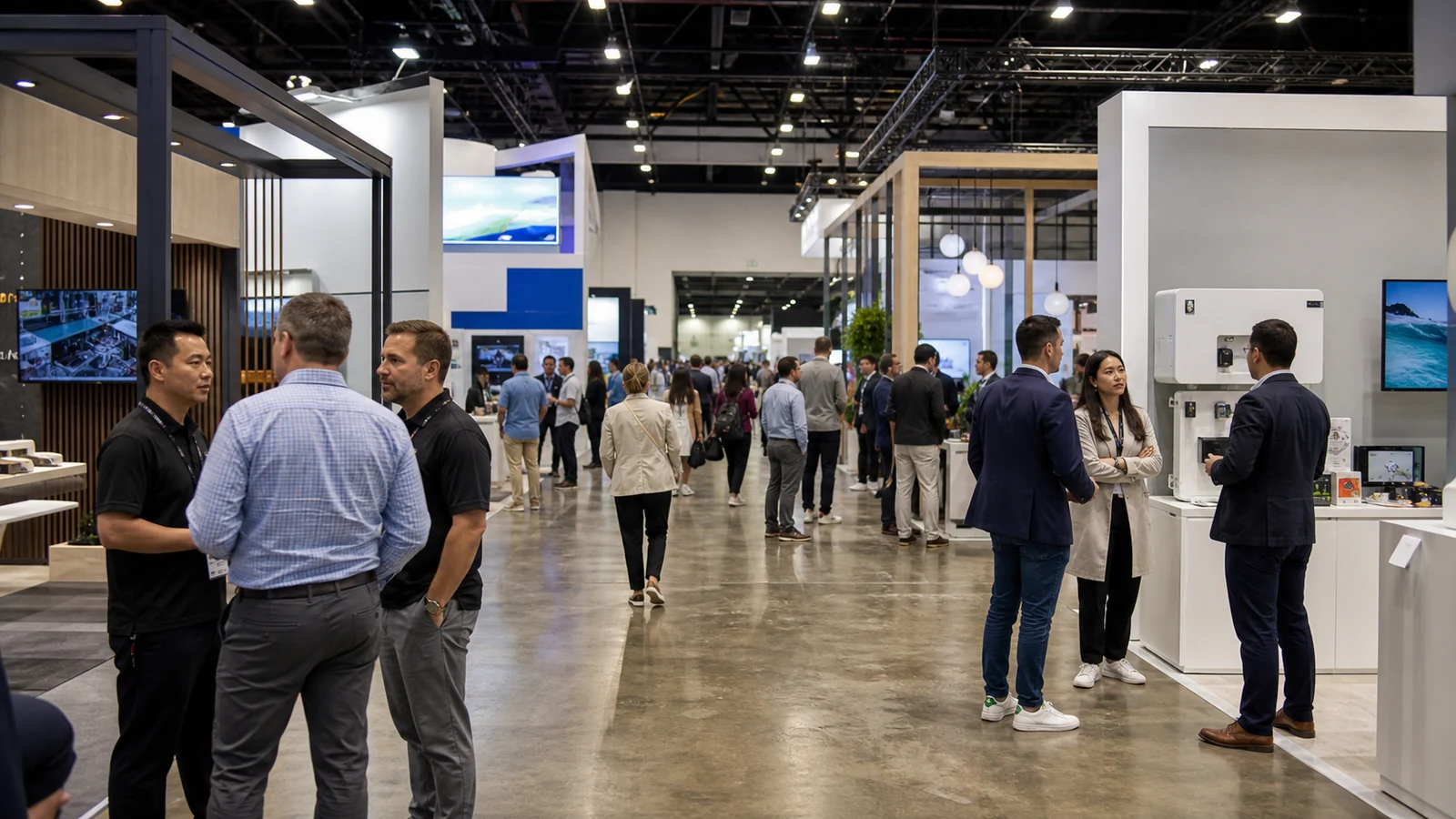
ISC West can put your security technology in front of integrators, end users, consultants, dealers, and public-safety professionals. That reach is useful only when your exhibit makes the right buying conversation possible. This guide separates confirmed 2027 details from information that exhibitors still need to wait for, then shows how to plan around the gap.
What is confirmed for ISC West 2027?
ISC West 2027 is scheduled for April 5–9 at The Venetian Expo in Las Vegas. The official schedule separates two parts of the event:

| Program | Confirmed dates | What it means for an exhibitor |
|---|---|---|
| SIA Education@ISC | April 5–8, 2027 | Conference sessions begin before the exhibit hall opens. Education requires its own agenda and should not be described as four exhibit days. |
| ISC West Exhibit Hall | April 7–9, 2027 | Product demonstrations, booth meetings, and floor staffing should be planned around these three days. |
The organizer currently lists exhibit-hall hours as 10:00 a.m.–5:00 p.m. on Wednesday and Thursday, and 10:00 a.m.–3:00 p.m. on Friday. The venue address is The Venetian Expo, 201 Sands Ave, Las Vegas, NV 89169. Recheck the official hours and location page before booking staff travel or printing a final schedule.
That distinction matters. A technical employee attending SIA Education@ISC may arrive before the exhibit team, while the people responsible for demos, lead capture, and booth closing need a plan for the exhibit-hall days. Combining both schedules into “April 5–9 on the show floor” would create incorrect staffing and freight assumptions.
What kind of event is ISC West?
ISC West is an annual U.S. security trade event produced by RX with the Security Industry Association as premier sponsor. The current event positioning centers on the convergence of physical and digital security. The show scope includes companies working in physical security, cybersecurity, IoT, identity, and converged security. Established product areas include access control, alarms and monitoring, biometrics, detection devices, smart-home systems, video surveillance, and wireless equipment.
The audience is not one generic group of “security buyers.” The organizer names system integrators and installers, dealers and distributors, consultants and specifiers, enterprise end users, critical-infrastructure operators, government agencies, and public-safety or law-enforcement professionals. Those roles can look at the same product for different reasons. An integrator may ask about interoperability and deployment. An enterprise end user may focus on risk, administration, or lifecycle support. A distributor may care about channel fit and market demand.
The organizer reports that the 2026 event drew 29,000+ security professionals, 750+ exhibiting brands, and participants from 80+ countries. These are 2026 organizer figures, not a forecast or guaranteed audience for 2027. Use them to understand the event's scale, but use the role mix to decide whether the show matches your sales plan.
Decide whether your product has a clear show-floor job
A product category match is only the first filter. Before requesting space, write down the one action a qualified visitor must complete at your booth. For a camera platform, that may be comparing low-light footage or searching recorded video. For access-control hardware, it may be seeing credential, reader, controller, and management software work as one chain. For a cyber-physical security platform, it may be following an alert from detection to investigation and response.

This single action exposes the inputs your exhibit will need. A live cloud demonstration depends on reliable internet and a fallback recording. A rack, gate, turnstile, or door assembly creates weight, anchoring, clearance, and power questions. A product that can resemble a weapon or tactical device requires early written review with show management and security. A controlled demonstration is more credible than a crowded counter of equipment that visitors cannot test.
Next, choose the primary conversation behind that action. If you want integrators, prepare architecture, compatibility, deployment, and support answers. If you want enterprise end users, show the operational problem, evidence, and handoff to their technical team. Trying to serve every audience in the same five-minute demo usually produces a message that none of them can repeat.
How to start the official exhibitor process
The organizer currently provides two routes. A new exhibitor should complete the ISC West exhibitor interest form to request package information and view the 2027 floor plan. A current or returning exhibitor should contact its assigned ISC sales representative about renewal, available space, and sponsorship options.
Treat the first sales conversation as a fact-finding step, not a booth-design approval. Ask for the current floor plan, available booth types, package inclusions, payment schedule, cancellation terms, and any product-category or pavilion placement. Confirm whether the space is raw floor area or includes carpet, power, furniture, a directory profile, lead retrieval, or other services. No package price or inclusion should be assumed from a prior year.
Once contracted, the exhibitor's operational work moves through official channels. The current exhibitor resources page points exhibitors to an Exhibitor Hub, an exhibitor checklist, assigned Customer Solution Coordinators, and later access to registration, the exhibitor manual, customer invitation tools, and a booth planning tool.
What is still pending for 2027?
As checked on September 7, 2026, the official ISC West resources page marks the 2027 exhibitor manual, exhibitor registration, customer invitation program, and booth planning tool as “Coming Soon.” The page does not yet publish the complete 2027 service deadlines, display rules, shipping windows, targeted move-in plan, or hall-specific move-out schedule.

Do not fill that gap with a 2026 manual. Prior-year documents are useful for discovering which questions will matter, but the dates, contractors, booth limits, forms, and service terms can change. Build a control sheet now with four columns: item, responsible owner, official source, and review trigger. Then activate each task when the 2027 manual or your exhibitor dashboard provides the controlling information.
| Hold for the 2027 manual or contract | Why it can change your plan |
|---|---|
| Booth type, orientation, height, sightline, and hanging-sign rules | The assigned configuration can make a proposed wall, overhead sign, or demonstration layout noncompliant. |
| Exhibitor-appointed contractor procedure and insurance | Missing approval or insurance can keep an outside contractor from accessing the floor. |
| Electrical, internet, rigging, cleaning, catering, and plumbing ordering | The provider, scope, rate tier, and deadline determine both design feasibility and cost. |
| Advance warehouse and direct-to-show shipping instructions | Labels, receiving dates, material handling, and late shipments affect delivery risk. |
| Targeted move-in and move-out schedule | Your booth number or hall may determine when freight and labor can work. |
| Vehicle, battery, laser, drone, recording, or special-device approvals | A security product demonstration may need review beyond ordinary booth construction. |
The 2026 ISC West documents illustrate why this control matters: display rules varied by booth type, and move-out timing varied by hall. Those old details are not 2027 instructions. Their only safe lesson is that you must wait for the current assignment and manual before releasing production drawings or freight bookings.
Design the demonstration before the exhibit structure
Security products are often difficult to judge from a static display. Begin with a short demonstration script and mark every physical dependency it creates. Where does the visitor stand? What can the visitor touch? Which screen shows the result? Does the demonstration require a local server, cloud connection, PoE switch, camera sightline, credential reader, door, barrier, microphone, or controlled lighting?

Turn that script into a service location plan. Put power and data at the device, not merely somewhere inside the booth. Separate a hands-on station from a scheduled technical meeting if the two conversations have different depth. Keep queues inside your footprint and protect accessible paths. Plan a recorded fallback that still proves the workflow when an external network, cloud service, or test device fails.
The Venetian's current venue guidance identifies catering, cleaning, rigging, lighting, internet/telecom, electrical, and plumbing as exclusive services. It also asks for a CAD or Vectorworks drawing and a service location plan with rigging orders. These are venue-level planning signals, not a substitute for the 2027 ISC West exhibitor manual. After you receive a booth assignment, reconcile the show contract, current manual, and venue order portal before placing any order.
Prepare the content that different security roles need
One demonstration can support several conversations if the supporting evidence is layered. The first layer should let a visitor understand the problem and result in seconds. The second should show the workflow or product difference. The third should give a technical evaluator something specific to take away.
For integrators and specifiers, prepare supported protocols, architecture diagrams, environmental limits, cybersecurity documentation, and deployment requirements. For end users, connect the feature to the operating event it changes: a forced door, false alarm, identity check, investigation, or response handoff. For dealers and distributors, make product availability, channel structure, training, and sales support easy to discuss without blocking the demo station.
Keep claims inside the evidence you can show. If a performance statement depends on lighting, distance, network conditions, database size, or a particular model, display that condition. If certification or compliance is important, identify the exact product and current certificate rather than placing a broad logo across the booth. The goal is not to make every conversation longer. It is to let the right visitor reach the next technical or commercial step without guessing.
Build a live 2027 exhibitor checklist
Use the following sequence while official information is released:

- Confirm fit and participation route. Match your product to the audience role you need, then contact ISC sales through the correct new or returning exhibitor path.
- Record the contracted facts. Save the booth number, dimensions, orientation, package inclusions, payment terms, and named organizer contact.
- Lock the demonstration brief. List the visitor action, equipment, power, internet, mounting, sound, lighting, data, and fallback requirements.
- Wait for controlling documents. When the 2027 manual appears, record its version or access date and replace every provisional assumption.
- Submit approvals before production. Check drawings, hanging elements, special equipment, EAC documents, insurance, and demonstration-specific approvals against the current rules.
- Order each service from the correct channel. Verify provider, deadline, rate tier, labor scope, and service location before payment.
- Release freight against the current shipping instructions. Use the official labels and receiving windows; connect the carrier plan to the assigned move-in and move-out schedule.
- Run a tabletop rehearsal. Test the live demo, recorded fallback, lead handoff, staff roles, opening routine, and shutdown routine before shipping.
This checklist should stay live. A person must own each item, and a dated official source must close it. “We used the same setup last year” is not a source.
FAQ
Is ISC West 2027 a five-day exhibition?
No. The published event range is April 5–9, but SIA Education@ISC and the Exhibit Hall have different schedules. Education is listed for April 5–8, while the exhibit hall is listed for April 7–9. Staff travel, booth operation, and conference attendance should be scheduled against the program each person will actually use.
Has the 2027 ISC West exhibitor manual been released?
Not on the public exhibitor resources page checked on September 7, 2026. The page labels the exhibitor manual “Coming Soon.” Do not use a 2026 deadline, shipping label, contractor form, height limit, or move schedule as a 2027 instruction. Monitor the official resources page and your Exhibitor Hub.
Who should a first-time international exhibitor contact?
Start with the official exhibitor interest form. The ISC sales page also lists regional international sales contacts, while the exhibitor resources page identifies a Customer Solution Coordinator for international companies. Use the current pages rather than copying an old contact list, because assignments can change.
Should we order internet from our exhibit builder?
Do not assume that you can. The Venetian currently identifies internet/telecom as an exclusive venue service. Confirm the controlling 2027 ordering route, rate, deadline, and service location in the ISC manual and venue portal. Give the provider your device count and demo requirements, then keep an offline or recorded fallback.
When can we finalize freight and labor bookings?
You can shortlist providers and reserve internal budget now, but final instructions should wait for the 2027 manual, official shipping labels, booth assignment, receiving windows, and targeted move schedule. Your outbound plan also needs the current move-out deadline and material-handling process. Prior-year hall times are not a safe substitute.
Final planning decision
ISC West is a strong candidate when your security product fits the organizer's audience and you can prove its value through a controlled, role-specific demonstration. The confirmed 2027 dates and official exhibitor inquiry route are enough to begin the commercial conversation. They are not enough to release a final booth, service order, or freight plan.
Proceed in two stages: secure the right participation option and define the demonstration now; release drawings, orders, and logistics only after the 2027 manual and booth assignment resolve the remaining rules. That boundary keeps early planning useful without turning last year's instructions into this year's mistakes.