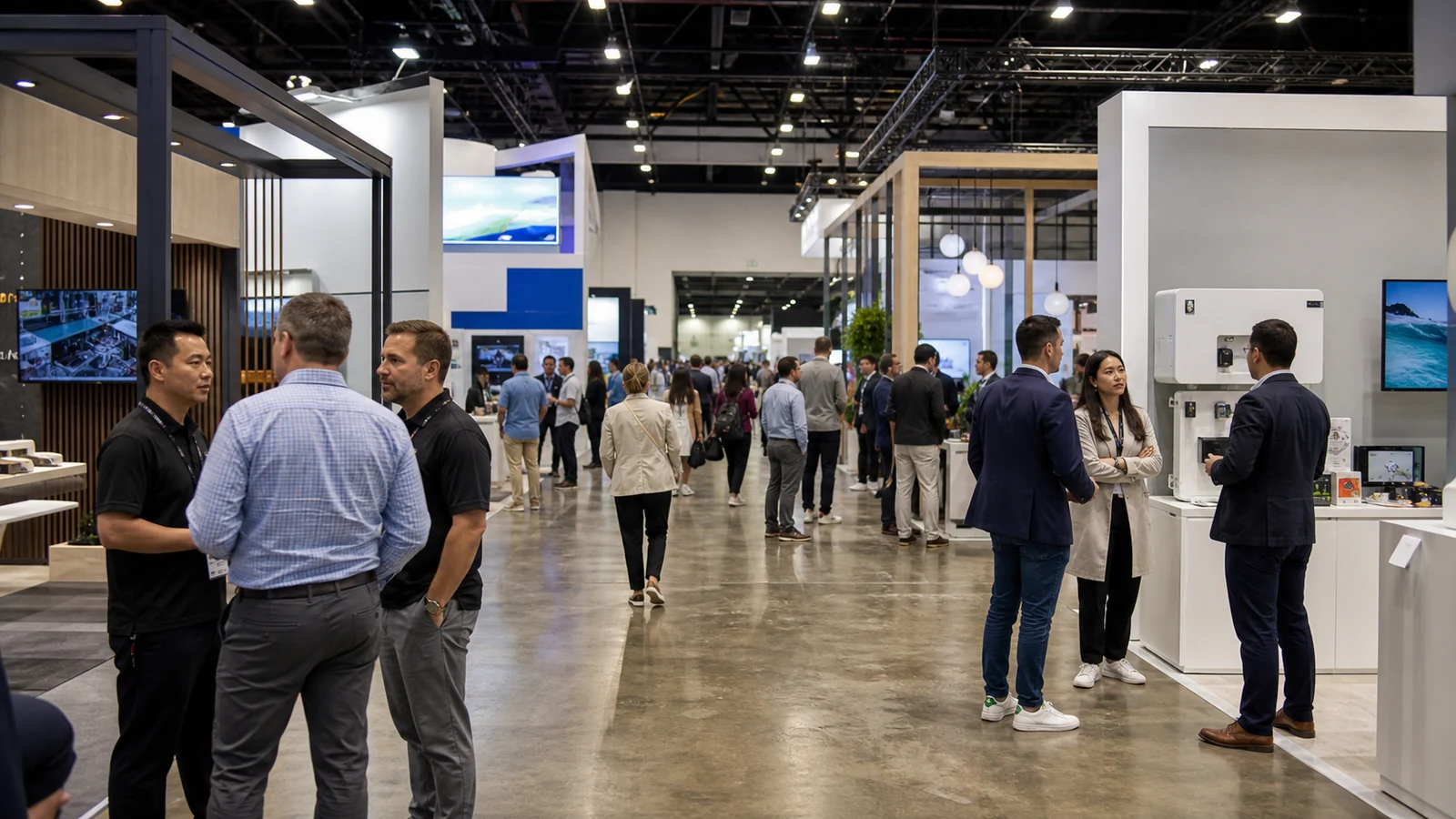
If you sell wafer inspection equipment, SEMICON West puts your demonstration in front of a broad semiconductor audience. The useful question is whether the people you need can understand your system there. This guide explains the event, its changing location, and what that means for your exhibit.
The 2026 show is in San Francisco; 2027 moves to Phoenix
The next SEMICON West runs October 13–15, 2026, at Moscone Center in San Francisco. The venue lists Moscone North and South for the event. This is a conference and exhibition for the semiconductor and electronics manufacturing industry, organized by SEMI. Event venue

For your 2026 staffing plan, the expo opens from 10 a.m. to 5 p.m. on Tuesday and Wednesday, and from 10 a.m. to 4 p.m. on Thursday. Monday, October 12, has separate pre-show programming, including SEMI U courses and the SEMI Market Symposium; it is not an extra expo day. Official agenda
The following edition is scheduled for March 30–April 1, 2027, at Phoenix Convention Center. SEMI's July 30, 2026 announcement establishes Phoenix as the show's long-term home on an annual spring schedule. These are successive editions of SEMICON West, not two interchangeable city options for 2026. SEMI schedule announcement
Older descriptions can still refer to alternating between San Francisco and Phoenix. For example, Phoenix's October 2025 announcement described a rotating schedule. Use the July 2026 SEMI announcement for future planning. Historical Phoenix announcement
If you are considering both editions, allow for the short interval between them. A reusable exhibit may help, but its suitability for Phoenix depends on that edition's space and rules. A San Francisco approval does not settle a Phoenix design decision.
Where inspection equipment fits in the show
SEMICON West covers the microelectronics supply chain. The organizer's audience description includes semiconductor manufacturers and equipment suppliers, as well as engineers and technical professionals. It also includes researchers, investors and workforce participants. That is a relevant setting for your inspection system, but it is not an audience made up entirely of purchasing teams. Official event overview

The 2026 program includes advanced packaging and smart manufacturing alongside broader industry topics. Official event overview For an inspection supplier, those themes offer different conversations: examining a packaging defect is a different discussion from moving inspection results into a manufacturing workflow. Lead with whichever problem your actual system addresses; a popular program theme is not evidence that your equipment supports it.
The official 2026 exhibitor list and floor plan feature Accretech America Inc and 3D-Micromac AG among the participating companies. Use the directory to investigate the surrounding equipment market and potential contacts. An exhibitor listing confirms participation in the directory, not a company's attendance at your demo or its intention to purchase. 2026 exhibitor map
Before committing to space, ask your U.S. sales team which engineering conversations would justify the trip. If the answer is still “anyone in semiconductors,” review the program and company profiles first. The show is broad enough that an unfocused inspection pitch can disappear into that breadth.
Decide what visitors need to see on your system
Your exhibit needs to explain the inspection task before it explains the machine. A visitor should be able to identify the sample, see the defect you are discussing, and understand what the displayed result means. Any performance comparison needs its test conditions beside it. A striking image alone does not establish detection capability.


Bring the working system when seeing the measurement or handling sequence answers an important question that recorded footage cannot. If the useful conversation happens entirely around defect images and results, a screen with a physical sample may be enough. That choice depends on your product and demonstration, not on a rule that every equipment supplier needs a large machine.
There are practical limits at SEMICON West. The posted 2026 rules require demonstrations and their audiences to remain inside the contracted space without obstructing aisles. Equipment with moving parts needs particular care. Inline booths cannot use hanging signs. Exhibitor rules, pages 6 and 25
Put the viewing position on the drawing with the machine footprint. Otherwise, a system that fits the booth can still leave its audience standing in the aisle. Confirm the proposed operating setup with show management and the relevant service provider before shipping; floor space alone does not establish that the demonstration can run.
What still needs attention for October 2026
As of September 7, the published design-submission dates have passed. The exhibitor FAQ requests custom-booth designs by August 12; the linked rules give August 14 for booth plans. If your design remains unsubmitted, ask SEMI which process now applies and whether it can still be reviewed. Neither date is a promise of late acceptance. Exhibitor FAQ · Rules, page 24

Freight arrival is also tied to your booth's assigned move-in slot. The service center lists targeted arrivals on October 8–10, no exhibitor move-in or freight receiving on Sunday, October 11, and general move-in on October 12. Give your forwarder the actual slot for your booth, rather than the public show-opening date. Exhibitor service center
Two nearer dates deserve a place in your preparation schedule: September 14 for profile updates to appear in the mobile app, and September 17 for the GES ordering discount deadline. Other services can have different deadlines. Use the exhibitor profile to describe your inspection application clearly enough for a relevant visitor to find you before arriving. Exhibitor FAQ
Exhibitor questions
Can a partner company share our booth listing?
The 2026 co-exhibitor application provides a separate registration route. The primary exhibitor submits a form for each co-exhibitor; the additional company is added to the floor plan after its fee is paid. The published deadline is September 9, 2026. If a distributor or partner will exhibit under its own company identity, resolve that registration with SEMI before promising a shared listing. Official co-exhibitor form
Can we photograph our equipment during show hours?
Do not assume your own booth is exempt from photography restrictions. The posted rules distinguish exhibitors photographing their own displays before opening or after closing from photography during show hours, which is restricted to authorized parties. Ask show management how to arrange photography of your system during the event. Rules, page 2
Can we reserve a separate room for technical discussions?
The exhibitor FAQ provides a meeting-room booking route, but availability is limited: on September 7, it reports Tuesday and Wednesday Moscone meeting rooms as sold out. Check the live booking page for remaining options before inviting customers to a room. Exhibitor FAQ
Which floor plan should our team use?
Use the 2026 exhibitor list and floor plan. At this check, an older official directory page still labels its content as 2024 despite showing a 2026 date in the page header. Check the map's edition before sharing booth locations with your team.
Choose the demonstration before the footprint
Take your proposed inspection demo and a named list of target engineering contacts into the space discussion. If the demonstration needs a working machine, resolve its setup and viewing area before choosing the booth. If it does not, put that space into a conversation visitors can follow.