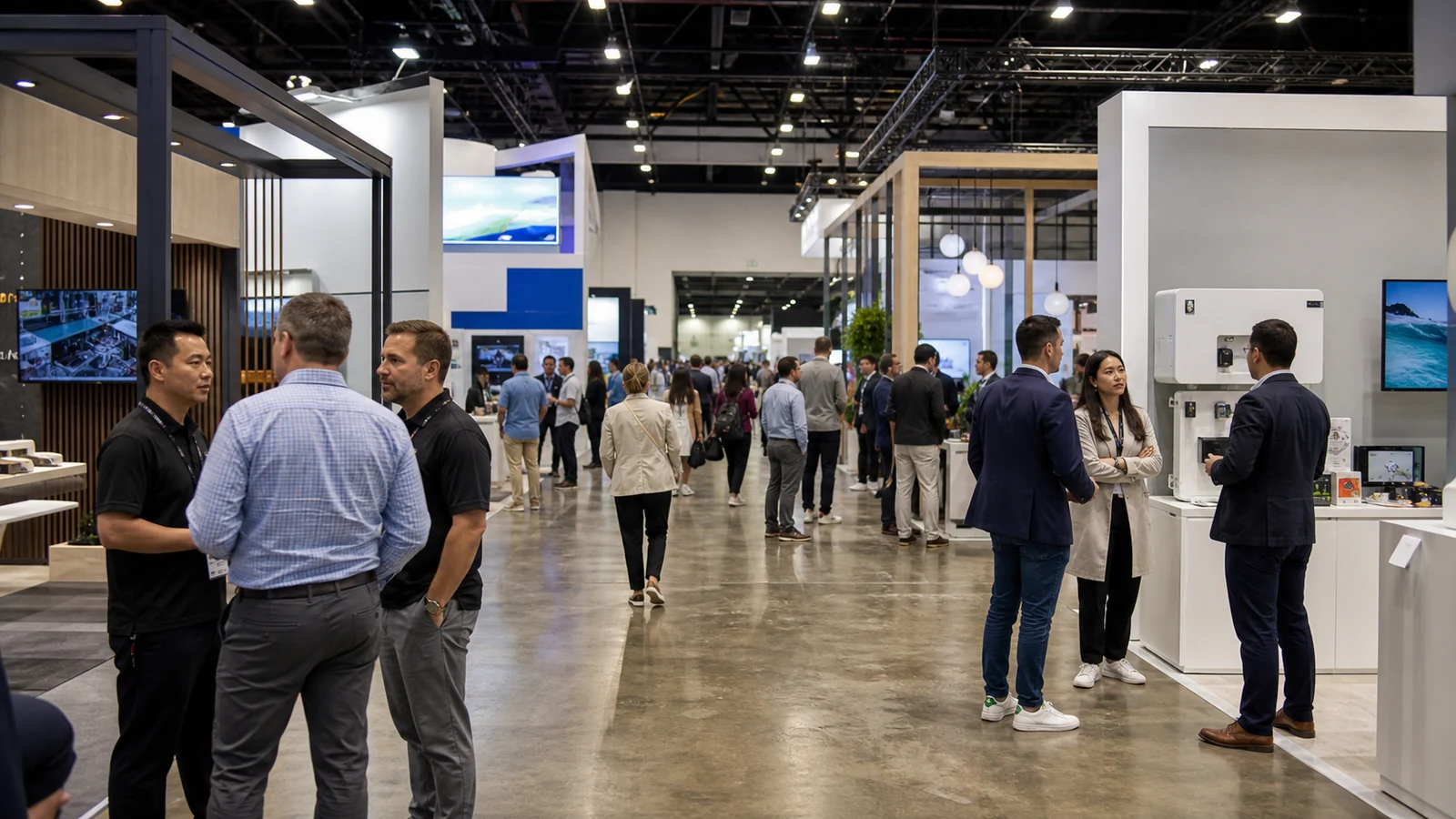
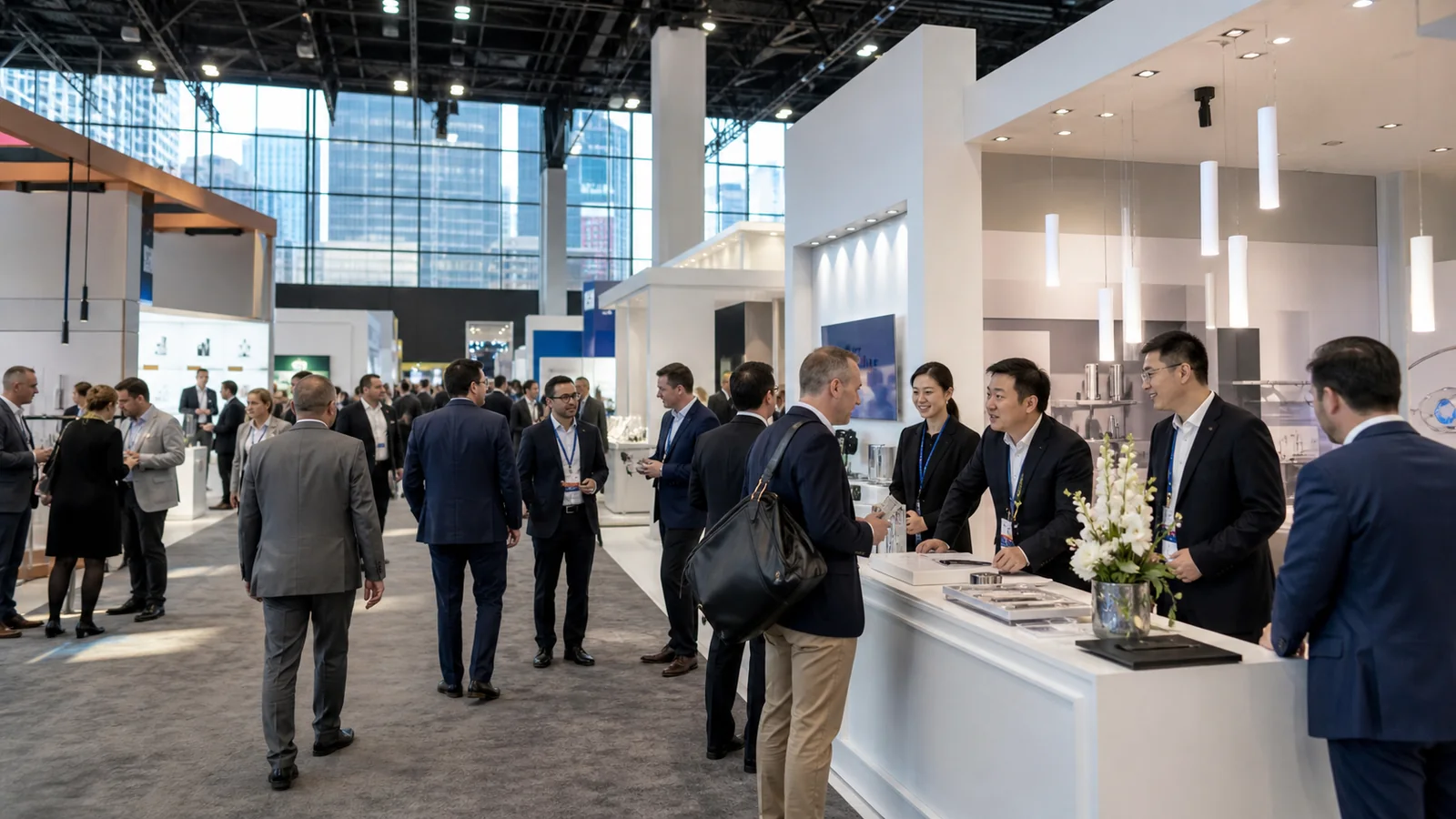
A photonics buyer rarely stops because a booth says “innovative optics.” The useful conversation begins when an engineer can see what your component changes, measure it, and compare it with the condition they already know.
This guide is for an international B2B marketing manager preparing to exhibit at SPIE Photonics West in San Francisco. It separates the 2027 exhibition from the conference program, explains the available exhibit paths, and shows how to turn a technical product into a workable exhibit plan without treating an old manual as a current rule.
Confirm which part of SPIE Photonics West you are exhibiting in
SPIE uses Photonics West as the name of a week that contains conferences, courses, industry programming, and two exhibitions. Those dates are not interchangeable.

| Program | 2027 dates | Location or scope |
|---|---|---|
| SPIE Photonics West conferences and courses | 30 January–4 February | San Francisco, California |
| BiOS Expo | 30–31 January | Moscone North/South Exhibition Level |
| Photonics West Exhibition | 2–4 February | Moscone North/South Exhibition Level and Moscone West Level 1 |
The official event page gives 30 January–4 February as the overall event period. The official exhibitions page gives the shorter dates and locations for each exhibition. This article focuses on the Photonics West Exhibition on 2–4 February 2027.
That distinction affects more than hotel nights. A team attending conference sessions may arrive before the exhibition opens. BiOS exhibitors have a different show period. Your freight, staffing, meeting calendar, and product readiness plan must use the dates attached to your contract, not the headline dates for the whole week.
Choose the exhibition that matches what you sell
The first exhibitor decision is not booth size. It is whether your product belongs in the Photonics West Exhibition, the BiOS Expo, or neither.
SPIE describes the Photonics West Exhibition as a photonics and laser exhibition with more than 1,200 companies each year. Its published technology coverage includes lasers and light sources, laser systems, cameras and CCD components, fiber-optic equipment, optical components, detectors, high-speed imaging and sensing, optical materials, coatings, lenses, filters, and positioning hardware. The exhibition also includes areas for quantum technologies, AR/VR/MR, and Vision Tech.
BiOS Expo is the biomedical optics and biophotonics exhibition. A camera platform may fit either show, for example, but the correct choice depends on the application you need visitors to understand. A general imaging component presented for industrial machine vision points toward the Photonics West Exhibition. The same underlying technology configured around a biomedical workflow may fit BiOS better. Do not book both merely because the product can be described with both vocabularies.
The 2027 exhibitor page provides separate floor plans, prospectuses, and online contracts for the two exhibitions. Before signing, write one sentence that names the application, the person who needs it, and the evidence you can show at the booth. Send that sentence with your product description to SPIE Sales when the category is unclear.
Expect a technical audience, then narrow it for your booth
SPIE lists engineers and designers, corporate managers, application and product developers, and standards developers among the exhibition audience. It also says more than 20,000 people from around the world attend Photonics West each year and that more than half of attendance is in R&D, project development, and other decision-making functions. SPIE labels those attendance statements as historical data; they are not a forecast of verified 2027 attendance.

This audience rewards specificity, but it is still too broad for one booth message. Choose one priority conversation. An optical-coating company might need a lens-system engineer to compare wavelength range, angle of incidence, and environmental limits. A machine-vision company might need an automation developer to judge whether a camera and interface can maintain the required capture rate under the proposed lighting.
The booth should make that first comparison possible in less time than a complete sales presentation. Longer technical discussions can follow at a table or in a scheduled meeting. If the first message tries to address every market, the most relevant engineer has to do the classification work for you.
Make the product proof visible and repeatable
At this show, a working demonstration is not automatically a good demonstration. The right demo exposes the difference your visitor is qualified to judge.
Build a one-page proof sheet for each product you plan to operate:
- claim being demonstrated;
- input or test condition;
- instrument, reference sample, or comparison method;
- output the visitor can see or read;
- normal reset time and consumables;
- electrical, data, ventilation, light-control, or safety needs;
- result that the demonstration does not establish.
The final line keeps the conversation honest. A live image can show contrast under the booth conditions, but it may not prove performance across every wavelength or production environment. A beam demonstration can show alignment or output behavior without establishing a customer-specific safety classification.
Ambient conditions deserve special attention. Exhibition lighting can wash out a display, reflections can interfere with an imaging setup, vibration can disturb a sensitive alignment, and an open aisle can make controlled laser use unsuitable. Decide whether the proof needs an enclosure, a dark viewing hood, a remote camera, recorded backup data, or an appointment-only explanation. The current show and venue rules must approve the arrangement before it becomes part of the released design.
Use the floor plan as part of the technical brief
The 2027 Photonics West Exhibition uses the exhibition levels in Moscone North and South plus Level 1 of Moscone West. SPIE already links a 2027 floor plan, but a chosen space still needs to be translated into operating conditions.

When a booth number is assigned, record the building and level, booth type, open sides, neighboring exhibits, nearby entrances, and any feature that affects your demo. Then place the demonstration where the intended visitor can understand it without standing in an aisle or crossing a controlled equipment zone.
A compact component display may need close viewing and a quiet technical conversation. A vision system may need a longer sightline. An AR/VR device may require fitting, cleaning, and a safe waiting position. These are product-use conditions, not decorative preferences. They should determine the counter depth, screen position, storage, queue, and staff station before graphics are finalized.
Build a live document register before releasing the booth
The public 2027 exhibitor page currently provides the event dates, venue, floor plans, prospectuses, online contracts, published space rates, and a link to exhibition policies. As of 7 September 2026, the public SPIE pages reviewed for this guide did not provide a complete PW27 Exhibitor Service Manual with the show’s move-in and move-out schedule, service-order deadlines, advance-warehouse instructions, or full booth-construction rules.

That gap should change the status of your decisions, not stop all work. Create a register with these fields:
| Item | Controlling source | Owner | Current status | Release condition |
|---|---|---|---|---|
| Exhibit and space | Signed PW27 contract and assigned floor plan | Marketing lead | Confirmed/pending | Contract accepted and booth assigned |
| Booth geometry | PW27 rules plus approved drawing | Exhibit lead | Pending | Current limits and review path confirmed |
| Product demo | Internal proof sheet plus show/venue approval | Product lead | Pending | Utilities and safety conditions accepted |
| Freight | PW27 service manual and carrier booking | Logistics lead | Pending | Warehouse/site instructions and target dates confirmed |
| Facility services | Current official order portals | Exhibit lead | Pending | Rates, cutoffs, and delivery points confirmed |
Do not copy a number from a previous year into the “controlling source” column. An older manual can help you form questions, but it cannot approve a 2027 drawing, shipment, labor order, or budget.
Convert every demonstration into a utility schedule
Product teams often describe a demo as “one laptop and a laser.” The booth team needs a more exact schedule.
For every powered item, record voltage, amperage or wattage, plug type, operating hours, and whether it must remain powered overnight. Mark the physical connection point on the same plan used by the exhibit builder. Add wired internet, dedicated bandwidth, local network equipment, compressed air, exhaust, cooling, or water only when the product truly requires them.
Optical demonstrations may also need conditions that do not appear on a standard utility order. Note warm-up time, calibration sequence, vibration sensitivity, stray-light control, interlocks, protective barriers, and the staff role allowed to operate the equipment. Ask the current show contact which documents and approvals apply. Do not infer permission from the fact that a similar device appeared at an earlier event.
Prepare a truthful fallback for the failure that would stop the live proof. That may be a recorded run with the test conditions displayed, a duplicate sample, a local dataset, or a static optical path with annotated measurements. A fallback should preserve the technical conversation; it should not pretend that a failed live system is running.
Route freight through the show’s current contractor instructions
The Moscone Center does not receive or store show freight on behalf of exhibitors. Its freight-handling rules state that the event’s general service contractor or freight handler manages show-related material according to the contractor’s schedule. Freight sent early should go to that contractor’s advance warehouse, once the current event instructions identify it.

This is why “ship to Moscone Center” is not an acceptable line in an internal logistics plan. Wait for the PW27 shipping labels, warehouse address, receiving dates, and direct-to-site schedule. Match every case to the legal exhibitor name and booth number used in the current documents.
Moscone also limits lobby hand-carry to small items that one person can carry in one trip without material-handling equipment. Carts and dollies are not permitted through lobby areas, and exhibitors may not operate forklifts inside the facility. If the product needs a pallet jack, lifting equipment, multiple trips, or a dock, plan it through the current freight channel rather than calling it hand-carry.
Create a return plan before the outbound case closes. Photograph the packed arrangement, keep an inventory by case, prepare reusable labels, and name the person who will confirm outbound paperwork. Product samples that are easy to unpack can still be expensive to lose during a rushed move-out.
Give each team member a specific show-floor job
The conference program and exhibition can pull the same technical staff in different directions. A subject-matter expert scheduled for a technical session cannot also be assumed to cover the booth.
Build the staffing plan around four jobs: receive and qualify the visitor, operate the proof, answer the deeper application question, and record the next action. One person may cover two jobs during a quiet period, but the responsibility should remain visible on the schedule.
Use a short lead record that matches the technical conversation. Capture the application, current system or constraint, evidence requested, decision stage, named owner, and promised follow-up date. Scanning a badge without this context records that somebody stopped; it does not preserve why the discussion mattered.
Also define who can change the demonstration, approve a technical claim, or promise a sample. This prevents a busy booth from creating commitments that engineering or operations has never reviewed.
Final readiness check
Before freight leaves, hold one review using the actual product, current booth drawing, and current PW27 documents. The booth is ready only when your team can answer all of these questions:

- Are we contracted for the correct exhibition and working from its dates?
- Can the priority visitor identify the relevant application from the aisle?
- Does the demonstration show one defined claim under stated conditions?
- Do the floor plan and service orders use the same product locations and utility points?
- Has the current show process accepted every structure or activity that needs review?
- Is each shipment following the current warehouse or direct-to-site instruction?
- Can the booth continue an honest technical conversation if the live demo fails?
- Does every qualified conversation leave with a named next action?
Any “not sure” answer needs an owner and a source, not a last-minute assumption.
Frequently asked questions
Is there a current directory of Photonics West exhibitors?
Yes. SPIE maintains a searchable 2027 Photonics West exhibitor directory. Use it to check category language, neighboring companies, and published booth locations. Because listings and assignments can change, confirm your own company record and booth number in the current contract or dashboard before printing or shipping anything.
When is SPIE’s turnkey kiosk or mini booth worth considering?
It can suit a small team that needs a compact product and meeting point without managing a custom build. SPIE’s current exhibitor page says its kiosk and mini-booth options include printed backwall graphics, basic furniture, carpet, a wastebasket, 5-amp electricity, installation, and dismantling. Product shipping and material-handling charges may still apply, so compare the exact current package with your demo and storage needs before booking.
Can an exhibitor use the 2026 service manual to book 2027 services?
No. An older manual can suggest questions, but its contractors, prices, dates, shipping labels, and construction rules may change. Use the current PW27 manual, exhibitor communications, and official service portals when they are released. Keep unresolved items marked pending in the document register.
Can we carry our demo equipment through the Moscone lobby?
Only within Moscone’s current hand-carry limit: a small load that one person can carry in a single trip without carts or dollies. Anything that needs material-handling equipment or dock access should be routed through the event’s current freight contractor instructions.
What should we send for approval if the demonstration uses a laser or controlled optical setup?
Prepare a dimensioned layout, equipment description, operating sequence, beam or activity boundary, power needs, protective measures, and the name of the trained operator. Ask SPIE and the relevant current service or venue contact what additional form or technical review is required. Do not assume a general booth approval also approves the activity.
What should be rechecked immediately before publication or travel?
Reopen the official SPIE event, exhibitions, and exhibitor pages. Then check your signed contract, assigned floor plan, latest exhibitor manual, service-order portal, shipping labels, and organizer emails. Dates, contractors, rates, deadlines, rules, and hall assignments can change after an article or internal plan is written.
Official planning sources
Final thoughts
SPIE Photonics West brings research, product development, and commercial technology into the same week, but your exhibit still needs one clear job. Choose the correct exhibition, show a claim the intended visitor can inspect, and keep every operational decision tied to the current PW27 source.
Until the complete 2027 manual and service schedule are available, leave affected design, freight, and service decisions visibly pending. That discipline is more useful than completing a plan early with rules that belong to another year.