Trade Show Exhibit RFP Guide

If you need a booth partner to respond with a workable design, a transparent quote, and a delivery plan, your trade show exhibit RFP has to do more than say “send us your best idea.” Without a shared brief, you can end up comparing attractive renderings that cover different services, dates, and costs. This guide gives you a practical way to set the same facts and decision rules for every respondent.
What Is a Trade Show Exhibit RFP—and Is It the Right Document?
A trade show exhibit RFP (request for proposal) asks a supplier to recommend a complete approach to your exhibit project and explain how it will be delivered and priced. It is useful when design, fabrication, graphics, logistics, installation, technology, or on-site support still require professional judgment.
Use the document that matches the uncertainty in your project:
| Document | Best used when | Typical response |
|---|---|---|
| RFI (request for information) | You are learning what suppliers or solutions are available | Market information, capabilities, and questions |
| RFP (request for proposal) | You need a solution and will evaluate several factors | Concept, scope, assumptions, schedule, price, and evidence |
| RFQ (request for quote) | The specification is already fixed and price is the main variable | Comparable pricing against a defined specification |
These are general procurement distinctions, not a private exhibit contract requirement. For a plain-language reference, see the GSA explanation of RFIs, RFQs, and RFPs and FAR 15.203. Those sources explain general terminology; commercial exhibit projects may use different formats, approval rules, and contractual terms. If the booth concept, scope, and delivery path still need to be shaped, an RFP is usually the better fit.
Define the Project Context and the Result You Need
Start with the context that can change the exhibit—not a long company history. State what you offer, which show you are attending, who you want to meet, and what the booth must help those visitors do.
If you are weighing more than one show, make that choice before sending the RFP. Rank each event by audience fit, objective fit, practical feasibility (space, rules, dates, and freight), and the quality of evidence you have; issue an exhibit RFP only for a show that clears those checks. An RFP cannot rescue a show whose audience or commercial objective is a poor match.
Choose one primary objective. “Increase awareness, launch products, collect leads, hold meetings, and support sales” gives a supplier no priority. A clearer brief might say that the main outcome is qualified product demonstrations, with private meetings as a secondary use.
Describe evidence you can actually observe: booked meetings, completed demonstrations, qualified conversations, sample requests, or agreed follow-up. This keeps the design conversation tied to a result without promising a revenue number that the exhibit alone cannot control.
Include these fields:
- company and brand context that affects the booth;
- primary objective and secondary objectives;
- target visitor action;
- products, launches, or messages that must be visible;
- how the internal team will recognize a useful result;
- the person who can answer questions and approve decisions.

Describe the Show, Space, and Current Exhibitor Rules
Your floor plan and current exhibitor manual are more valuable than a rough statement such as “we have a 20-by-20 booth.” Give the show name, city, dates, venue, booth number, footprint, configuration, open sides, neighboring conditions, columns, doors, rigging points, and any known obstructions.
Attach the latest floor plan, exhibitor manual, service-order deadlines, height and hanging rules, electrical and internet information, move-in and move-out windows, approval steps, and official contractor details. Add the document version or access date so an outdated rule does not quietly enter the quote.
Separate three kinds of instructions:
- Must comply: show or venue rules and hard internal requirements.
- Preferred: choices you would like to keep if they fit the budget and schedule.
- Open to alternatives: areas where a supplier may recommend a different solution.
When a rule or measurement is unknown, mark it as TBD and assign someone to verify it. A supplier should not be forced to invent a ceiling height, hanging approval, or service responsibility.
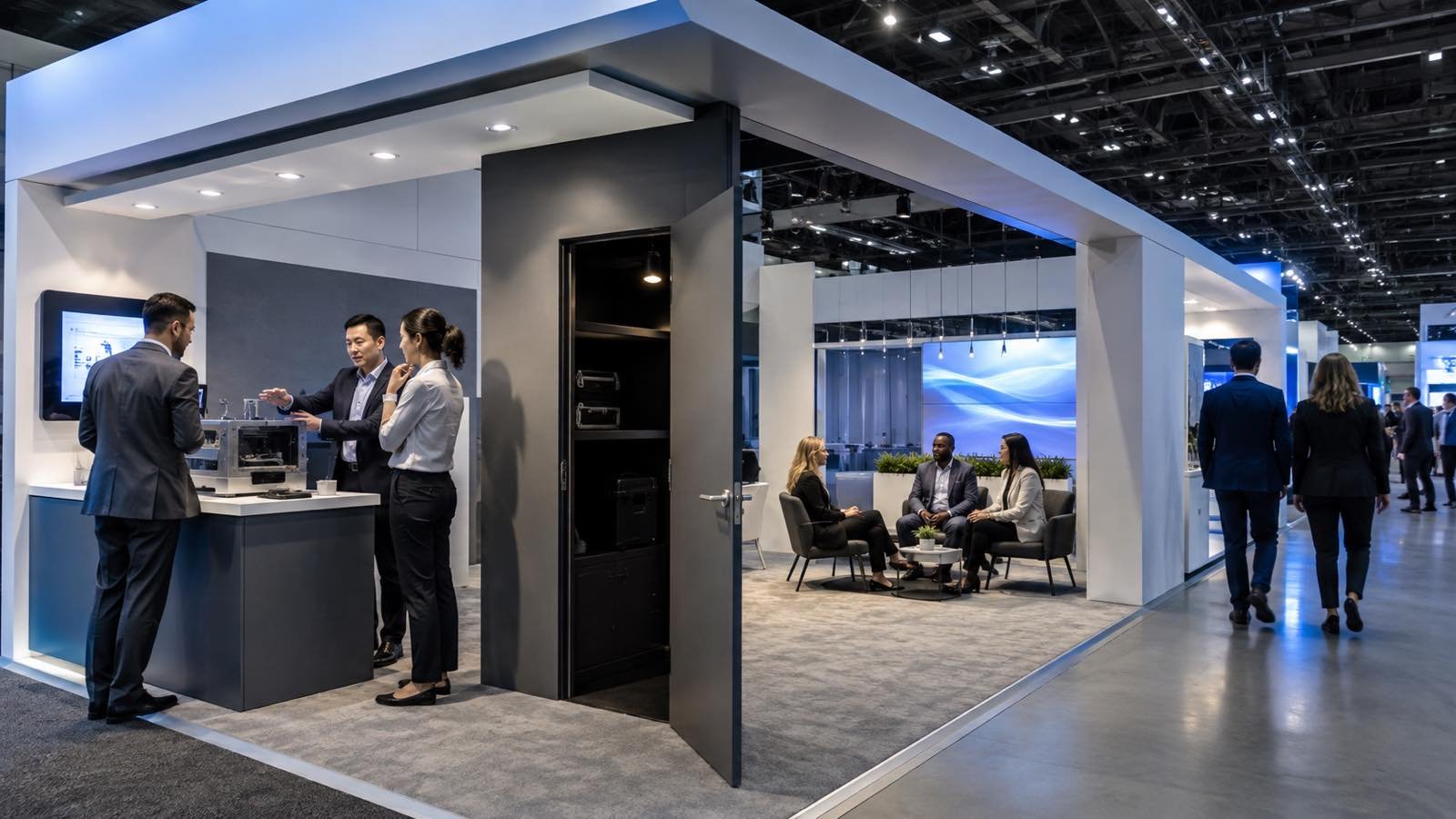
Specify What the Booth Must Do for Visitors and Staff
Describe work tasks before you describe furniture. A product demo, a sample review, and a confidential meeting each need different space, equipment, and reset time.
For every important activity, record:
| Activity | Who uses it | Inputs or equipment | Simultaneous use | Space or service effect |
|---|---|---|---|---|
| Product demonstration | Presenter and visitor | Product, power, screen, consumables | How many sessions at once? | Viewing angle, queue, reset area |
| Sample evaluation | Visitor and staff member | Samples, packaging, cleaning | Individual or group? | Counter depth, storage, replenishment |
| Meeting | Staff and visitors | Open table, semi-private room, or private room | Expected overlap | Acoustics, access, circulation |
| Staff operations | Your team | Personal items, spare parts, waste, cleaning | Throughout the show | Back-of-house storage and service path |
Include accessibility and clear circulation requirements early. The final structural, electrical, fire, and venue approvals belong with the responsible qualified parties and the show organizer; your RFP should still tell the supplier what must be coordinated.
Set Brand, Creative, Technical, and Material Requirements Without Designing the Booth for Them
Give enough creative direction for a supplier to stay on brand and estimate the work, but leave room for professional problem-solving. Provide approved logos, colors, fonts, messages, language versions, visual references, and expressions that cannot be used.
List technical inputs that affect layout and cost: screen or LED size and orientation, projection, sound, lighting, power, network, software, and equipment you will supply. If a specification is not final, label the assumption and ask respondents to price an option.
For materials and reuse, state the outcome you want—durability, repairability, reuse at another show, lower waste, or a particular finish—and ask how the supplier will meet it. “Sustainable” is not a sufficient specification by itself.
Your RFP should request a limited concept direction, key trade-offs, and meaningful options. It should not require every respondent to produce a complete, engineered, unpaid booth package. A fair request might ask for one primary direction, a simple plan or elevation intent, and the decisions that drive scope and price. Detailed engineering follows award.
Define the Services and Required Proposal and Pricing Format
“Please quote a turnkey booth” is too vague to compare. List the services you need—design, engineering, fabrication or rental, graphics, AV, furniture, packing, freight, material handling coordination, installation, dismantling, show-site support, storage, and post-show handling—and assign each a status.
| Status | Meaning in the RFP |
|---|---|
| Included | Respondent prices and owns the work |
| Coordinated | Respondent manages an outside party or order |
| Client-supplied | You provide the item or information |
| Excluded | Not part of this response |
| TBD | Requires clarification before award |
Require one response format with the concept direction, layout rationale, scope matrix, project team, evidence, milestones, assumptions, exclusions, compliance information, and change process. Set file type, concept/page limits, units, deadline, question channel, and contact person. Alternatives must be labeled and priced separately.
State rental or purchase, ownership of graphics and equipment, post-show storage, damage responsibility, and change pricing. Keep venue and official-contractor charges separate from the exhibit partner’s fee; “turnkey” does not automatically include every third-party cost.

Trade Show Exhibit RFP Template
Use the following structure as the starting point for your RFP. Copy it into your working document and replace the brackets. [Required] fields should be completed before release; [Optional] fields can be marked TBD when they do not affect the base response.
Trade Show Exhibit RFP
1. Project Overview [Required]
Company and offering: Primary objective and visitor action: Decision owner and contact: Supplier must answer: recommended approach and key assumptions.
2. Show and Booth Information [Required]
Show, city, venue, dates, booth number, footprint, configuration, open sides: Floor plan, exhibitor manual, rule version, service deadlines: [attach links/files] Supplier must answer: compliance risks and missing inputs.
3. Objectives and Visitor Experience [Required]
Target visitors and priority message: Products, demos, meetings, storage, staffing, accessibility: Supplier must answer: how the layout supports each activity.
4. Scope of Services [Required]
Design / engineering / fabrication or rental / graphics / AV / furniture: Packing / freight / material handling / installation / dismantling / storage: Mark each item: Included / Coordinated / Client-supplied / Excluded / TBD.
5. Brand and Technical Requirements [Required]
Brand files, approved copy, languages, AV, power, network, materials, reuse: Open alternatives and non-negotiables: Supplier must answer: assumptions, options, and technical dependencies.
6. Required Proposal Deliverables [Required]
Concept direction and rationale: Plan/elevation intent, scope matrix, team, evidence, schedule: Supplier must answer: every required field and every exclusion.
7. Budget and Pricing Format [Required]
Budget range or ceiling: Currency and tax treatment: Base scope and optional items: Venue-direct charges: Payment terms requested: Supplier must answer: line-item price, unit, assumption, and exclusion.
8. Timeline and Key Deadlines [Required]
RFP issue, questions, proposal, finalist presentation, award: Design approval, production, artwork, freight, move-in, opening: Supplier must answer: dependencies, critical path, and contingency.
9. Evaluation Criteria [Required]
Criteria and weights: Required evidence or references: Supplier must answer: project team, relevant proof, and risks.
10. Submission Instructions [Required]
File format, page/concept limit, deadline, question channel, addenda process: Submission contact and finalist presentation format:
11. Terms, Assumptions, and Questions [Required]
Confidentiality, ownership, insurance, cancellation, delay, changes, disputes: Known assumptions, open questions, and requested clarifications: Supplier must answer: acceptance, exceptions, and proposed wording.
The template gives you a complete response skeleton, but the current show manual and venue instructions still control the project.
Build a Realistic RFP and Exhibit-Delivery Timeline
Use the earliest deadline that could stop the project—venue approval, hanging, electrical, artwork release, freight booking, or move-in—as the anchor. The table below is an illustrative planning window, not a universal rule; adjust it to the show manual, design complexity, approval path, and freight distance.
| Planning stage | Illustrative timing | Check before you commit |
|---|---|---|
| RFP preparation | 5–8 months before the show | Space, rules, goals, and budget boundary available |
| Questions and answers | 1–2 weeks after release | One deadline and one shared response log |
| Proposal submission | 2–4 weeks after release | Same format and line items for every respondent |
| Finalist review | 1–2 weeks after proposals | Clarifications and presentation agenda ready |
| Award | At least 3–5 months before opening | Scope, price, ownership, and approvals closed |
| Design and approvals | 2–4 months before opening | Artwork, engineering, venue and organizer checks |
| Production and freight | Per venue and freight windows | Critical path and contingency confirmed |
Ask respondents to flag dependencies and critical path. If budget and schedule conflict, require an alternate path with its effect on scope, risk, and dates.
Manage Questions and Addenda
Set a question deadline in the RFP and require every respondent to use the same channel. Send material answers to all participants, not only to the company that asked, and keep a dated response log.
When an answer changes a requirement, issue an addendum with a version number, date, changed section, and response deadline. If the show organizer changes a rule after release, record the change, notify every respondent, and extend the deadline when a fair response requires more work.
Decide in advance whether suppliers may request a site visit and whether finalists will present live. State who pays travel or site-visit costs and whether the presentation is scored. This prevents one respondent from receiving privileged information or extra design time.

Choose Respondents and State the Evaluation Criteria
Shortlist for fit before requesting creative work. Check similar footprint or complexity, required services, venue experience, proposed team, references, and evidence of execution.
Publish the scoring dimensions with the RFP:
| Criterion | What to examine |
|---|---|
| Requirement fit | Does the response answer the brief and constraints? |
| Design logic | Does the layout support visitor and staff tasks? |
| Scope clarity | Are ownership, exclusions, and dependencies visible? |
| Price comparability | Are line items and third-party charges visible? |
| Schedule and risk | Are critical dates and contingencies credible? |
| Team and evidence | Who will deliver, and what proof is supplied? |
| Communication | Can you clarify open points efficiently? |
Set weights before scoring. Do not add hidden points for a dramatic rendering or familiar name. Invite only as many qualified respondents as your team can evaluate consistently.
Evaluate, Clarify, and Award the Proposal
Read every proposal against the same matrix. Compare layout rationale, response statuses, price lines, assumptions, exclusions, schedule, team, and risks together.
When totals differ, test whether the cause is a design choice, a third-party charge treated differently, or an omission. Ask who orders power, whether material handling is included or coordinated, whether graphics and installation are priced, and which items you must supply. Record each answer beside the score.
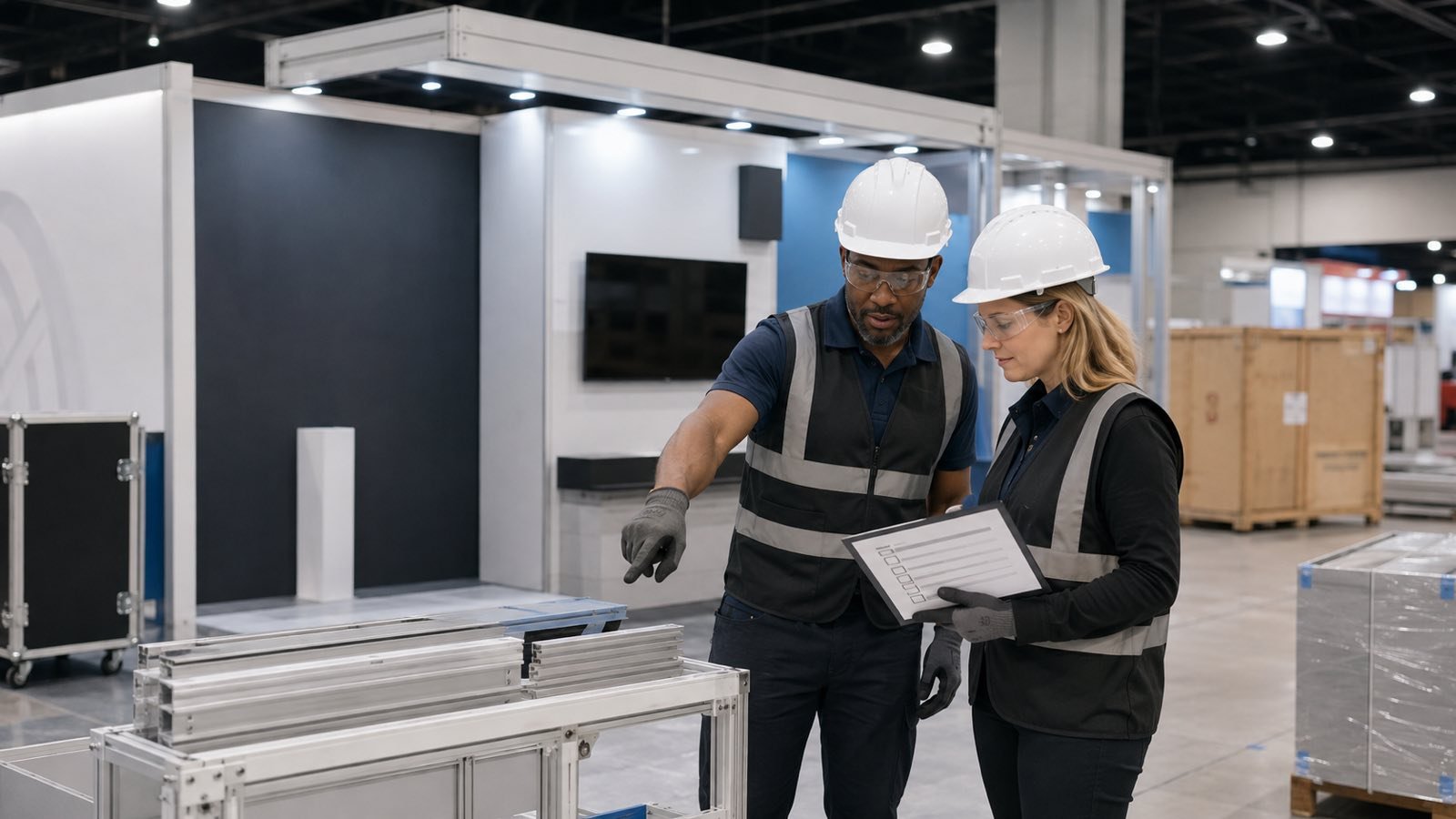
Before award, close open items that could change price, responsibility, or dates. Then preserve the decision in a handoff package with the final proposal, approved views, plan intent, relevant component information, service-order responsibilities, contacts, approvals, and change process. Technical approvals for structure, fire, electrical, rigging, accessibility, and insurance remain with the responsible qualified parties and the organizer.
Confirm Contract and Procurement Terms Before Award
Your RFP does not need to become a legal contract, but it should identify the terms that can change risk or total cost. Ask the selected respondent to confirm:
- payment milestones, deposits, and final-payment conditions;
- cancellation, postponement, force-majeure, and delay responsibilities;
- required insurance and certificates;
- intellectual-property, graphic, equipment, and design-file ownership;
- confidentiality or non-disclosure requirements;
- damage, loss, storage, and show-site responsibility;
- who can approve change orders and how revised price/date are documented;
- governing law and dispute-resolution process, subject to your legal review.
Use counsel or your procurement lead for enforceable wording. The practical goal is to prevent a clear proposal from becoming an unclear contract.
Common Trade Show Exhibit RFP Mistakes to Avoid
| Common mistake | Why it causes trouble | Better instruction |
|---|---|---|
| Saying only “20×20 booth” | Suppliers guess the configuration and constraints | Attach the current floor plan and manual |
| Asking for a “turnkey quote” only | Third-party charges and exclusions disappear | Use scope statuses and line items |
| Mixing venue and supplier charges | Totals are not comparable | Show venue-direct charges separately |
| Vague client-supplied items | Installation and testing responsibility is unclear | List each item, owner, date, and task |
| Omitting exclusions | Low totals may hide missing work | Require an exclusion and assumption list |
| Letting every supplier design everything | You receive unpaid, inconsistent work | Request limited concepts and rationale |
| No evaluation weights | Decisions drift toward appearance or price | Publish criteria and set weights first |
| No versioned addenda | Respondents price different rules | Use one shared log and version number |
| No change approver | Scope expands without a controlled decision | Name the approval authority and process |
Use this table as the final send check: each row should be resolved or assigned an owner before the RFP leaves your team.
FAQ
What documents should you attach to a trade show exhibit RFP?
Attach the current floor plan, exhibitor manual, service-order deadlines, booth assignment, brand files, approved artwork or copy, product dimensions, and any technical or venue instructions that affect the response. Label each file with its version or access date. A supplier can then price against the same facts instead of filling gaps with assumptions.
Should installation and dismantling be included in a trade show booth RFP?
Yes, if you expect the respondent to manage them. List installation, dismantling, supervision, labor windows, material handling, and show-site support as separate scope lines. If the venue or official contractor performs part of the work, mark that line as coordinated or client-supplied and show the related charge separately.
How should you handle client-supplied items in an exhibit RFP?
Name each item, its dimensions, delivery date, condition, owner, and point of contact. State who unpacks, installs, tests, stores, and removes it. “Client-supplied AV” or “client-provided samples” is too broad to price safely; the handoff needs an item-level list.
Can you reuse a trade show exhibit RFP template for another show?
Reuse the headings, not the assumptions. Replace the show dates, footprint, configuration, venue rules, service deadlines, freight path, visitor goals, and technical requirements every time. Keep a short change log so a previous show’s height, hanging, or contractor rules do not carry into the new quote.
What makes a trade show booth quote comparable?
Each response must use the same scope lines, status labels, units, tax treatment, third-party charges, assumptions, exclusions, and deadline. Compare the normalized matrix first, then compare creative choices. A quote becomes comparable when you can explain the price difference without guessing what one respondent left out.
Final Thoughts
The strongest trade show exhibit RFP is not the longest document. It is the one that gives every respondent the same facts, makes unknowns visible, and turns each proposal into a comparable set of decisions. Once your brief includes the show conditions, visitor tasks, scope boundaries, budget logic, and approval dates, you can ask a qualified exhibit partner to refine the concept and delivery plan with far less rework.
If you already have those inputs, share the brief with KingExhibits or another qualified trade show exhibit design and build team and ask them to confirm assumptions, exclusions, and the next approval step before work begins. KingExhibits can help you turn a clear RFP into a design, fabrication or rental, logistics, and on-site delivery plan that your team can review before committing to detailed work.