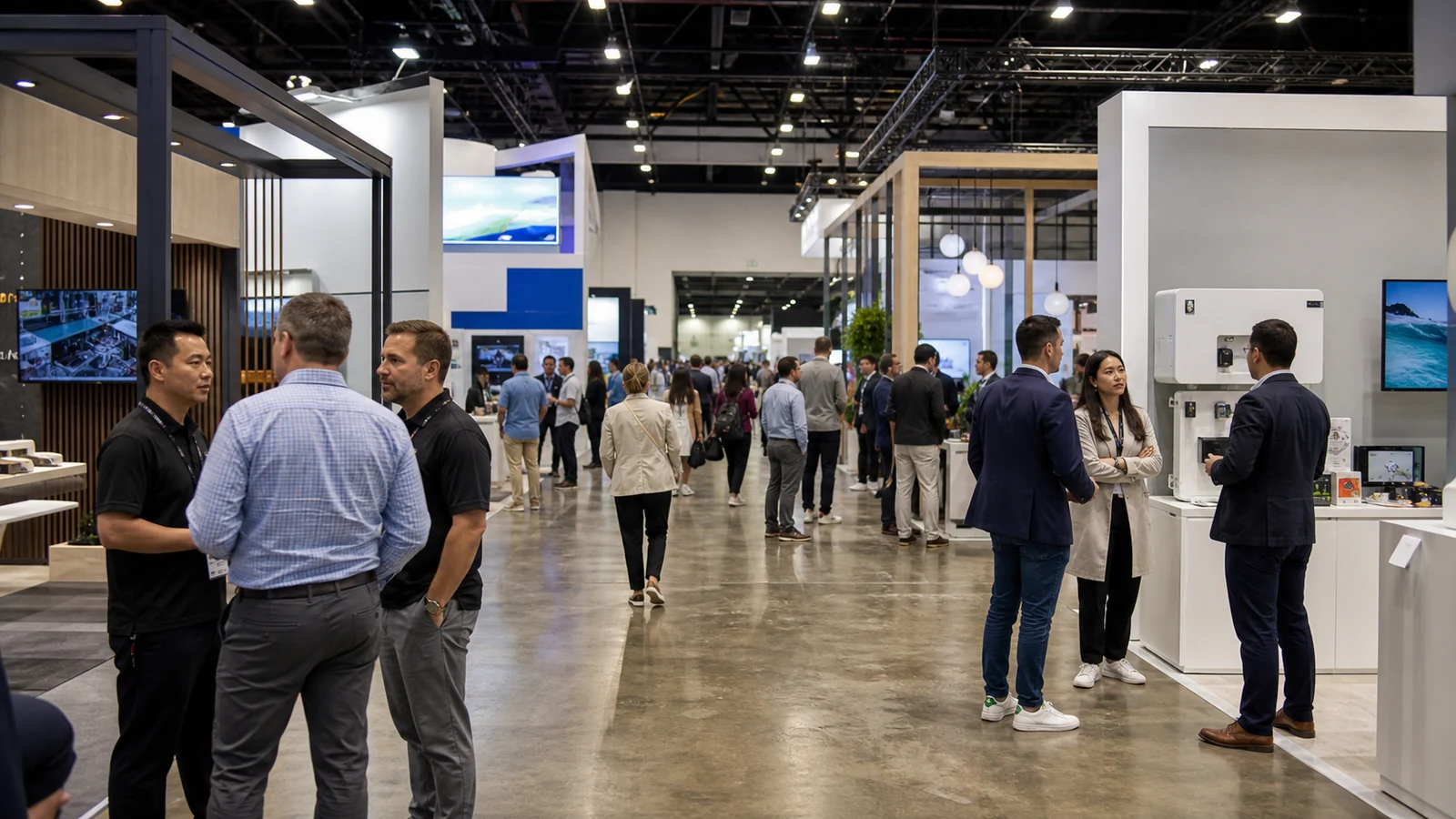
SEG and tension fabric displays can look similar in a rendering. Both use printed fabric. Both can pack smaller than many rigid graphics. The important difference is how the fabric attaches to the frame—and what that means when your team installs, lights, updates, ships and reuses the exhibit.
If you are choosing graphics for a portable or modular trade show booth, do not ask which system is “better” in general. Decide which surfaces need an architectural finish, which need a lightweight shape, how often graphics will change and who will handle them.
First, Fix the Terminology
SEG stands for silicone edge graphic. A narrow silicone strip is sewn around the edge of a printed fabric graphic. That edge is pressed into a matching channel in an aluminum extrusion, which tensions the fabric across the opening. Orbus's SEG measuring and installation guide shows the perimeter finish and the common corner-to-midpoint installation sequence.

SEG is therefore a type of tensioned fabric graphic. However, exhibit suppliers often use “tension fabric display” to describe a different construction: a sewn pillowcase-style graphic that pulls over a tubular frame and usually closes with a zipper. Britten's tension fabric display specification is one example of that tube-frame format.
This guide uses:
- SEG for silicone-edged fabric inserted into an extrusion channel;
- pillowcase tension fabric for a sewn cover stretched over a tube frame.
Confirm what a vendor means before comparing quotes. “Fabric wall” alone does not define the system.
Quick Comparison
| Decision | SEG | Pillowcase tension fabric |
|---|---|---|
| Graphic attachment | Silicone edge inserted into frame channel | Sewn cover pulled over frame, commonly zippered |
| Typical visual character | Flat, edge-to-edge, architectural panel | Soft, continuous skin around straight or curved form |
| Frame type | Channeled extrusion, often modular | Sectional aluminum tube frame |
| Graphic change | Remove and insert panel from the face/edge | Remove cover, orient and pull replacement over frame |
| Lighting | Strong fit for purpose-built lightboxes | Available on specific systems, but not an automatic feature |
| Shape | Flat walls, corners, boxes and engineered forms | Straight walls, curves and sculptural portable shapes |
| Packing | Folded fabric plus extrusion/frame components | Folded cover plus compact tube sections |
| Main fit risk | Wrong finished size, bead or frame profile | Wrong cover size, orientation, zipper or frame sequence |
| Best decision test | Do you need a precise panel or lit surface? | Do you need a lightweight portable form or curve? |
These are typical patterns, not universal product rules. The actual frame, graphic specification and supplier instructions control the result.
Choose SEG for a Precise Panel Finish
SEG is often the better fit when the graphic should read like part of the architecture rather than a sleeve placed over it. The fabric meets the perimeter channel, leaving little visible hardware on the face.

That makes SEG useful for:
- large flat brand walls;
- modular walls with replaceable panels;
- counters and product surrounds;
- single- or double-sided partitions built for the purpose;
- framed product stories that change by market;
- integrated lightboxes;
- surfaces that must align with adjacent architectural elements.
The finish depends on fit. A graphic made for one frame is not guaranteed to fit another frame with the same advertised width. The extrusion profile, channel position, bead thickness, measured opening, fabric stretch, sewing and print orientation all matter.
When ordering a replacement, identify the frame manufacturer and system, provide the measurement method the printer requests and confirm which side loads the graphic. A photograph of the profile and existing label can prevent a nominal-size guess.
Choose Pillowcase Tension Fabric for a Lightweight Form
Pillowcase tension fabric is often useful when portability, quick frame assembly or a curved shape matters more than a rigid panel line. Numbered tube sections connect into a form; the sewn graphic stretches over it and closes.
Common uses include:
- straight portable backwalls;
- curved or serpentine walls;
- freestanding towers and signs;
- headers and shapes designed around a tubular skeleton;
- displays that travel in compact cases;
- booths that a trained team sets up repeatedly.
Because the cover wraps the structure, the graphic can continue around an edge or curve. That same construction means seams, zipper placement, feet and the order of assembly can affect the visible result.
Do not assume “pillowcase” means loose. A correctly produced cover on its intended frame can look smooth and taut. Problems usually appear when the wrong frame section is used, the cover is reversed, a zipper is forced, the fabric is stretched unevenly or the graphic was not produced to the final frame.
Compare the Face, Edges and Back
Do not approve either system from a front-view rendering alone. Ask to see the actual face, corner, side and rear treatment.
For SEG, inspect:
- whether the channel or frame edge will be visible;
- how two panels meet at a seam or corner;
- where pull tabs are located;
- whether the graphic loads from the front, side or reverse;
- how the back of a single-sided frame is finished;
- whether adjacent panels will align after repeated assembly.
For pillowcase systems, inspect:
- the zipper or closure location;
- sewn seams and how artwork crosses them;
- feet and stabilizers;
- fabric gathered near curves or corners;
- the reverse side of a single-sided cover;
- how the bottom edge sits when the cover is fully closed.
A clean straight-on photo can hide the exact detail your visitor sees while approaching from the aisle.
Treat Backlighting as a Complete System
SEG is widely used in lightboxes because a graphic can be tensioned across the face of an illuminated frame. That does not mean any SEG fabric, frame or LED layout will produce even light.

A backlit surface requires a compatible combination of:
- frame depth and internal finish;
- LED type, spacing and power;
- backlit fabric and print profile;
- graphic tension and seam plan;
- blockout where light should not escape;
- ventilation and access;
- electrical approval and service;
- packing that protects the light components.
Pillowcase systems can also include lighting when they are designed for it. Do not wrap a standard portable wall around improvised lights and call it a lightbox.
Test the actual production combination in a dim and bright environment. Look for hot spots, dark bands, light leaks, visible internal hardware and color changes. Confirm what happens when one power supply or section fails.
Plan Artwork for the Construction
The same artwork file should not be sent blindly to both systems.
SEG artwork must account for the visible opening, perimeter finishing, bleed, panel breaks, insertion orientation and any portion hidden by the channel. Pillowcase artwork must account for seams, the side or back wrap, zipper, stretch and the way the cover moves over the frame.
Before releasing art, ask for:
- the current template for the exact frame and graphic finish;
- final visible and finished dimensions;
- front, side and back orientation;
- seam and closure locations;
- safe areas for text, logos and faces;
- color profile and approved proof method;
- fabric type, opacity and intended lighting;
- panel labels and installation sequence.
Keep critical text and faces away from corners, zippers and panel joints. A design that looks continuous on a flat screen may distort when it wraps a curve or splits across frames.
Compare Graphic Changes in the Real Booth
Both systems are often described as easy to change. Test the actual change with the people who will do it.
SEG panels are commonly installed by setting the corners, then the midpoints, then working the silicone edge around the frame. A large panel needs clean hands, floor protection, correct orientation and even tension. Starting in the wrong place can shift alignment or leave a loose section.
A pillowcase cover must be matched to the frame, oriented correctly, pulled over without snagging and closed without overstressing the zipper or seam. Curved frames and double-sided artwork make orientation especially important.
For either system, record:
- number of people required;
- safe access and ladder needs;
- change time after the frame is assembled;
- how the removed graphic is folded, labeled and stored;
- cleaning and damage inspection;
- the backup if a panel, bead, seam or zipper fails.
“No tools for the graphic” does not mean no labor for the booth. The frame still needs to be assembled, leveled, stabilized and handled under current show rules.
Compare Shipping by the Complete Kit
Fabric usually packs compactly, but the frame determines the shipment.
A tube-frame wall may break into short sections that fit a portable case. An SEG wall may use longer or heavier extrusion sections, although modular or collapsible SEG systems can change that pattern. Lightboxes add electrical components and protective packing.
Compare:
| Shipping input | What to record |
|---|---|
| Packed pieces | Number of cases, crates and loose items |
| Largest piece | Length that can change vehicle or parcel options |
| Total weight | Complete kit, not fabric alone |
| Protection | How corners, channels, feet, LEDs and connectors are secured |
| Replacement graphic | Packed size, label and delivery deadline |
| Return condition | Who inventories, dries, cleans and repacks everything |
Do not call one option cheaper to ship until both quotes include the full structure, feet, lights, cases and accessories.
Think About Cleaning, Wrinkles and Damage
Fabric graphics should be handled with clean, dry hands and stored according to the supplier's instructions. Confirm whether the specific fabric can be steamed, washed or spot-cleaned; methods vary by material, ink, coating and finishing.
For SEG, inspect the silicone edge, sewing, pull tab and corners. Do not yank a panel from one point or press it into a damaged channel. For pillowcase covers, inspect seams, zipper, high-stretch corners and areas that rub the frame during installation.
Wrinkles are not solved by pulling harder. First confirm that the frame is complete and square, the graphic is oriented correctly and it belongs to that frame. Then use only the approved finishing method.
Carry a labeled spare when one graphic is essential to the booth story. A generic blank wall may be safer than displaying a damaged or badly fitted brand panel.
Choose Based on the Update Pattern
Ask what will change over the next three to five shows:

- the entire campaign;
- one product panel;
- a market or language message;
- sponsor or partner logos;
- product availability;
- booth size and orientation;
- backlit versus non-lit use.
SEG can be useful when separate framed panels change independently. Pillowcase graphics can be practical when the whole wall changes as one portable skin. Neither is economical if the frame will not fit the next booth or every small text change requires replacing an unnecessarily large graphic.
Map the likely changes onto the wall before dividing panels. A seam should serve an update, transport or construction need—not cut through the most important image by accident.
A Mixed System May Be the Better Exhibit
You do not have to choose one fabric attachment for the whole booth.
An exhibit might use:
- a non-lit SEG wall for the main architectural surface;
- a backlit SEG panel for the primary product proof;
- a curved pillowcase wall to guide the visitor path;
- portable tube-frame signs for regional shows;
- rigid graphics where visitors touch, write or mount hardware.
The right mix reduces compromise. The wrong mix creates too many unlabeled parts, suppliers and replacement specifications. Keep a component register with the system, frame ID, graphic ID, orientation, packed location and approved replacement source.
Ask for Quotes That Expose Compatibility
Give each supplier the same use case and request these fields:

| Quote field | Why it matters |
|---|---|
| Exact system and frame profile | Controls replacement compatibility |
| Overall and visible dimensions | Prevents nominal-size confusion |
| Graphic material and finishing | Defines opacity, stretch, edge, seams and closure |
| Single/double-sided construction | Clarifies the unseen side and required layers |
| Lit/non-lit specification | Prevents a standard graphic being priced for a lightbox |
| Complete packed size and weight | Supports freight and handling comparison |
| Setup method and labor assumption | Shows who can actually install it |
| Replacement graphic price/schedule | Exposes future update cost |
| Warranty and damage boundary | Clarifies frame, print, sewing, LEDs and handling coverage |
| Rental return or ownership/storage | Defines what happens after the show |
Ask for a physical fabric sample and a finished-edge sample when color, opacity or hand feel matters. A material name on a quote is not a visual approval.
Frequently Asked Questions
Is SEG the same as a tension fabric display?
SEG is a tensioned fabric system, but suppliers often use “tension fabric display” for a pillowcase graphic stretched over a tubular frame. Ask how the graphic attaches: silicone edge into a channel, or a sewn cover over tubes.
Which looks more premium, SEG or pillowcase tension fabric?
SEG often creates a precise, panel-like architectural face. A well-made pillowcase system can create a clean continuous shape, especially on curves. The better-looking option depends on the intended form, fit, seams, viewing angles and installation quality.
Which is better for a backlit trade show wall?
A purpose-built SEG lightbox is a common choice for flat illuminated walls because the graphic tensions across the frame face. The result still depends on frame depth, LEDs, power, backlit fabric and testing. Some pillowcase systems are designed for lighting, but a standard tube wall is not automatically a lightbox.
Can I order an SEG replacement graphic using only the frame width?
Do not rely on width alone. Identify the frame system and profile, follow the printer's measuring method, and confirm finished dimensions, bead, loading side and orientation. Two frames sold at the same nominal width may require different graphics.
Which system is easier for our team to install?
That depends on the exact size and system. Test one complete setup. SEG requires even insertion and alignment; pillowcase covers require correct frame assembly, orientation and controlled stretching. Include the frame, feet, lighting and safe access—not only the last graphic step—when comparing labor.
Choose the System by the Work It Must Do
Choose SEG when you need a precise framed surface, modular panel changes or a purpose-built lightbox. Choose pillowcase tension fabric when you need a lightweight portable wall, a continuous wrap or a curved form. Use both when different surfaces have different jobs.
Before ordering, approve the actual sample, profile, template, installation method, packed kit and replacement path. The fabric image may attract the buyer, but the attachment system decides whether that image still fits and works at the next show.