
If you are preparing for a show at the Oregon Convention Center, expensive mistakes can start before the booth reaches Portland. You may approve a layout without the right service locations, send freight to the venue instead of the show decorator, or assume a “turnkey” booth quote includes charges that only OCC or the official show contractor can bill.
This guide helps you identify the controlling documents, assign each service, and decide whether your booth is ready for design approval, freight booking, and production. It is an independent planning guide, not an official Oregon Convention Center document.
| Item | Quick answer |
|---|---|
| Venue | Oregon Convention Center (OCC) |
| Address | 777 NE Martin Luther King Jr. Blvd., Portland, OR 97232 |
| Exhibitor rules | Use the current organizer kit plus the applicable OCC documents |
| Freight | Follow the event's show decorator or official contractor instructions |
| Electrical | Order through the current OCC/Edlen route |
| Internet | OCC controls high-speed internet service |
| Chain-motor rigging | ON Site Audio Visual is the exclusive provider |
| Load-in | Confirm your assigned time and ramp with the show manager |
| Parking | Limited and not guaranteed; loading and parking are separate operations |
Start With the Documents That Actually Control Your Booth
There is no single universal manual that controls every exhibitor at the Oregon Convention Center, commonly called OCC. The venue sets facility rules and controls certain services, while each event organizer sets show-specific dates, booth restrictions, contractor procedures, and order routes.

Use this document order:
| Document | Who issues it | What it controls | What your booth builder needs |
|---|---|---|---|
| Event exhibitor manual or kit | Event organizer or show manager | Booth rules, assigned contractor, deadlines, target move-in, labels, insurance, and event contacts | The full current file, not selected screenshots |
| Current OCC planning documents | Oregon Convention Center | Facility rules, exclusive services, technical limits, fire-safety conditions, and rigging procedures | The sections that affect your structure, utilities, demo, and installation |
| Event-specific service order forms or portal | OCC, the organizer, or an authorized provider | Prices, order deadlines, quantities, locations, payment, and on-site contacts | Confirmations plus the final utility or rigging drawing |
The revision date matters. As of September 2026, OCC's planning resources include rules and rates for July 2026 through June 2027, while the Exhibitor Services Ordering Guide still linked on the exhibitor-services page is labeled FY2025–2026. Confirm the event-specific order form before using a price or deadline.
Current OCC documents also publish more than one timing reference:
| Published timing reference | Where it appears | How to use it |
|---|---|---|
| 21 days before the event starts | Equipment, Services, and Labor Rates | General published advance-rate reference |
| 14-day note | Client Services Guide checklist | Planning reminder that needs line-item confirmation |
| Seven days or less before first move-in | Equipment, Services, and Labor Rates | Potential late-rate threshold |
| Date printed in the event portal or current order form | Event-specific order route | Use as the operational deadline after conflicts are confirmed |
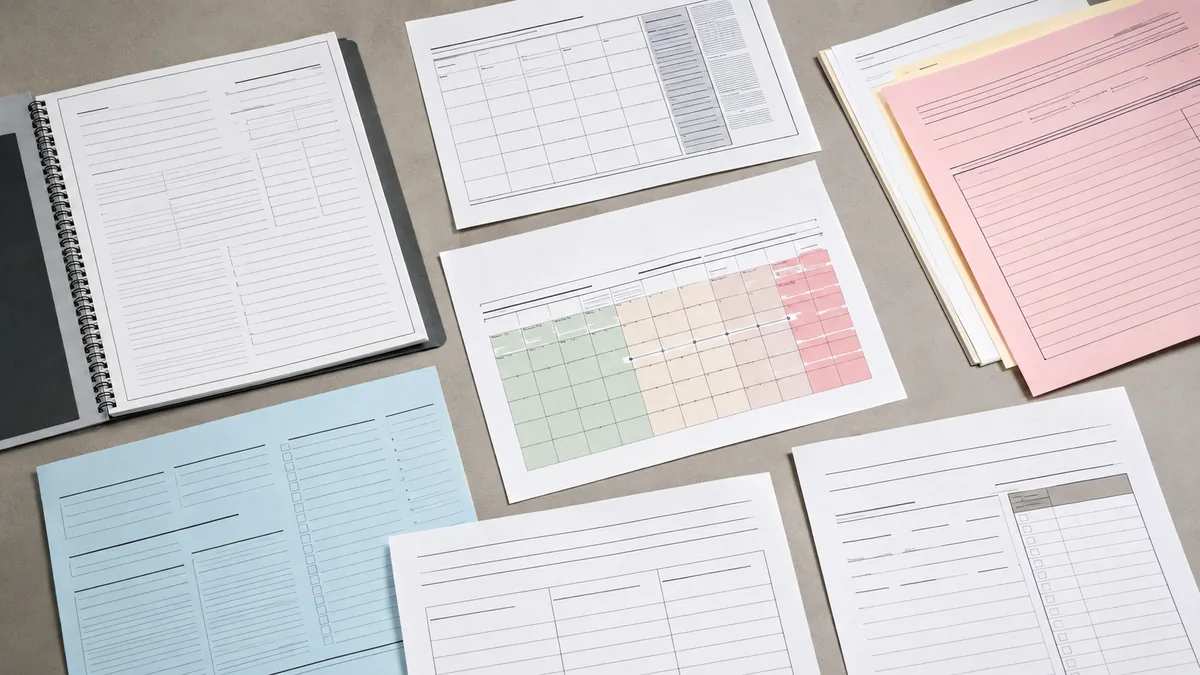
Deadline rule: Do not create one universal OCC deadline. Record the date printed on each current event-specific form and confirm any conflict before payment. Save the event name, file date, issuer, deadline, and task owner in your document tracker.
Assign Ownership Across the Project
A booth can be sold as “turnkey” and still contain charges that only the venue or show contractor can provide. The word describes a level of coordination; it does not automatically move every third-party service into the booth builder's invoice.
Use a responsibility table before comparing proposals:
| Task | Typical owner or provider | What you need to confirm |
|---|---|---|
| Booth objectives, budget, approvals, products, and content | You, the exhibitor | Decision-maker, payment contact, final copy and graphics |
| Booth assignment and show rules | Event organizer or show manager | Hall, booth number, footprint, open sides, height rules, and target move-in time—the delivery slot assigned to your booth |
| Freight route and material handling | Organizer's official service contractor, when appointed | Advance warehouse, direct-to-show address, labels, rates, and outbound process |
| Electrical power, utilities, Wi-Fi, loading-dock management, rigging, booth/aisle cleaning, and food service | OCC or its designated exclusive providers | Order channel, specifications, drawing, deadline, and payer |
| Booth design, rental or fabrication, graphics, packing, and contracted installation/dismantle work | Your booth builder | Included scope, exclusions, change-order rules, and handoff points |
The exact assignment can vary by event. Treat the organizer's manual as the source for show-contractor responsibilities and OCC's current Venue Rules and Regulations as the source for venue-controlled services.
Your internal owner still matters even when an outside provider performs the work. For example, OCC may provide the electrical service, but someone on your project must collect the equipment loads, approve the outlet location, place or authorize the order, and send the confirmation to the installer. “OCC handles power” is not a complete task assignment.
Use the role closest to the question instead of forwarding every issue to the same person:
| Question | First contact |
|---|---|
| Event manual, freight target, show contractor, or exhibitor parking | Show manager |
| OCC venue-controlled service | OCC event manager or Exhibitor Services |
| Electrical order | Current OCC/Edlen order route |
| Rigging plot | OCC event manager and the current rigging contact |
| Booth design, structure, graphics, or service-placement drawing | Booth builder |
| Carrier delivery appointment | Official show contractor or show decorator |

Freeze These Inputs Before You Approve the Booth Design
The builder cannot produce a reliable layout from the booth size alone. A 20-by-20-foot island in one hall can require a different utility route, rigging plan, or freight sequence from the same footprint at another event.
Confirm the exact space
Start with the event name, hall, booth number, dimensions, booth type, open sides, neighboring spaces, and the organizer's latest floor plan. OCC has multiple exhibit halls and other event spaces, so the hall name is part of the technical brief, not just an arrival detail. Check it against the venue's official maps.
Turn your sales goal into a working layout
Decide what the booth must help your team do. If you are demonstrating industrial equipment, the product, operator space, safety clearance, and visitor viewing line come first. If your main goal is distributor or buyer meetings, protect conversation space and give staff a place to store bags, samples, and literature without blocking circulation.
Write down the expected product count, demo method, meeting capacity, storage need, reception position, lead-capture point, and staff count. These inputs let the designer make trade-offs you can approve. “Make it open and premium” does not.
Put every service on the drawing
List each powered device and its electrical requirement. Mark the desired locations for outlets, internet connections, screens, lighting, water, compressed air, natural gas, or other services that your exhibit may need. Include cable routes and equipment positions rather than sending a separate equipment list with no locations.
OCC's current Client Services Guide says Edlen is the exclusive electrical provider and notes that floor-box alignment can affect labor charges. The same guide identifies OCC as the exclusive provider of high-speed internet access and on-site network support. That makes the service plan part of the design: a late outlet move can affect the floor, counters, demo equipment, cable management, and installation time.
Trigger early review for non-standard features
Do not wait until production to reveal a hanging sign, tall truss, canopy, enclosed room, display vehicle, cooking or sampling plan, fog or laser effect, heavy machine, or unusual floor load. Each feature can introduce a separate venue, organizer, fire-marshal, engineering, or service-provider review.
For rigging, the current OCC Rigging Rules direct plots through the OCC event manager for review and approval at least 30 days before move-in. OCC's Production Services page identifies ON Site Audio Visual as the exclusive provider for rigging that requires a chain motor. Qualified contractors may have a different role in assembling truss or ground-supported systems, so confirm the review, inspection, and labor route for work that does not use a chain motor.
Design release: Do not approve the booth until every unresolved item has one of three labels: confirmed, assigned to a named owner, or excluded from the quote with a clear next action.
What Can Your Own Staff Set Up?
Do not decide this from the booth size alone. A small inline display may still have event labor rules, while your staff may be allowed to place personal materials or lightweight products under specific conditions. Start with these assumptions, then verify them in the current exhibitor kit:
| Task | Starting assumption |
|---|---|
| Carrying personal materials | Check the event's hand-carry entrance, time, cart, and vehicle rules |
| Placing lightweight products | Confirm the show allows your staff to do it and that the items do not block aisles or equipment access |
| Assembling booth structure | Check labor-jurisdiction rules and whether an Exhibitor Appointed Contractor must be registered |
| Making electrical connections | Use the current OCC/Edlen-authorized service route |
| Rigging or hanging signs | Obtain venue review; chain-motor rigging goes through ON Site Audio Visual |
| Using a forklift or powered equipment | Follow the official contractor or venue process |
| Using ladders or power tools | Do not assume permission; check the organizer's labor and safety rules |
If your booth builder or installer is not the show's official contractor, ask whether the organizer requires an EAC form, certificate of insurance, crew credentials, or an advance approval deadline. These conditions are event-specific. The fact that your employees can carry a box does not prove they can assemble the structure, connect power, or operate material-handling equipment.

Example: A 20' × 20' Booth With a Hanging Sign and Live Demo
The responsibility split becomes clearer when it is applied to one booth:
| Requirement | Working owner or route |
|---|---|
| Booth layout and structure | Booth builder |
| Hanging-sign design and weight data | Booth builder |
| Rigging plot review and approval | OCC event manager and current rigging contact |
| Chain-motor rigging | ON Site Audio Visual |
| Electrical load list and outlet map | You and the booth builder |
| Electrical service and connection | Current OCC/Edlen order route |
| Freight receiving and material handling | Official show contractor or decorator |
| Live-demo approval | Organizer and OCC, as the equipment and activity require |
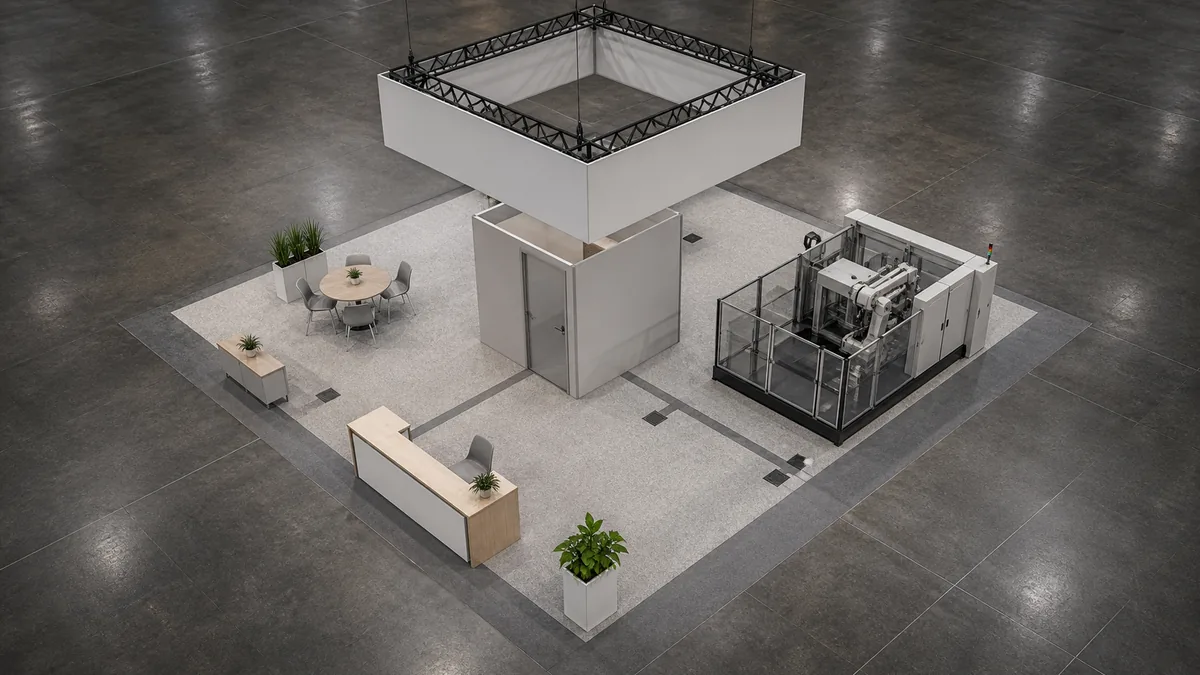
Before production, your team would need the approved booth location, sign weight and points, equipment loads, outlet map, demo conditions, freight labels, and move-in target. The table does not replace the event manual; it shows what information must cross from one party to the next.
Order Utilities and Technical Services in the Right Sequence
Service orders work best when they follow the design, but the design cannot be completed without early service information. Resolve that loop with a staged process:
- Confirm the event's authorized order route and current deadlines.
- Build an equipment schedule with quantities, power loads, network needs, and operating positions.
- Mark service locations on the booth plan.
- Obtain any technical review required for rigging, special effects, vehicles, cooking, or unusual equipment.
- Place each order through the authorized channel.
- Save the order confirmation, drawing, receipt, and on-site contact in one show folder.
- Reconcile the confirmed orders against the builder's installation drawing before shipping.
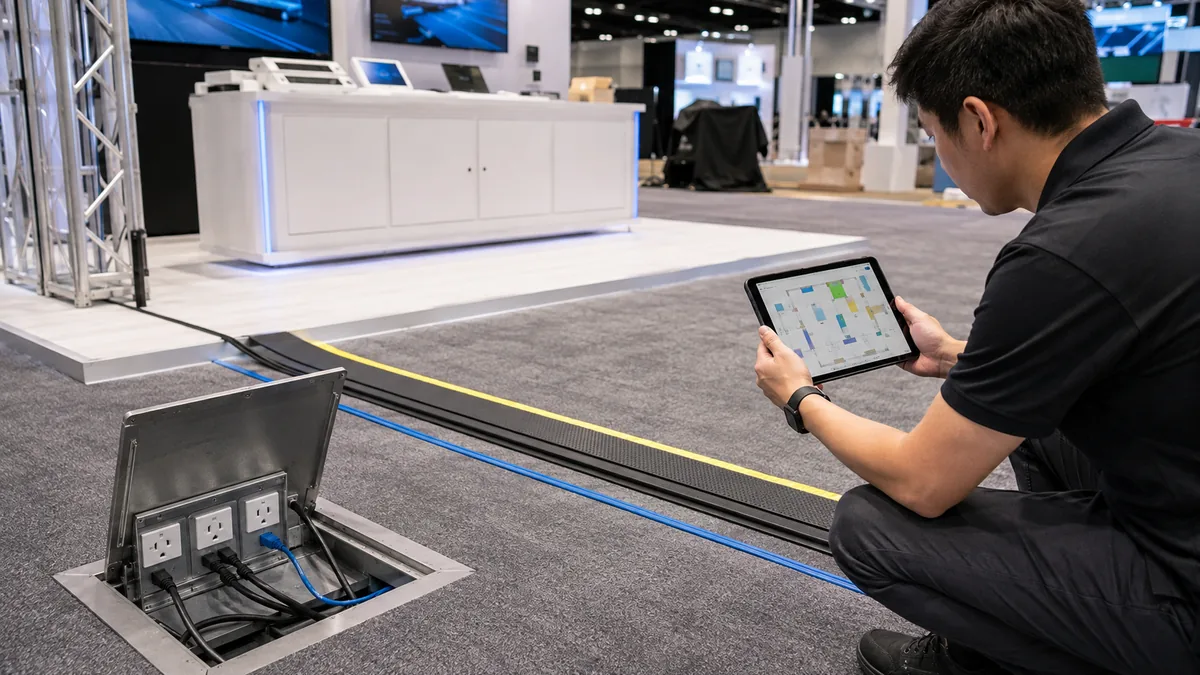
Avoid ordering “one internet connection” without stating what it must support. Lead retrieval, staff email, a cloud-based product demo, live video, and a visitor-facing interactive screen do not carry the same risk if bandwidth drops. Tell the provider how many devices will connect, whether the demonstration is business-critical, and whether you need a wired connection, private network, public Wi-Fi, or backup plan.
Use the same discipline for power. Give the builder and electrical provider a device-by-device schedule instead of a single estimated amperage. That makes it easier to find a missing screen, refrigerator, machine, charger, or lighting circuit before the crew is waiting on the show floor.
What Should You Know About OCC Loading and Parking?
OCC's current move-in and move-out guidance says exhibitor freight should go to the show decorator and that OCC does not accept or ship exhibitor freight or drayage. If an event has no decorator, the page currently directs shipments under 150 pounds to a local UPS Store arrangement. Confirm that route before shipping; do not use the venue's street address as a default freight address.
The venue has 18 loading bays, three drive-in ramps, and about 8,000 square feet of indoor dock space. That capacity does not let you choose any entrance or arrival time. Your show manager assigns the load-in time and ramp, and your carrier still needs the event name, booth number, approved label, delivery window, piece count, weight, and on-site contact.
Unloading and parking are separate. OCC instructs drivers to move their vehicles after unloading, oversized vehicles receive parking directions at check-in, and the underground garage does not accommodate RVs, campers, or trucks with trailers. The venue's current parking information also says availability is not guaranteed. Do not schedule a commercial freight vehicle around a passenger-garage assumption.
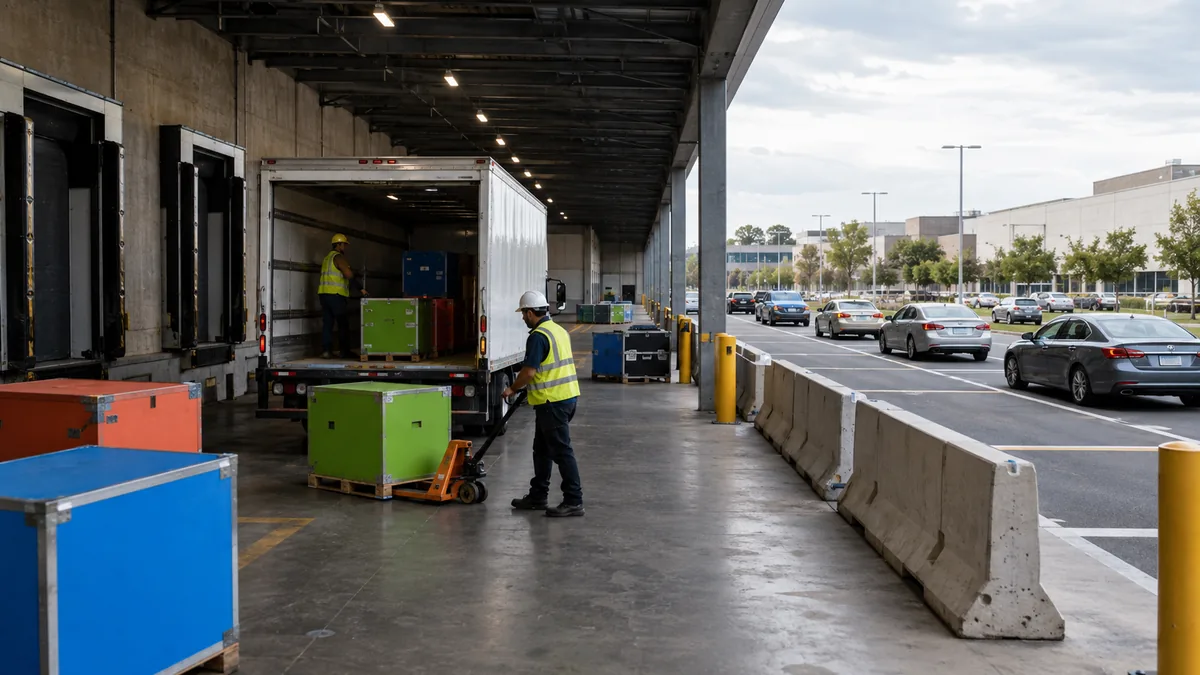
Before pickup, confirm the advance-warehouse or direct-to-show address, target time, carrier contact, crate and empty-container plan, installer access, outbound labels, bill of lading, return booking, and post-show destination.
Keep transportation and material handling separate in your budget. The carrier moves the shipment between locations. Material handling, often called drayage, is the show contractor's on-site receiving, movement, empty-container storage, and return-to-dock work. Paying the carrier does not mean that work is included.
Compare the Booth Quote With Show and Venue Charges
Ask every bidder to show what is included, excluded, estimated, or paid directly by you. A shorter quote is not necessarily cheaper if it leaves critical show costs unnamed.
| Cost area | Questions to ask before approval |
|---|---|
| Design and project management | How many concepts and revisions are included? Who produces service-placement drawings? |
| Booth structure or rental | What hardware, finishes, damage terms, and return conditions apply? |
| Graphics, flooring, furniture, lighting, and AV equipment | Which specifications and quantities are included? Who installs and tests them? |
| Packing and transportation | Is the route one-way or round-trip? Are crates, pickup windows, and carrier waiting time included? |
| Installation and dismantle | Who hires the labor? What hours, supervision, overtime, and travel assumptions apply? |
| Material handling or drayage | Is it included, estimated, or paid to the official show contractor? |
| OCC-controlled services | Who prepares the specifications and drawings? Who places and pays for electricity, internet, rigging, cleaning, and other venue services? |
| Organizer requirements | Who handles insurance, permits, badges, safety approvals, and required forms? |
| Changes and post-show work | What triggers a change order? Where does the booth go after dismantle? |
If a line says “by exhibitor,” add the person's name, order channel, deadline, and budget allowance. That turns an exclusion into a managed task.
Also flag the cost triggers that a base quote can miss: advance/standard/late order timing, overtime or after-hours labor, specific electrical placement, floor-box misalignment, rigging review or inspection, drawing revisions, material-handling weight and piece count, and missed freight targets. Use the current event form for amounts rather than carrying a rate from an older OCC guide.
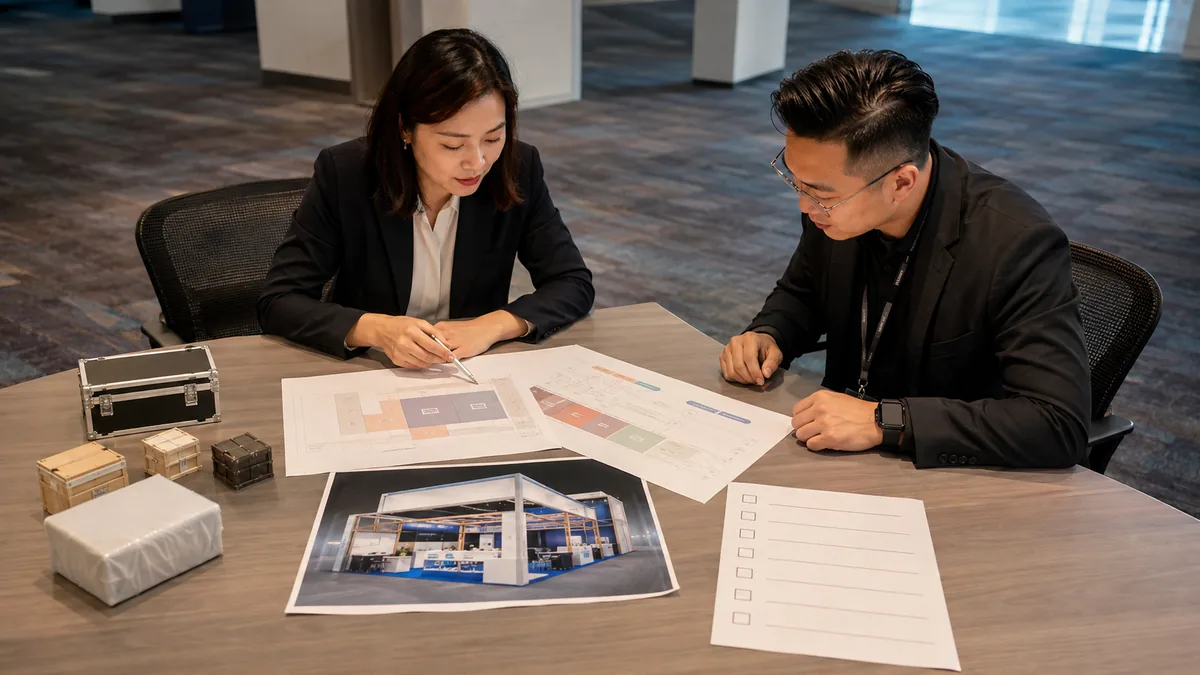
Use This Pre-Production Handoff Before You Release the Booth
Treat production release as a go/no-go decision. Before the builder starts fabrication or final rental preparation, verify that:
- you have the current organizer manual and applicable OCC documents;
- the event, hall, booth number, footprint, booth type, and open sides are confirmed;
- the approved design matches the organizer's floor plan and booth rules;
- utility locations, demo needs, and non-standard features have been reviewed through the right channel;
- staff, EAC, freight, load-in, parking, and outbound instructions are confirmed;
- builder, organizer, show-contractor, and OCC charges have named owners;
- insurance, payment, on-site escalation, dismantle, return, and storage responsibilities are assigned.
Go/no-go check: If the booth location, service channel, freight route, or approval owner is still unknown, the project is not ready for production. Holding the release for one verified answer is usually less expensive than changing graphics, floors, wiring, packing, or labor plans after the booth is already moving.
Frequently Asked Questions
How Do I Order Exhibitor Badges for an OCC Event?
Use the registration route in your event's exhibitor kit. OCC hosts many independently managed events, so the venue address or a general OCC contact is not a badge order. Confirm the allocation, naming deadline, pickup location, replacement policy, and whether installer credentials are separate from exhibitor badges.
Who Provides Lead Retrieval at an OCC Trade Show?
The event organizer normally names the lead-retrieval provider and order route. Before renting a scanner or app license, check what data the badge contains, how many devices and users are included, whether offline capture is available, and how quickly your team can export the leads. OCC internet service and an event's lead-retrieval platform are separate purchases.
Can I Distribute Food or Beverage Samples in My Booth?
Do not treat sampling as an ordinary product giveaway. OCC rules distinguish samples of products that an exhibitor represents from other food or beverage giveaways, and permits, portion limits, catering, hand-washing, or fire-safety conditions may apply. Send the product, serving method, portion size, equipment, and expected volume to the organizer and OCC for written approval before you design the counter or order utilities.
Does OCC Clean My Booth During the Show?
Booth and aisle cleaning are among OCC-controlled services, but you should not assume daily booth vacuuming or mopping is automatically included with the space. Confirm the current order route, service days, floor type, booth size, and who pays. Keep installation debris and post-show dismantle cleanup in the labor scope as separate responsibilities.
Is Oregon Convention Center the Same as Portland Expo Center?
No. Oregon Convention Center is at 777 NE Martin Luther King Jr. Boulevard, while the Portland Expo Center is at 2025 N Expo Road. They have separate maps, event pages, service documents, and shipping instructions. Verify the full venue name before sending a manual, freight label, or order link to your team.
Final Thoughts
Before requesting a final proposal, gather your event name, hall and booth number, organizer manual and floor plan, product or demo requirements, utility schedule, target move-in information, and post-show destination.
Send KingExhibits the current event documents and your booth requirements before you approve production. We can turn them into a clear design/build or rental scope, show which handoffs we coordinate, and separate venue or show charges that remain outside the booth quote.