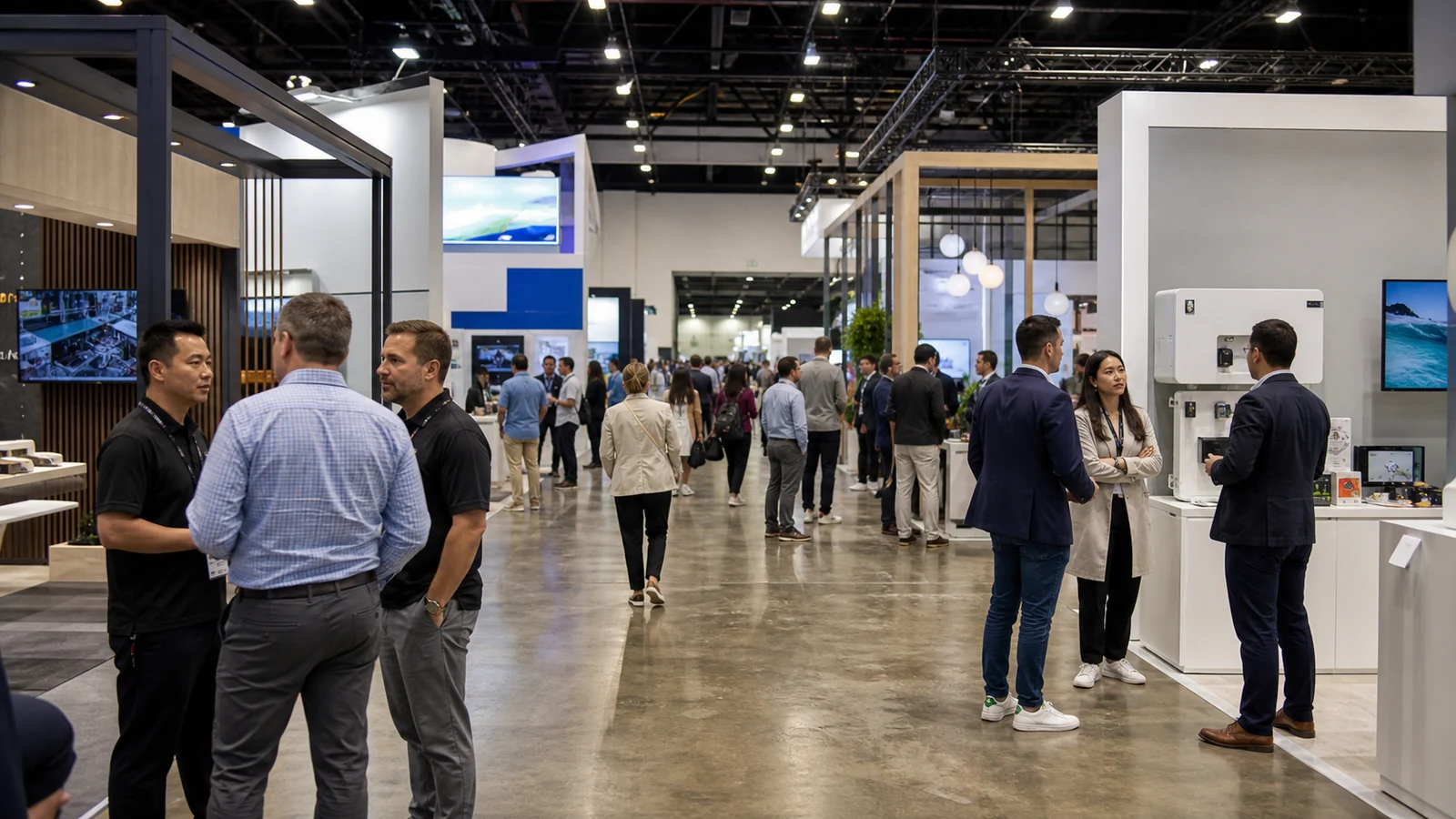
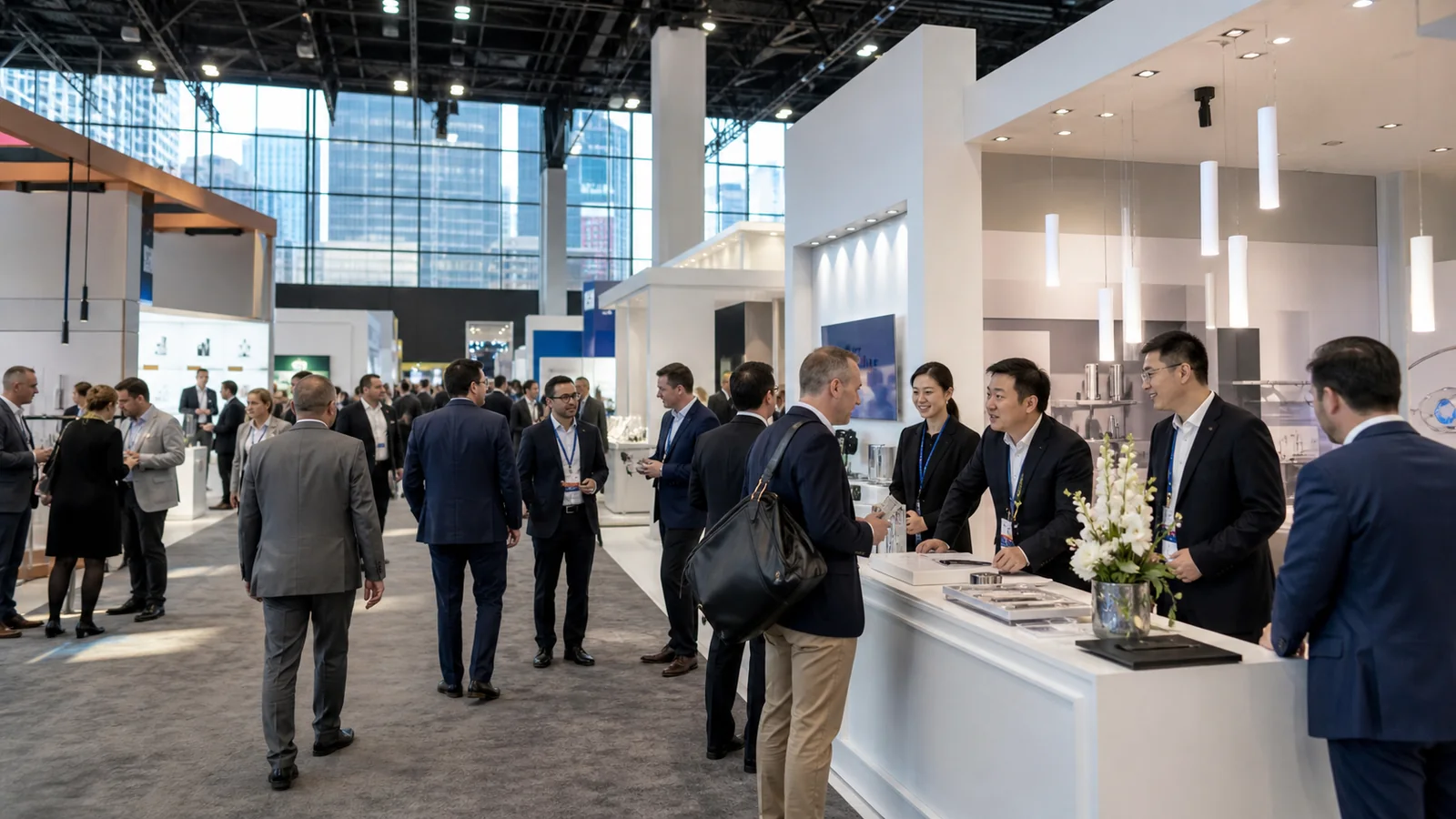
A busy booth can still produce a weak show. If people stop for a prize, scan a badge, and leave without understanding why your company matters, the activity has created traffic rather than engagement. In practical terms, trade show engagement means giving the right visitor a clear reason to stop, a simple way to participate, and a next step worth taking after the show.
This guide helps you build that strategy around the people you actually want to meet. It covers the message visitors see from the aisle, the experience inside the booth, the questions your team asks, and the information sales needs when the show is over.
Start with the business conversation you want
Do not begin by asking which game, screen, or giveaway would attract the largest crowd. Begin with the conversation that would make the show valuable.

For example, a packaging-equipment company may want plant engineers to bring a difficult line-change problem to a live demonstration. A healthcare software company may want hospital leaders to compare their current handoff process with a shorter workflow. An industrial component manufacturer may want design engineers to place a real sample into an assembly and discuss a tolerance problem.
Each goal produces a different booth. More importantly, each one gives the visitor a different reason to spend time with you.
Write one sentence before the design is approved:
A useful visit happens when a qualified attendee ________, and agrees to ________ next.
The first blank describes something the visitor does or learns at the booth. The second defines a real continuation: a technical review, sample request, scheduled demonstration, site assessment, distributor discussion, or another specific action. “Has a good conversation” is too vague to guide the team.
Choose one primary attendee, not the whole show audience
The show organizer may describe thousands of attendees across many job titles. Your booth cannot speak clearly to all of them at once.
Choose the person whose problem your exhibit is best prepared to handle. Describe that person by situation rather than title alone. “Operations leaders” is broad. “The person trying to reduce changeover time on an existing packaging line” gives you something to design and discuss.
You can still welcome other visitors. The choice simply controls the main aisle message, the featured proof, and the first question your staff asks. Secondary audiences can follow separate paths once they enter.
Use four filters:
| Question | What you need to decide |
|---|---|
| What problem brings this person to the show? | The issue your message should name or demonstrate |
| What can this person judge at the booth? | The proof, comparison, sample, or expert access you should provide |
| What can this person influence next? | The realistic follow-up you can ask for |
| What would make the visit a waste of time? | The irrelevant attraction or conversation your team should avoid |
This step is deliberately narrow. When the aisle message tries to cover every product, market, and buyer, visitors have to do the sorting themselves. Most will keep walking.
Give the right person a reason to stop
People decide quickly whether a booth deserves attention. They need to understand what is happening before they need to understand every benefit.

Your first layer of engagement should answer three questions from the aisle:
- Is this relevant to the problem I came to solve?
- What can I see, try, compare, or ask here?
- Can I participate without being trapped in a sales pitch?
A message such as “Innovation for Tomorrow” answers none of them. “Compare a 12-minute changeover with your current setup” gives a packaging professional a subject and an action. “Bring us your difficult label sample” gives a converter a reason to approach. The exact wording depends on the product, but the principle is stable: promise an encounter, not a corporate virtue.
The exhibit should make that promise visible. A live product needs a clear viewing line and enough room for the operator. Small samples need to be reachable and well lit. A workflow comparison needs a screen or graphic that can be understood while another conversation is taking place. If the invitation exists only in a staff script, the booth is relying on employees to interrupt passersby all day.
Build a short engagement path
An attendee should not have to guess what happens after stopping. Design a short path that moves from interest to useful information without forcing every person through the same long presentation.
1. Recognition
The visitor sees a problem, application, product, or outcome that matches the reason for attending. This happens at the aisle edge.
2. Participation
The visitor does something small: chooses a sample, answers one diagnostic question, tests a feature, compares two results, or asks an expert about a real situation. The action should reveal interest, not merely occupy time.
3. Proof
Your team shows the part of the product or process that supports the claim. This may be a physical demonstration, a before-and-after result, a working interface, a cutaway, a relevant case detail that is approved for public use, or a technical answer from the right specialist.
4. Qualification
The staff member asks enough to understand whether the issue, authority, timing, and next step are real. Qualification should feel like helping the visitor reach the right answer, not completing a form in front of them.
5. Continuation
The visit ends with a specific next action and owner. If a promised drawing review needs an engineer, name who will arrange it. If a sample will be shipped, record the application and delivery details. If there is no fit, close politely instead of manufacturing a follow-up neither side wants.
Not every attendee needs all five stages. Someone collecting general information may stop after proof. A scheduled account meeting may begin with qualification. What matters is that your team knows the possible next step instead of treating every badge scan as the same result.
Freeman's 2024 attendee research places hands-on experiences and preplanned attendee-exhibitor meetings among the preferred ways people interact with exhibitors. CEIR has also reported a persistent gap between the booth staff attendees want to meet and the people exhibitors typically provide, especially when visitors need product or technical expertise. These findings do not prescribe one activity for every show. They support a more useful rule: give visitors something relevant to do and access to someone who can answer what the activity reveals.
Make the interaction earn its floor space
Games, photo moments, challenges, digital walls, and giveaways can help, but an activity deserves space only when it supports the business conversation.

Test any proposed activation with four questions:
- Does it attract the person we want, or anyone who wants a prize?
- Does participating reveal a need, preference, application, or level of interest?
- Does the activity create a natural opening for our product or expert?
- Can the team record a useful result without slowing the line?
Suppose a manufacturer wants visitors to spin a prize wheel. The wheel may create motion and a crowd, but it tells the staff little about why a person stopped. If the same footprint lets visitors select a production problem and compare how two setups handle it, the interaction begins the conversation the company came to have.
This does not mean every activity must be serious. Enjoyment lowers the barrier to participation. The problem begins when the entertainment and the business have no bridge between them.
Design the booth around engagement, not just display
The floor plan should show how people will approach, pause, participate, talk, and leave. A beautiful booth can fail when the main demonstration blocks the entrance or when a crowd around a screen hides the product from everyone else.
Map these zones on the actual plan:
| Zone | Purpose | Common design failure |
|---|---|---|
| Aisle message | Let the target attendee recognize relevance | Too much copy or a slogan with no subject |
| Open interaction | Give people a low-pressure way to begin | Activity faces inward or requires staff permission |
| Demonstration | Show proof without blocking circulation | Audience stands in the main entrance |
| Focused conversation | Let staff discuss a real project | Too isolated, too noisy, or used as staff storage |
| Lead capture | Record the visit and agreed next step | Scanner is far from the conversation or creates a queue |
| Exit | Let people leave naturally and retain the next action | Visitors must cross another presentation to get out |
Watch the plan from both aisle approaches. A message or activity that works only from the front may disappear for half the traffic. Then place people into the drawing. Counters, stools, staff, bags, mobility devices, and a demonstration audience all consume space that an empty rendering does not show.
If participation requires touch, reach, sound, captions, or a clear viewing height, test those conditions before approving the fabrication. The point is not to add a generic accessibility statement. It is to make sure the person you invited can actually use the experience.
Prepare the staff to open the right conversation
The booth does not become engaging because the structure looks interactive. Staff behavior determines whether the visitor feels helped, intercepted, or ignored.

Replace “Can I help you?” and “What brings you to the show?” with an opener connected to what the visitor is already seeing. A staff member beside a sample comparison might ask, “Which finish is closer to what you are using now?” At a process demonstration, the opener might be, “Is speed or repeatability the harder issue on your current line?”
These questions are specific enough to answer and broad enough to begin a real exchange.
Then give staff clear routes:
- who can handle a technical question immediately;
- when a visitor should be introduced to a salesperson or distributor manager;
- which claims or project details may be discussed publicly;
- how to record the problem in the visitor's own words;
- how to end courteously when the booth is not a match;
- who covers each zone when someone takes a break or joins a long meeting.
Attendees often want access to people who can answer product and application questions, not only someone trained to collect contact details. Schedule the right experts during the periods when relevant customers are expected, and give every staff member a way to find them quickly.
Connect pre-show outreach to the booth experience
Do not invite someone to “visit booth 123” without explaining why. The invitation should describe the useful encounter that will be available there.

Offer a limited set of reasons to book time: bring a sample for review, reserve a working demonstration, compare a current configuration, meet a named product expert, or discuss one documented problem. The booth must then deliver the promised experience. A prospect who books a technical review should not arrive and receive the same three-minute overview given to every passerby.
Use the organizer's current exhibitor tools where they genuinely help people find or plan the interaction. Event profiles, meeting systems, mobile apps, session opportunities, and sponsored wayfinding vary by show, so check what is included, what costs extra, and what attendee data you are allowed to use. Do not build the plan around a feature before confirming that the event offers it and your team can operate it.
Schedule enough space between appointments to record the outcome and reset the demonstration. A calendar with no recovery time creates late meetings, missing notes, and a booth team that stops noticing walk-up visitors.
Capture the reason for follow-up, not only the badge
A badge scan identifies a person. It rarely explains what happened.
Before the show, agree on the few fields that sales will actually use. They may include the visitor's application, current problem, product of interest, decision stage, agreed action, timing, and follow-up owner. Use the visitor's words where possible. “Needs quote” is weaker than “wants a 20-unit pilot price after engineering confirms washdown compatibility.”
Keep the form short enough to complete while the details are fresh. If the team adds long notes hours later, conversations will blend together. Use a small number of qualification categories, then allow one concise free-text note for the detail that makes the contact memorable.
Get consent and follow the event's rules and applicable privacy requirements when collecting, using, or sharing attendee information. A scan is not a reason to add every person to every campaign. The promised follow-up should match the conversation.
Measure whether the strategy produced progress
Trade show booth traffic can help diagnose visibility, but it does not tell you whether the engagement worked. Track a small sequence that reflects the path you designed.

| Measure | What it tells you | What it does not prove |
|---|---|---|
| People who pause | Whether the aisle message or activity is noticed | That the audience is relevant |
| People who participate | Whether the first action is easy and interesting | That a business need exists |
| Qualified conversations | Whether the experience reaches the intended visitor | That an opportunity will close |
| Agreed next actions | Whether the booth creates continuation | That follow-up will happen on time |
| Completed follow-ups | Whether the team kept the promise | Revenue or long-term value by itself |
Define each measure before the show. If one employee counts every question as a qualified conversation and another requires budget and timing, the daily totals cannot guide a decision.
Look at ratios as well as totals. If many people pause but few participate, the invitation may be unclear or intimidating. If participation is high but qualified conversations are low, the activity may be attracting the wrong crowd. If strong conversations produce few next actions, staff may not know how to close the visit.
These are operating signals, not universal benchmarks. Your normal sales cycle, product complexity, show audience, booth location, and appointment mix affect the numbers. Compare them with the goal you set for this event rather than borrowing an unexplained target from another exhibitor.
Adjust during the show without changing the promise
Hold a short review after each day and ask concrete questions:
- Which message made the right person stop?
- Where did visitors hesitate or become confused?
- Which demonstration led to a useful product question?
- What did qualified visitors ask that the booth did not answer well?
- Which notes gave sales enough information to act?
- What caused queues, dead space, or staff congestion?
Change the opener, staff position, demonstration timing, or visible instruction when the evidence is clear. Do not replace the whole concept after one slow hour. Traffic patterns change with sessions, meal periods, and competing activities.
Photograph approved adjustments and update the team brief before the next morning. Otherwise one shift may continue using yesterday's message while another has moved on.
A practical attendee engagement plan
Before finalizing the exhibit, put the following on one page:

- Primary attendee: the person and situation the booth is designed to help.
- Booth promise: what that person can do, learn, compare, or solve.
- Visible invitation: the words and object that make the promise clear from the aisle.
- First action: the easiest meaningful way to participate.
- Proof: what makes the claim believable.
- Staff opener: one or two natural questions tied to the experience.
- Qualification route: the information needed and the person who handles each type of visitor.
- Next actions: the small set of continuations the team is ready to fulfill.
- Capture fields: what sales needs to understand the conversation.
- Daily measures: the counts and ratios the team will review.
- Owner: who can approve an on-site adjustment.
Then walk through the plan with the physical products, final graphics, staff roles, lead system, and real floor plan. If the sequence works only in a presentation deck, it is not yet a show-floor strategy.
Frequently Asked Questions
How many engagement activities should one booth have?
Use as few as you need to support the main visitor path. A small booth may need one strong interaction, while a larger exhibit can support different entry points for separate product areas. Add another activity only when it serves a distinct audience or decision. Several unrelated attractions compete for space, staff, power, and attention, and they make it harder to understand what your company wants visitors to remember.
Should staff scan a badge before or after the interaction?
Ask only when the exchange has created a reasonable reason to capture information. For a scheduled appointment, scanning at check-in may be practical. For a walk-up visitor, beginning with a badge request can feel like an entry fee. Let the person see the value first, then explain what information is being recorded and how it will be used. Follow the organizer's system rules and your company's privacy process.
What should we do when an activation creates a line?
First decide whether the line contains people you want to meet. If it does, give waiting visitors a useful preview, qualification question, or booking option, and protect the aisle and neighboring exhibits. If the line is mostly prize traffic, reduce the attraction or change the participation rule. A long queue is not automatically success; it can hide the exhibit and prevent qualified visitors from entering.
Can QR codes replace booth staff for attendee engagement?
QR codes can let visitors save technical material, choose content, or request a later action without waiting. They do not replace the expert conversation that many B2B attendees came to have. Use a code for a clear task, label what happens after the scan, and test the page on the venue network and common phones. Do not use one unlabeled code as the answer to every visitor need.
How should we handle visitors who are interested but not ready for a sales conversation?
Offer a next step that matches their stage. That may be a technical guide, sample request, product update, webinar, or permission-based follow-up after a known milestone. Record why the topic matters and when contact would be useful. Pushing an immediate meeting can damage a good early relationship, while collecting no context leaves marketing unable to continue it meaningfully.
Make every interaction lead somewhere
Good attendee engagement is not measured by how much activity fits into the booth. It is measured by whether the right visitor can recognize a relevant reason to stop, reach credible proof, speak with the right person, and leave with a next step both sides understand.
Before the exhibit design is locked, test that full journey on the floor plan. Bring the actual product, message, staff roles, lead fields, and follow-up options into the review. That is how an engagement idea becomes an experience your team can operate and your visitors can use. If the layout has not yet been translated into production, the trade show booth rental process explains how a show brief moves through design, approval, fabrication, and installation.