You open an exhibitor manual or booth quote and find drayage, EAC, CWT, I&D, and target date on the same page. A dictionary definition does not tell you who handles the task, which document controls it, or whether the charge sits inside or outside your booth proposal.
This trade show glossary helps a B2B marketing or operations manager decode common U.S. exhibit terms and turn them into clear responsibilities. You can use it while reviewing your space contract, floor plan, booth design, supplier quote, or freight paperwork.
How Should You Use This Trade Show Glossary?
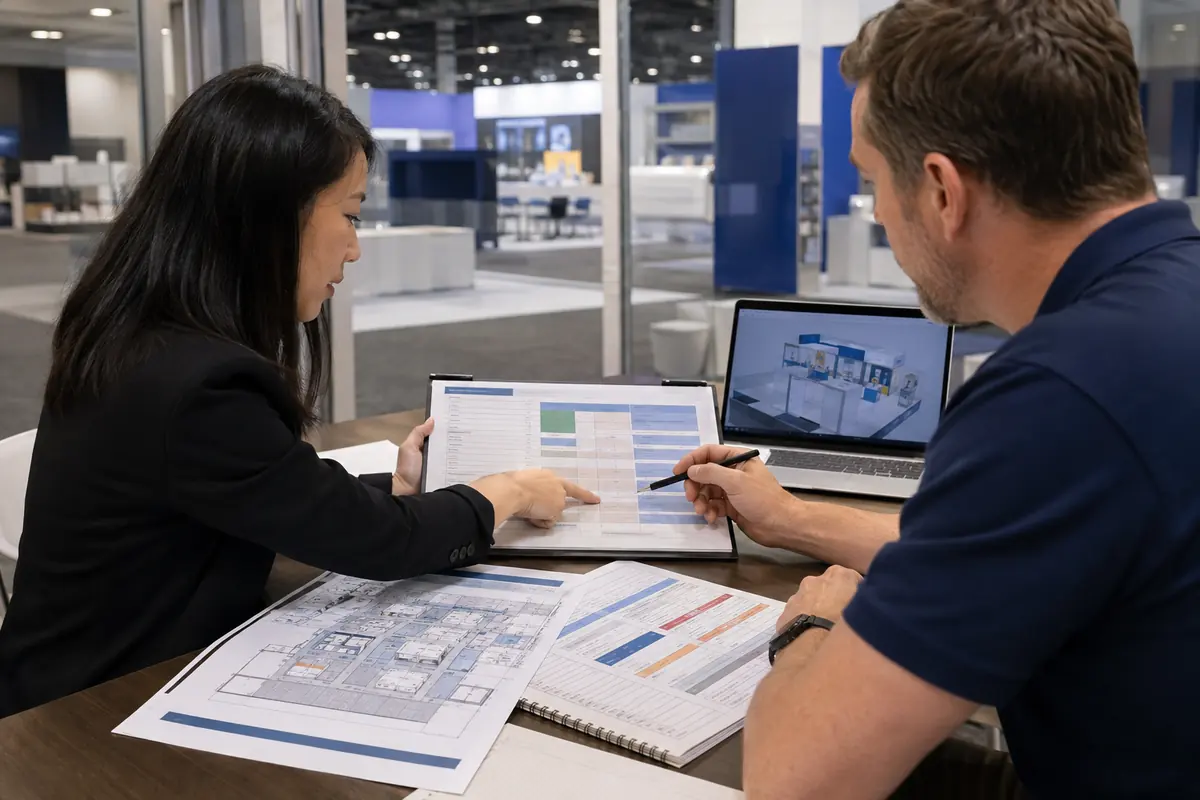
Look up a term when it appears in a document or onsite conversation. Then add it to your responsibility sheet with four details: what it means in this project, who owns the task, which order path and deadline apply, and whether the cost is included, separate, or TBD.
Highest-risk terms: Drayage · EAC · CWT · I&D · GSC · MHA · Rigging · Target Date · Turnkey Exhibit
Alphabetical sections: A–D · E–H · I–L · M–P · Q–T · U–Z
The grouped headings make a long page easier to scan; they do not imply that the glossary contains a useful term for every letter. Use your browser’s page search when you know the exact word.
A–D Trade Show Terms
Advance Order / Advance Rate
An advance order is placed before a provider’s stated deadline. An advance rate is a discounted price available when that provider’s ordering, documentation, and payment conditions are met by its deadline. Different services can have different cutoffs.
Advance Warehouse
An advance warehouse is a designated location that receives eligible exhibit freight before direct-to-show receiving begins. Freight later moves from the warehouse to your booth through the show’s material-handling process. The receiving dates, labels, restrictions, and charges determine whether this route fits your shipment.
Aisle / No-Freight Aisle
An aisle is the attendee route between exhibits. A no-freight aisle must remain clear during specified move-in or safety operations. Your structure, products, cases, and visitor queue need to stay inside the approved booth boundary.
Attendee
An attendee is registered to visit the event. Attendee, exhibitor, booth staff, organizer, and contractor badges can carry different access rights.
A/V (Audio-Visual)
A/V covers display, sound, playback, control, and related booth equipment. A useful A/V scope identifies the equipment, content source, mounting, power and internet needs, operator, and labor.
Backwall
The backwall is the wall or structural element at the rear of a booth. Its height, position, finish, and relationship to neighboring exhibits depend on the approved design and show rules.
Bill of Lading (BOL)
A bill of lading is an important carrier document recording the shipment, parties, transportation instructions, and applicable transport terms. It can also evidence the carrier’s receipt of freight. It is not automatically a document of title, and it does not replace the show’s outbound MHA or release procedure.
Boneyard / Empty Container Storage
The boneyard is an industry name for the area where empty crates and containers are stored while the show is open. Once the contractor removes a labeled empty, you may not be able to retrieve it until the return sequence begins after closing.
Booth / Exhibit
These words can mean the assigned space, the physical display, or both. In contracts and quotes, separate booth space from the physical exhibit so you can see what comes from the organizer and what comes from your booth partner.
Booth ID Sign / Standard Booth Package
A booth ID sign usually displays the exhibitor name and booth number. A standard booth package may include that sign plus basic pipe and drape or selected furnishings, but there is no universal package. Compare the space contract and service kit line by line before removing these items from your supplier quote.
Booth Space
Booth space is the floor area licensed or rented from the organizer. It does not automatically include walls, flooring, graphics, furniture, utilities, freight, material handling, or installation.
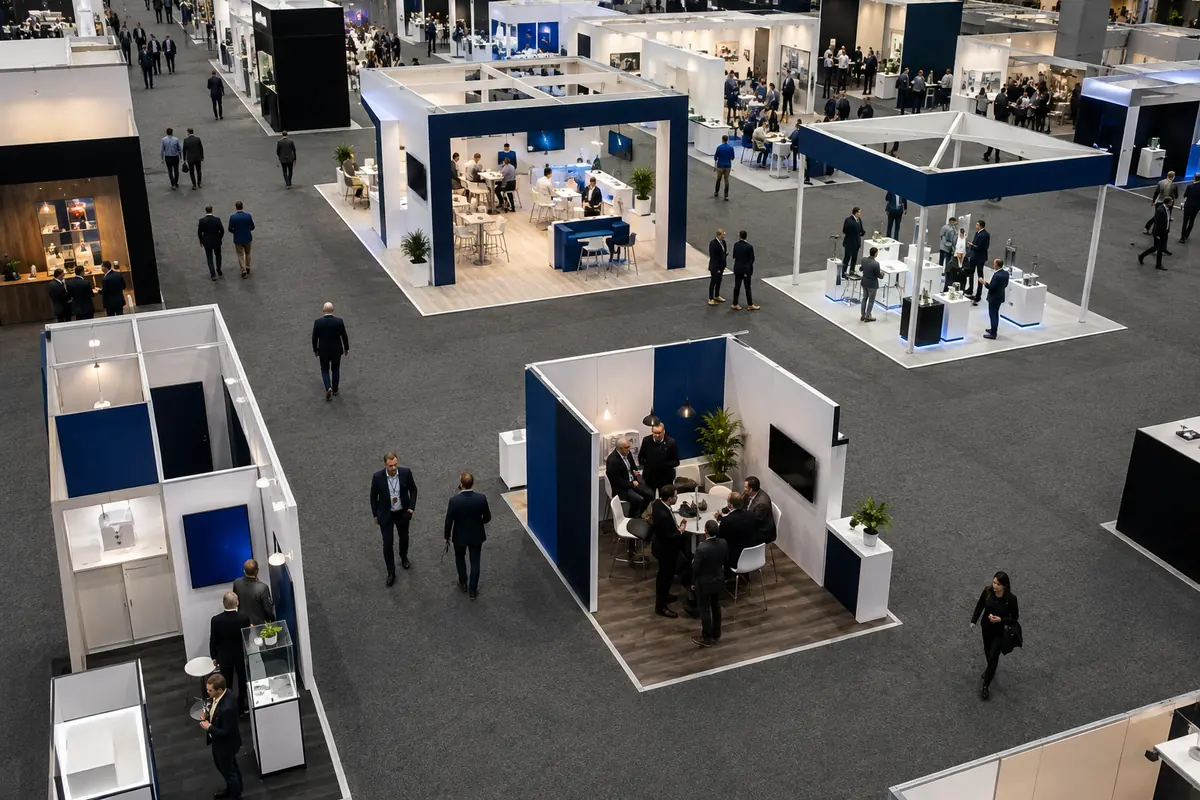
Booth Types: Inline, Corner, Perimeter, End-Cap, Peninsula, and Island
These labels describe a booth’s relationship to aisles, walls, and neighboring exhibits.
| Booth type | Typical position | First design check |
|---|---|---|
| Inline | One aisle-facing side; neighbors beside it | Backwall, sidewall, and sightline limits |
| Corner | Inline booth at an intersecting aisle | Which two sides remain open |
| Perimeter | Inline booth backed by a facility wall | Whether different height rules apply |
| End-cap | Inline-style booth placed at the end of a block | Line-of-sight limits for adjacent exhibitors |
| Peninsula | Three aisle-facing sides; fourth side connected | Backwall orientation and neighbor relationship |
| Island | Four aisle-facing sides | Setbacks, overhead elements, and utility routing |
The IAEE display-rule guidelines illustrate these configurations, but the current show’s plan and rules decide what you may build.
Certificate of Insurance (COI)
A COI provides evidence of specified insurance coverage. The event may request it from the exhibitor, EAC, or another contractor and may prescribe limits, certificate wording, holder or additional-insured details, and a submission date.
Certified Weight Ticket
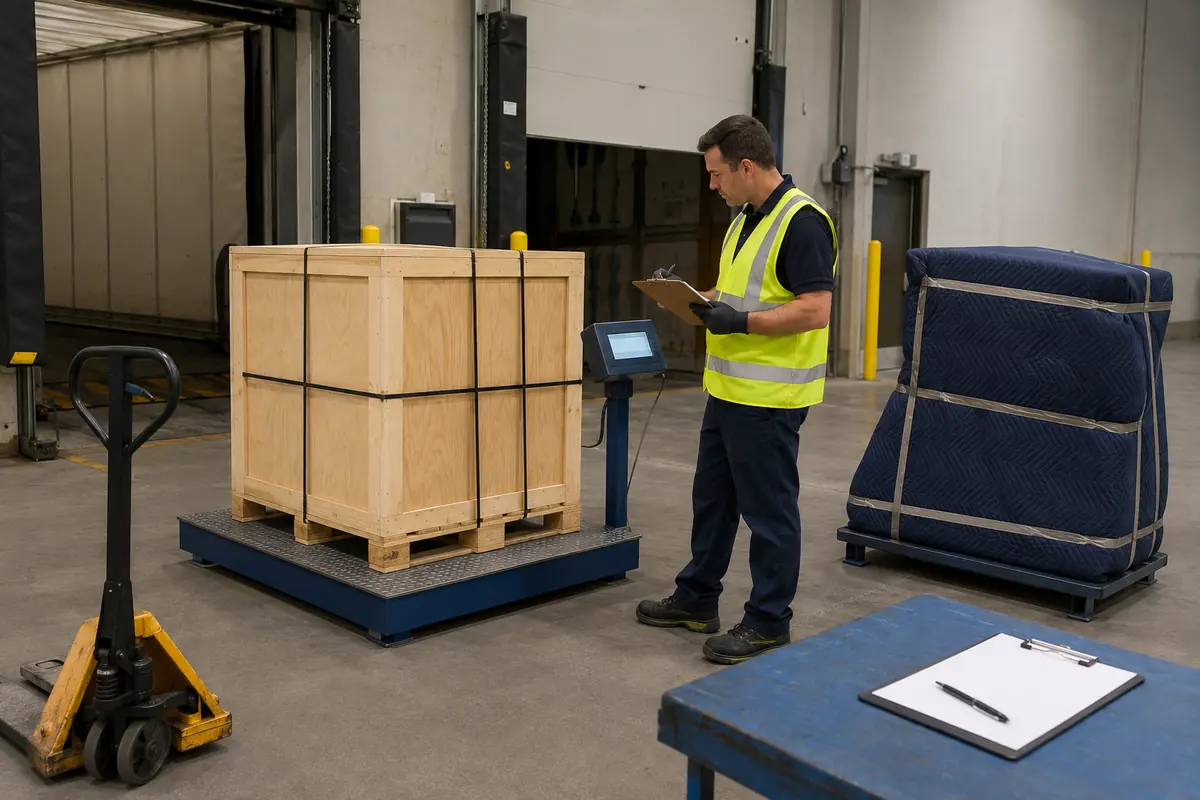
A certified weight ticket records shipment weight from an accepted scale or carrier process. It helps the material-handling provider establish billable weight and helps you investigate a weight discrepancy. Ask your carrier which gross, tare, and net records the show requires; Freeman’s freight guide specifically advises exhibitors to obtain certified weight.
Change Order / Overage
A change order records an approved change to scope, price, or schedule after the original agreement. An overage is a cost above the quoted or approved allowance, often caused by extra hours, quantities, services, or changed conditions. Before work continues, ask for the reason, price basis, schedule effect, and named approver in writing.
Crate / Packing List
A crate protects exhibit components or products in transit. A packing list records what is inside each shipment or container. Clear crate IDs and item lists help your crew install in sequence and identify missing parts without opening every box at random.
Crated / Uncrated Freight
Crated freight arrives in a container or on a skid that can be handled at the dock without extra handling. Uncrated freight arrives loose, pad-wrapped, or as machinery without the lifting provisions required by the provider. The category can change the handling method and rate, so send packaging photos and dimensions when requesting an estimate.
Cubic Content / Line-of-Sight Rule / Setback
Under a cubic-content rule, exhibit materials may use the approved width, depth, and height of the booth footprint. A line-of-sight rule limits parts of a booth so neighboring exhibits remain visible from the aisle. A setback is the required distance between an element and a booth boundary. IAEE recognizes cubic content and line-of-sight as different display-rule styles; never combine measurements from the two without checking which style your show adopted.

Custom Exhibit / Custom Booth
A custom exhibit is designed and produced around a specific brand, product, or visitor experience rather than selected as a fixed standard package. Custom does not tell you who owns the components or whether graphics, freight, I&D, utilities, or storage are included.
CWT (Hundredweight)
CWT means hundredweight; one CWT equals 100 pounds in U.S. trade show material handling. Providers may apply minimums, rounding, shipment categories, and special-handling rules, so calculate charges from the event-specific rate sheet.
Direct-to-Show
Direct-to-show freight travels to the venue during an allowed receiving window instead of going through the advance warehouse. Venue arrival is not booth delivery: driver check-in, unloading, material handling, and delivery to your space may still follow.
Discount Deadline
The discount deadline is a service provider’s cutoff for advance pricing. Electricity, internet, rigging, furnishings, cleaning, and labor may each use a different date or order form.
Dismantle / Teardown / Strike
These terms describe taking down the exhibit after the show. Your move-out plan also needs empty-container return, repacking, the outbound MHA, carrier check-in, pickup, and return shipment or storage.
Drayage / Material Handling
Drayage is commonly used for show-site material handling: receiving and unloading freight, moving it to the booth, storing empty containers, and returning repacked freight for outbound loading. It is separate from the carrier’s transportation service. Freeman’s freight guide maps these as different stages of the exhibit-freight journey.
E–H Trade Show Terms
EAC (Exhibitor-Appointed Contractor)
An EAC is a contractor selected by the exhibitor rather than appointed by the show as an official provider. A booth builder, independent I&D company, A/V company, or other vendor may be an EAC. Registration, insurance, badges, and work scope do not automatically give an EAC access to exclusive services.
Electrical Drop / Electrical Plan
An electrical drop is the point where ordered power reaches the booth. An electrical plan maps that point to circuits, equipment loads, cabinets, flooring, and cable routes. Your booth drawing and equipment list need to agree before the authorized provider installs the service.
Empty Sticker
An empty sticker identifies a container to be removed to empty storage and returned after the event. Do not leave tools, products, or show-day supplies inside anything you label empty.
Exhibit House / Booth Builder
An exhibit house or booth builder designs, produces, rents, or manages exhibit components. The company may also coordinate graphics, logistics, staging, or installation, but its title does not make it the organizer, GSC, carrier, or exclusive provider.
Exhibitor
The exhibitor is the company or organization contracted to occupy booth space. Even when a booth partner manages the project, the exhibitor remains responsible for the event agreement and approvals issued in its name.
Exhibitor Kit / Exhibitor Services Manual / Service Kit / Show Manual
These names refer to the event’s rules, forms, shipping labels, provider contacts, schedules, and deadlines. Record the version or portal update date used by your team. If a bulletin conflicts with a saved PDF, obtain written clarification from the responsible party.
Fire Marshal Review / Flame-Resistance Certificate
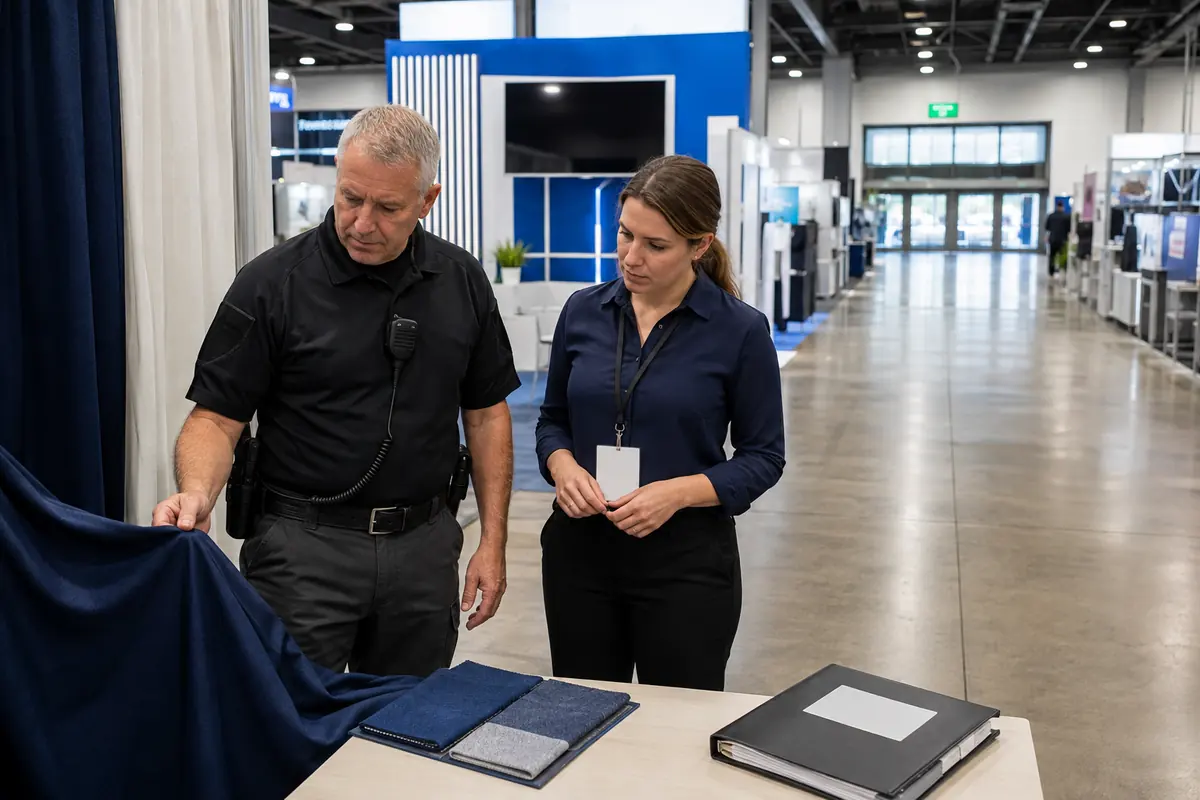
A fire marshal or fire-prevention authority may review event plans, inspect booth conditions, or require evidence for particular materials and activities. A flame-resistance certificate documents that a fabric or decorative material meets the stated test or approval basis. Requirements are local: Clark County’s January 2026 indoor exhibit guide, for example, addresses plans, inspections, and certificates for flame-resistant decorative materials. Use the authority and rules named by your event rather than treating that example as nationwide policy.
Floor Order / On-Site Order
A floor or onsite order is placed during move-in or at the venue rather than by the advance deadline. It may carry different availability, lead time, or pricing, so it is a contingency—not proof that every missing service can be supplied immediately.
Floor Plan
The event floor plan shows booth locations, numbers, aisles, entrances, and show-floor conditions. It is not your booth construction drawing. Check orientation and neighbors against the latest plan before you lock graphics, openings, storage access, or visitor flow. The IAEE floor plan workbook provides industry context.
Floor Port
A floor port is a venue access point for utilities such as power, data, air, or water where available. Its confirmed location can change flooring, cabinets, equipment placement, and cable routing.
Forced Freight
Forced freight is outbound freight the onsite contractor must route or transfer when pickup or paperwork does not meet the move-out procedure. The trigger, carrier, destination, and charge are defined in the show’s move-out instructions.
Freight / Shipping
Freight or shipping moves your exhibit and products between an origin, warehouse, venue, or next destination. It is separate from show-site material handling. When a proposal says “shipping included,” ask for the route, shipment type, weight assumption, carrier responsibility, and excluded onsite charges.
Freight Forwarder
A freight forwarder coordinates transportation and related documentation, especially for international shipments. It is not a customs authority or automatically the show’s material-handling provider. Put customs, temporary import, final-mile delivery, and return export under named owners.
General Service Contractor (GSC) / Official Contractor
A general service contractor is a primary contractor appointed by show management to perform designated show-wide services. An official contractor may refer to the GSC or to another provider officially appointed for a specific service. Read the provider list instead of treating the two labels as interchangeable in every document.
Graphics
Graphics are the printed or digital brand surfaces on an exhibit. The scope should state finished size, material, artwork format, quantity, placement, proof approval, installation method, and ownership or storage after the show.
Hanging Sign
A hanging sign is suspended above the booth for identification or visibility. The structure and the rigging service are separate scope lines; design eligibility, dimensions, weight, engineering, hanging points, labor, and deadlines may also need separate approval.
I–L Trade Show Terms
I&D (Installation and Dismantle)
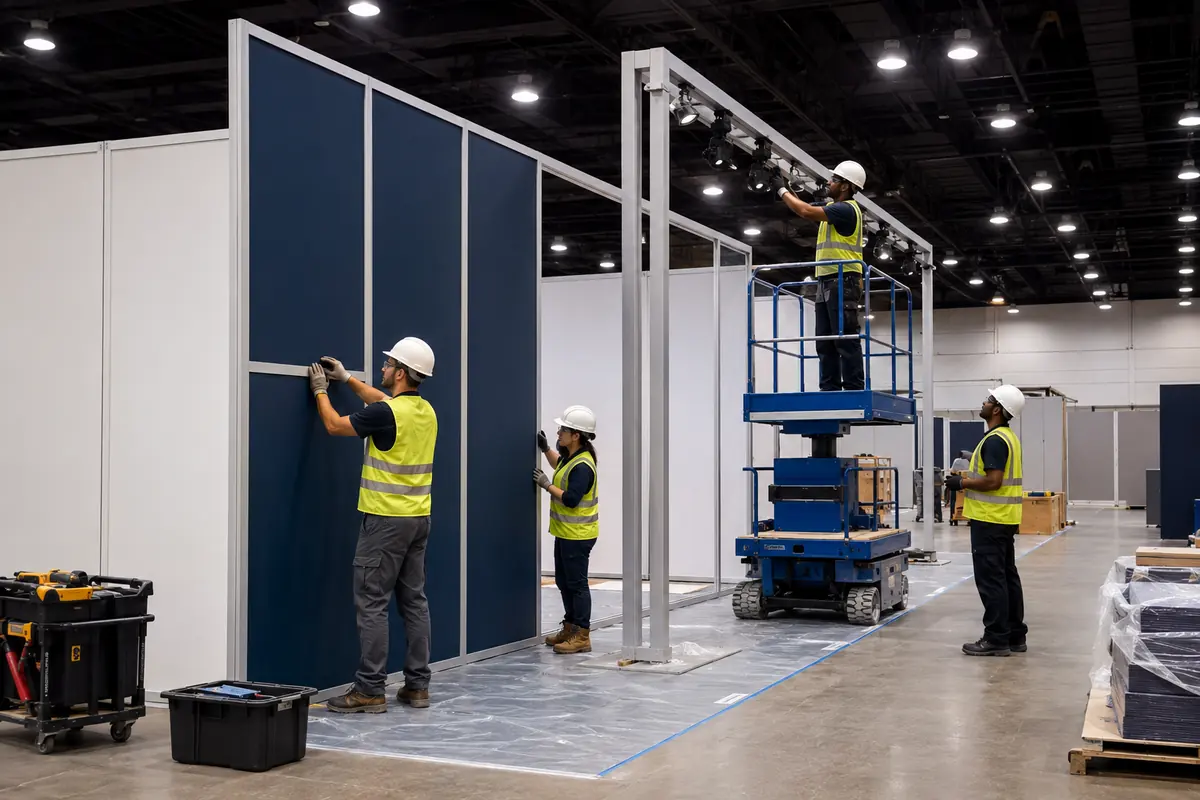
I&D is the labor and supervision used to install and dismantle an exhibit. It is not freight transportation or material handling. A usable I&D estimate identifies crew, hours, supervision, schedule assumptions, equipment, time category, and the effect of late freight or utilities. For a provider’s booth-build scope, review the installation and dismantling service after checking the event’s labor rules.
Installation / Setup
Installation or setup is the assembly of the booth under the approved drawings and onsite conditions. Clarify whether your booth partner supplies labor, supervises labor ordered from another provider, or does both—and when graphics, A/V, products, utilities, and cleaning enter the sequence.
Labor Call
A labor call reserves a crew or trade for a date, start time, and expected duration. The order form defines minimums, cancellation terms, jurisdiction, and straight-time or premium-time categories.
Lead Retrieval
Lead retrieval is the event-approved system used to scan attendee credentials and capture permitted registration data. It may not replace your CRM, qualification notes, or consent process. Assign the operator, qualifying questions, data transfer, and follow-up owner before the show.
Lead Time / Graphic Submission Deadline
Lead time is the period needed to complete a product, service, or approval before it is required. A graphic submission deadline is the cutoff for production-ready artwork. If booth design approval, artwork approval, printing, and freight depend on one another, record each date rather than treating “graphics due” as a single milestone.
Loading Dock
The loading dock is the venue’s freight receiving and release area. A driver may still need a target appointment, marshaling-yard check-in, paperwork, or dock assignment. Give the carrier the show instructions, not only the venue street address.
M–P Trade Show Terms
Marshaling Yard
A marshaling yard is a truck check-in and waiting area used to control dock traffic. Marshalling is a common spelling variant. Your carrier needs its address, hours, appointment or target requirements, paperwork, and driver contact process.
Material Handling Agreement (MHA)
An MHA is the onsite contractor’s form for releasing and routing outbound exhibit freight. It is distinct from the carrier’s BOL even when both contain shipment details. Complete the show’s form, identify the carrier, and meet the stated pickup procedure.
Modular Exhibit
A modular exhibit uses components that can be reconfigured for different spaces. Modular describes the system, not ownership, price, portability, or installation effort.
Move-In / Load-In
Move-in or load-in is the period when freight delivery, booth installation, utilities, and product placement are allowed. Your assigned target can be narrower than the general window, so build the schedule backward from the required completion time.
Move-Out / Load-Out
Move-out or load-out covers dismantle, empty return, repacking, outbound paperwork, and pickup. Show close does not mean every truck can enter immediately; align labor release and carrier check-in with the stated sequence.
On-Site Services / Show Services
These umbrella terms can include electricity, internet, cleaning, rigging, material handling, furnishings, plumbing, security, and labor. A quote that says only “show services” is not comparable until it identifies each line and the party that orders and pays for it.
Peninsula Booth
A peninsula booth has three aisle-facing sides and a fourth side connected to another exhibit or boundary. That fourth-side condition drives backwall orientation, finished-surface, sightline, and neighbor questions that do not apply in the same way to an island booth.
Pipe and Drape
Pipe and drape is a basic divider made from uprights, crossbars, and fabric panels. It marks space; it is not a complete branded exhibit. Find out what the organizer supplies and whether your design may touch, cover, or rely on it.
Portable Exhibit
A portable exhibit is designed for relatively easy transport and setup. Portability does not remove show rules, labor jurisdiction, safety review, or service orders. Compare packed size, weight, durability, replacement parts, and setup method with your team’s capabilities.
Pre-Build / Staging
Pre-build or staging is assembly and inspection before shipment. Define how much of the booth will be built, which systems will be tested, who reviews it, and how missing hardware, graphic fit, unstable parts, and punch-list corrections will be recorded. For a defined physical check before shipment, review the trade show booth pre-build guarantee and record which assemblies are included.
Privately Owned Vehicle (POV) / Cart Service / Small-Package Shipment
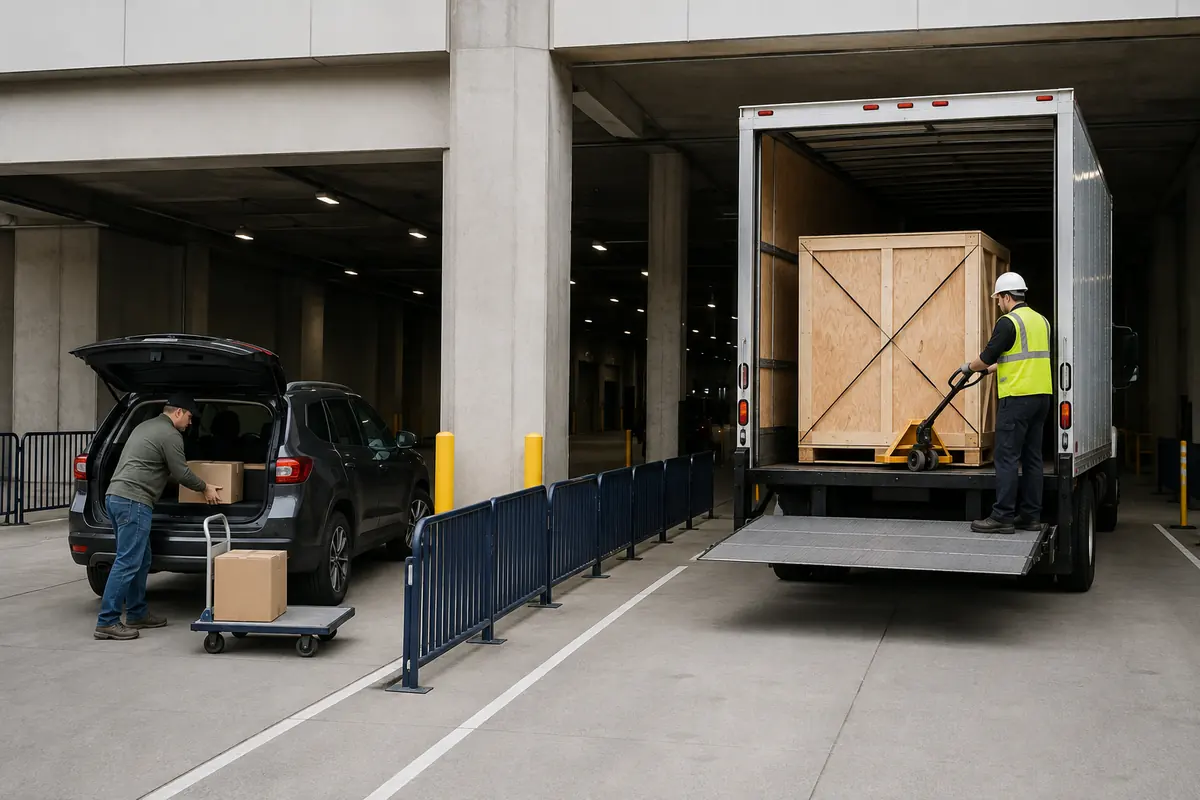
A POV is a passenger vehicle whose main purpose is moving people, not commercial freight. Some shows offer a cart-service or hand-carry route for eligible small loads. A small-package shipment arrives through a parcel carrier and may fall into a separate material-handling category. Vehicle, piece, weight, time, and access limits are event-specific; compare all three routes before assuming a small delivery is free.
Q–T Trade Show Terms
Rental Exhibit
A rental exhibit is used for an agreed period rather than purchased. Ask which components are included, custom, reusable, consumable, returnable, or separately billed—and who pays for damage or late return.
Rigging
Rigging is specialized work that lifts, suspends, or supports signs, truss, lighting, A/V, or other overhead loads. It can require approved plans, engineering data, authorized labor, equipment, and venue review. A glossary defines the responsibility; it is not a rigging instruction.
Service Desk / Exhibitor Service Center
The service desk is an onsite point for work orders, order status, freight paperwork, or provider questions. Record the relevant desk, hours, and escalation contact during move-in.
Shell Scheme
A shell scheme is a pre-built stand system commonly used outside the United States, often with wall panels, a fascia or nameboard, and selected basic items. The included carpet, lighting, power, furniture, graphics, and cleaning vary. GES’s exhibitor FAQ shows why you need the event’s exact package rather than a generic assumption.
Show Management / Show Organizer
Show management or the organizer runs the event and manages the exhibitor relationship. It is different from the venue, GSC, booth builder, and service providers. Send a question to the party that controls the decision.
Special Handling
Special handling is a material-handling category used when packaging, loading pattern, mixed freight, access, shipment integrity, or another condition requires extra time, labor, or equipment. Packaging photos and a provider’s written classification are more useful for budgeting than a generic definition.
Straight Time / Overtime / Double Time
These are labor billing categories based on when work occurs under the applicable schedule or agreement. Hours and multipliers are not universal. Match freight arrival, installation sequence, show close, and move-out to the current rate periods.
Target Date / Target Move-In
A target date or target move-in is an assigned time for freight arrival or access. It may be narrower than the general move-in period. Identify whether the target controls your carrier, installation crew, or both.
Trade Show / Exhibition / Expo / Trade Fair
These terms overlap in business-event usage. U.S. teams often use trade show or expo; international documents may use exhibition or trade fair. Preserve the official term in contracts and forms, then use one internal project term so the event is not confused with the physical exhibit.
Truss
Truss is a structural framework used to support lighting, signs, or A/V. Ground-supported and suspended systems raise different engineering, rigging, labor, floor-load, and approval questions, so one word is not a complete scope line. Use the truss trade show display page to compare a proposed exhibit structure with the engineering and venue approval questions described here.
Turnkey Exhibit
A turnkey exhibit is marketed as a more complete managed solution, but turnkey has no universal inclusion list. Require the proposal to separate what the booth partner supplies, coordinates, orders from show-appointed providers, excludes, and leaves TBD.
U–Z Trade Show Terms
Union Labor / Work Rules
Union labor works under applicable labor agreements and craft jurisdiction. The practical question for exhibitors is which tasks their own full-time employees may perform and which tasks must go to an authorized trade. Use the current show’s work rules; right-to-work is a different employment-law concept and should not be used as shorthand for booth labor permissions.
Venue
The venue is the building or campus where the event takes place. It may set facility rules or supply selected services, but it is not necessarily the organizer or GSC. Put each organization and its role on your contact sheet.
Walkthrough / Punch List
A walkthrough is a structured inspection before handover or opening. The punch list records incomplete, incorrect, or damaged items. Give every item a photo, owner, correction, deadline, and closure evidence.
Wayfinding
Wayfinding combines signs, visual cues, and layout choices to help visitors find destinations and move through the booth. It can direct people to reception, products, demonstrations, meetings, or exits instead of merely repeating brand graphics.
Which Terms Must You Clarify Before Approving a Booth Quote?
Use a table like this:
| Quote line | Meaning in this project | Responsible party | Order path and deadline | Included or separate | Evidence or TBD |
|---|---|---|---|---|---|
| “Installation included” | Assemble the listed booth components | Booth partner supervises; approved provider supplies crew | Labor form; date pending | Crew hours separate | Drawing issued; rate TBD |
Reconcile at least these six groups:
- Space and exhibit: space contract, structure, flooring, furniture, storage, and approvals.
- Design and production: drawings, engineering, graphics, fabrication or rental, pre-build, and packing.
- Venue services: power, internet, A/V, rigging, cleaning, plumbing, security, and ordering party.
- Inbound movement: carrier, warehouse or direct route, labels, weight ticket, packaging category, and material handling.
- Installation: I&D crew, supervision, labor call, time category, equipment, and completion time.
- Outbound movement: dismantle, empty return, repacking, MHA, carrier check-in, pickup, return, and storage.
Phrases such as “turnkey,” “shipping included,” “installation included,” and “show services” are not comparable until the task, owner, billing path, assumption, and exclusion behind each one are written down.
Frequently Asked Questions
Which freight documents should you have before move-in and move-out?
For inbound freight, collect the carrier’s BOL, certified weight record when required, shipment labels, packing list, and delivery instructions. For outbound freight, add the show’s MHA or release form and the carrier paperwork required for pickup. Match names, booth number, piece count, weight, route, and carrier across the documents before the driver arrives.
What should you send a booth partner when a service line is unclear?
Send the show and venue, booth number and size, current floor plan and manual, deadline summary, booth drawing, quote, and known providers. For freight, add packed dimensions, weights, piece count, origin, timing, and receiving route. Attach the written answer to the affected scope line.
Can your EAC or booth builder handle every service in the exhibitor manual?
No assumption is safe here. A show can reserve services for official, exclusive, venue, or authorized trade providers, while EAC registration and insurance control access. Ask the builder to mark every service as supplied, coordinated, show-appointed, excluded, or TBD.
Which booth rules should you confirm before design approval?
Start with the assigned booth type and orientation, the adopted line-of-sight or cubic-content rule, height and setback limits, open-side requirements, hanging eligibility, utilities locations, and fire or material documentation. A rendering can look finished while still relying on an unapproved wall, sign, cable route, or fabric.
When should you stop using a glossary and contact the organizer or contractor?
Escalate any answer that can change a deadline, price, approval, labor assignment, exclusive service, shipping label, dock access, or floor-plan decision. Ask for written confirmation when it affects an order or quote. A definition helps you ask the right question; it does not authorize the work.
Final Thoughts
Trade show terminology matters when the same word carries different responsibilities in your manual, booth quote, freight plan, and onsite handover. Put every cost- or schedule-sensitive term into one responsibility sheet before you approve the project.
To start a scope review with KingExhibits, send your show name, booth size, and current quote. If available, attach the floor plan and exhibitor manual; they help us identify missing scope, show-appointed services, and items that still need written confirmation. The result should separate supplied, coordinated, show-appointed, excluded, and TBD work so you can compare the real proposal—not just the headline price.