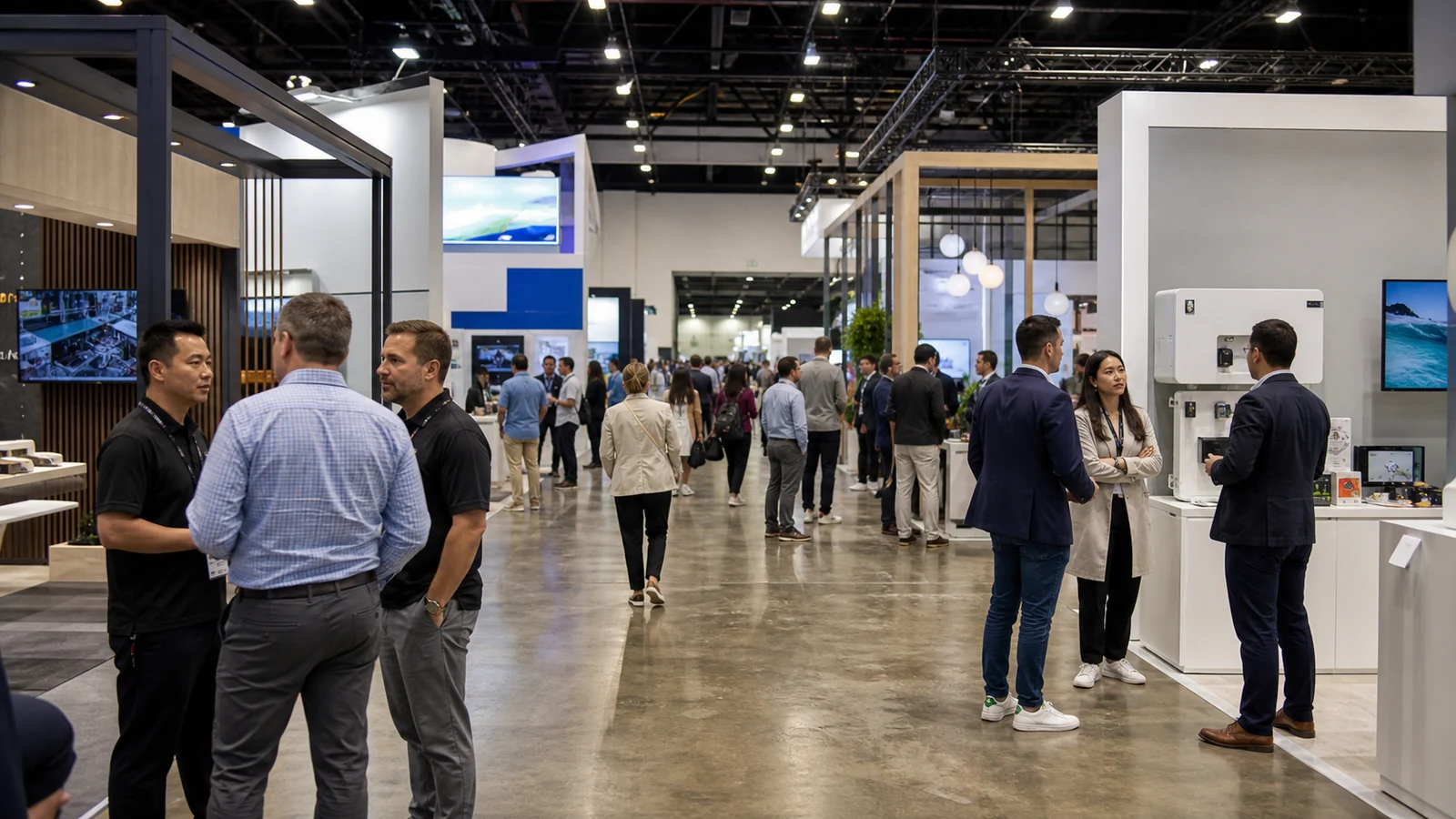
CES can give your technology company access to buyers, partners, media and industry conversations that are difficult to gather in one place. It can also consume a large budget while your team spends four days explaining too many products to the wrong people.
If you are exhibiting at CES 2027, your first job is not to make the booth look as large as the event. It is to decide which visitor you need, what that person must understand or see, and what should happen next. This guide helps an international B2B marketing manager turn those decisions into a booth, logistics plan and working show team.
Confirm the Current CES 2027 Facts
CES 2027 runs January 6-9, 2027, in Las Vegas. CES is not contained in one hall. Official exhibit information lists locations including the Las Vegas Convention Center, The Venetian Expo and several hotel-based exhibit, meeting and hospitality environments. Product categories help determine where companies are placed.

That matters because “exhibiting at CES” is not a complete operational brief. Your venue and space type affect freight instructions, access, labor, service vendors, height and display rules, move-in, move-out, customer meetings and daily transportation.
Use the official CES exhibitor guides and the manual attached to your exact venue and space. CES says its 2027 manuals and hospitality guides are being posted in September. If your document is not yet available, mark the rule or price as pending. Do not use a CES 2026 manual as silent proof of a 2027 condition.
Record the document name, year and date downloaded in your project file. A screenshot forwarded in a chat is not enough when the source changes.
Decide Whether Your Product Story Fits the Event
CES covers many technology areas. The official exhibitor overview currently lists categories such as vehicle technology and advanced mobility, health, audio/video, gaming and XR, food tech, smart home, enterprise AI, IoT infrastructure, lifestyle tech and energy.
Category fit is only the first test. Ask:
- Which business or technical role should stop?
- What problem will that person already recognize?
- Can the booth prove something that is difficult to understand from a website or sales deck?
- Does your team have a credible next step for a U.S. buyer, partner, distributor, integrator or media contact?
- Can the product and claims be shown under the space, safety, power, connectivity and demonstration conditions of the assigned venue?
Do not attend simply because your company uses AI, sensors or another broad technology label. If the booth message needs five minutes of company background before a qualified visitor understands the relevance, the show floor will expose that weakness.
A useful exhibit brief starts with one sentence: “For [priority visitor], we will prove [specific value] by showing [visible evidence], then ask for [next action].” It does not have to be the only conversation in the booth, but it must control the design.
Treat Venue Assignment as a Design Input
The same 20×20 concept should not be released before the team confirms where and how it will be used.
Build a venue sheet with:
| Field | What to record |
|---|---|
| Official venue and hall | Use the contract and current floor plan, not a sales conversation |
| Booth or suite number | Include orientation and neighboring spaces |
| Space type | Raw exhibit space, turnkey package, suite, meeting room or another contracted format |
| Dimensions and open sides | Confirm the actual footprint and aisle exposure |
| Display envelope | Height, setbacks, cubic-content or venue/show-specific rules |
| Approval requirements | Drawings, engineering, fire documentation, demonstrations, vehicles or special exhibits |
| Official vendors | Service area, ordering method and contact |
| Freight route | Advance warehouse/direct shipping rules, target date and move-in sequence |
| Utilities | Power, internet, rigging, plumbing, compressed air or other requirements |
| Access | Staff entry, customer access, badges, work passes and show-hour limits |
Do not fill missing fields with “standard CES rules.” CES publishes venue-specific manuals because the operating conditions differ. Your booth partner, freight team and staff should all work from the same venue sheet.
Build One Source of Truth From Official Tools
CES points exhibitors to the Exhibitor Dashboard, exhibitor manuals, personnel registration, housing and other official resources. Assign one internal owner to control these inputs.
Create a decision log with five columns: item, current source, owner, due date and status. Link the source document rather than copying a number into several spreadsheets. When a rate, deadline or rule changes, update the one record and tell the people whose work depends on it.
At minimum, control:
- space contract and floor plan;
- current venue manual and later revisions;
- exhibitor registration and badge process;
- official-vendor orders and confirmations;
- EAC registration if you appoint an outside contractor;
- booth drawing and approval correspondence;
- freight labels, target plans and delivery appointments;
- product, battery, wireless, demonstration or vehicle submissions that apply;
- staff shifts, customer meetings and on-site contacts;
- move-out and return-shipping instructions.
The official manuals page warns exhibitors about fake attendee-list solicitations and says CTA does not sell or publicly release its attendee list. Keep purchasing and sales teams from turning an official planning problem into a data-security problem.
Plan Backward From Product Readiness
The booth is not ready if the product is not ready to be shipped, powered, connected, reset and demonstrated repeatedly.

For each product or prototype, record:
- exact dimensions, weight and center-of-gravity concerns;
- final show configuration and allowed hands-on access;
- power draw, plug, voltage and startup sequence;
- network, cloud, wireless or local-content dependency;
- battery type, charging and transport documentation if applicable;
- heat, noise, motion, liquids, pressure, fumes or safety boundaries;
- daily consumables, cleaning and reset time;
- backup unit, spare parts and offline demo option;
- packaging, responsible shipper and customs status;
- person authorized to operate and troubleshoot it.
Then work backward from the approved freight route and target schedule. Separate the date the product must leave from the date the booth graphics go to print. If both depend on one unfinished product decision, show that dependency instead of pretending the schedules are independent.
International exhibitors should not send a critical prototype without a named importer/exporter process, commercial documents, return plan and party responsible for customs questions. Your exhibit company can coordinate the booth, but it does not automatically become the importer, customs broker or product-certification authority.
Design the Booth Around Proof, Not Product Count
A large CES audience does not make every product equally important. Visitors still decide within a short visual moment whether the booth is relevant to them.
Choose one hero proof. It might be a live comparison, a measurable output, a product interaction, a physical cutaway, a workflow before and after, or a clearly labeled system integration. Then decide what the visitor can understand from the aisle, what requires a staff explanation and what belongs in a scheduled meeting.
Give each physical element a job:
- high-level identification tells the right visitor why to look;
- the product or demonstration proves the main claim;
- supporting graphics explain only what cannot be seen;
- a screen shows content that remains legible and useful without perfect audio;
- standing conversation space handles brief qualification;
- protected meeting space serves discussions that genuinely require privacy or time;
- storage supports daily resets without becoming visible clutter.
Do not fill a bigger CES booth with a complete catalog. A visitor who cannot tell what to see first will often choose nothing.
Make the Demonstration Survive CES Conditions
A demonstration that works in an office can fail in a bright, noisy and crowded exhibit hall.

Test the full visitor experience before shipping:
- Start from the state the product will be in after several show hours.
- Run it using the actual power, screen, network and accessories planned for the booth.
- Add surrounding light and noise.
- Let a person join halfway through.
- Interrupt the network or primary device.
- Have a staff member restore the demo without engineering help.
- Record the reset time and daily consumables.
If the proof depends on live cloud access, prepare an honest offline fallback. It should not pretend to be a live result. Label what is recorded and train staff to explain why the fallback is being used.
Keep sound, light, motion and visitor queues inside the contracted footprint and current rules. Submit special demonstrations and structures through the official process rather than relying on an informal supplier assumption.
Separate Media, Buyer and Partner Conversations
CES can bring several valuable audiences to the same booth, but they do not need the same explanation.
Prepare three short routes:
| Visitor | What they need first | Useful next step |
|---|---|---|
| Buyer or enterprise user | Application fit, proof, implementation conditions and responsible commercial contact | Qualified meeting, evaluation or requirements exchange |
| Channel or integration partner | Market role, compatibility, support model and boundary between the companies | Partner review with named owner and requested materials |
| Media or analyst | Clear news value, accurate claim, spokesperson and approved supporting assets | Scheduled interview, press kit or follow-up with communications owner |
Do not make engineers improvise commercial terms or let salespeople invent technical answers. Train the handoff sentence and include the visitor's reason for speaking to the next person.
If media coverage matters, decide what is genuinely new before arriving. A press badge does not make a broad company introduction newsworthy. The spokesperson, approved claim, visuals and proof must agree.
Plan Staff Movement Across Las Vegas
CES activity is distributed, and travel time is part of the staffing plan. A person scheduled for a meeting at another venue cannot also be counted as booth coverage during the transfer.

Use named shifts and backups. Protect the booth's open sides, demonstration operator, scheduled-meeting host, technical specialist and lead-record process. Record which team member carries the on-site authority to approve a small operational change and who must be called for a larger commitment.
Official CES guidance says each attendee, including exhibitor personnel, must pick up their own badge at a remote badge pickup location. Check current locations and hours, and do not plan for one coordinator to collect a team's badges. Also verify customer access requirements for any pre-show, show-hour or after-hour meetings in official exhibit areas.
Give staff an arrival plan, venue name, hall, booth number, transport buffer, entry requirement and emergency contact. “Meet at the CES booth” is not adequate for a first-time international team.
Control Freight and Move-Out Before You Ship
Choose the freight route from the current manual and your risk, not from habit. Advance warehouse and direct-to-show shipments can have different receiving windows, labels, handling and consequences. CES also publishes target freight information by venue and booth range.
Before release, confirm:
- ship-from location and ready date;
- number, dimensions and weight of pieces;
- advance or direct destination and approved labels;
- target date or appointment;
- carrier contact and tracking method;
- material-handling scope;
- product/customs documentation;
- receiving contact for any separately delivered owned item;
- empty-container plan during the show;
- move-out carrier, paperwork, deadline and fallback if the carrier is late.
Move-out is not a problem to solve on the final afternoon. Decide what returns, what moves to the next show, what goes to storage and what may be disposed of. Put return labels and responsibilities in the project file before the outbound shipment leaves.
Use Deadlines as Decision Gates
An early order discount is useful, but the more important question is whether the order is based on approved information.

For every CES deadline, record three dates:
- the official submission or order deadline;
- your internal decision deadline;
- the date the supplier needs complete input.
The internal date should come first. A booth drawing cannot be approved if the product footprint is still changing. Power cannot be finalized if the demonstration equipment list is incomplete. Freight cannot be booked accurately if the crate plan does not exist.
Do not treat every deadline as equally critical. Mark which missed dates increase price, remove an option, threaten approval or create a show-opening risk. Escalate the decision, not just the calendar reminder.
Frequently Asked Questions
When and where is CES 2027?
CES 2027 is scheduled for January 6-9, 2027, in Las Vegas, Nevada. Exhibit and meeting activity spans multiple venues, so confirm the exact venue, hall and space type on your contract and current floor plan. Do not plan freight, staff transport or booth rules from the city and dates alone.
Is CES only for consumer products?
No. CES includes technology categories and conversations relevant to enterprise buyers, infrastructure, mobility, health, energy, smart home, AI and other B2B markets. The question is not whether your company is “tech.” It is whether the right CES audience can understand and act on a specific product proof and business next step.
Can we use a CES 2026 exhibitor manual to design for 2027?
Use an older manual only to identify questions and likely workstreams. Do not treat its rates, dates, forms, vendors or rules as current approval. CES publishes venue-specific resources; use the 2027 version for your exact location and keep later revisions in the decision log.
Can our exhibit house register as an exhibitor-appointed contractor?
CES has an EAC registration process for independent contractors hired by exhibitors. The official manuals page says 2027 EAC registration opens in the fall. Confirm the current procedure, insurance documents, deadlines and venue access rules. Hiring a contractor does not complete registration automatically.
Should we buy a CES attendee list?
No. CES states that CTA does not sell or publicly release the attendee list and warns that list-sale solicitations are scams. Use official exhibitor tools, customer invitations, scheduled outreach, your own consented contacts and on-site lead capture instead of purchasing an alleged CES list.
Leave With Owned Next Steps, Not a Larger Lead File
Before doors open, define what counts as a qualified buyer, partner, media contact, existing-customer request and non-priority conversation. Configure the lead record around the next action, owner and due date rather than vague labels such as “hot.”
CES rewards preparation because it creates more choices than your team can handle at once. A focused exhibit does not try to capture all of them. It makes one valuable claim easy to understand, protects the proof that supports it and transfers every worthwhile conversation to a person who owns what happens next.