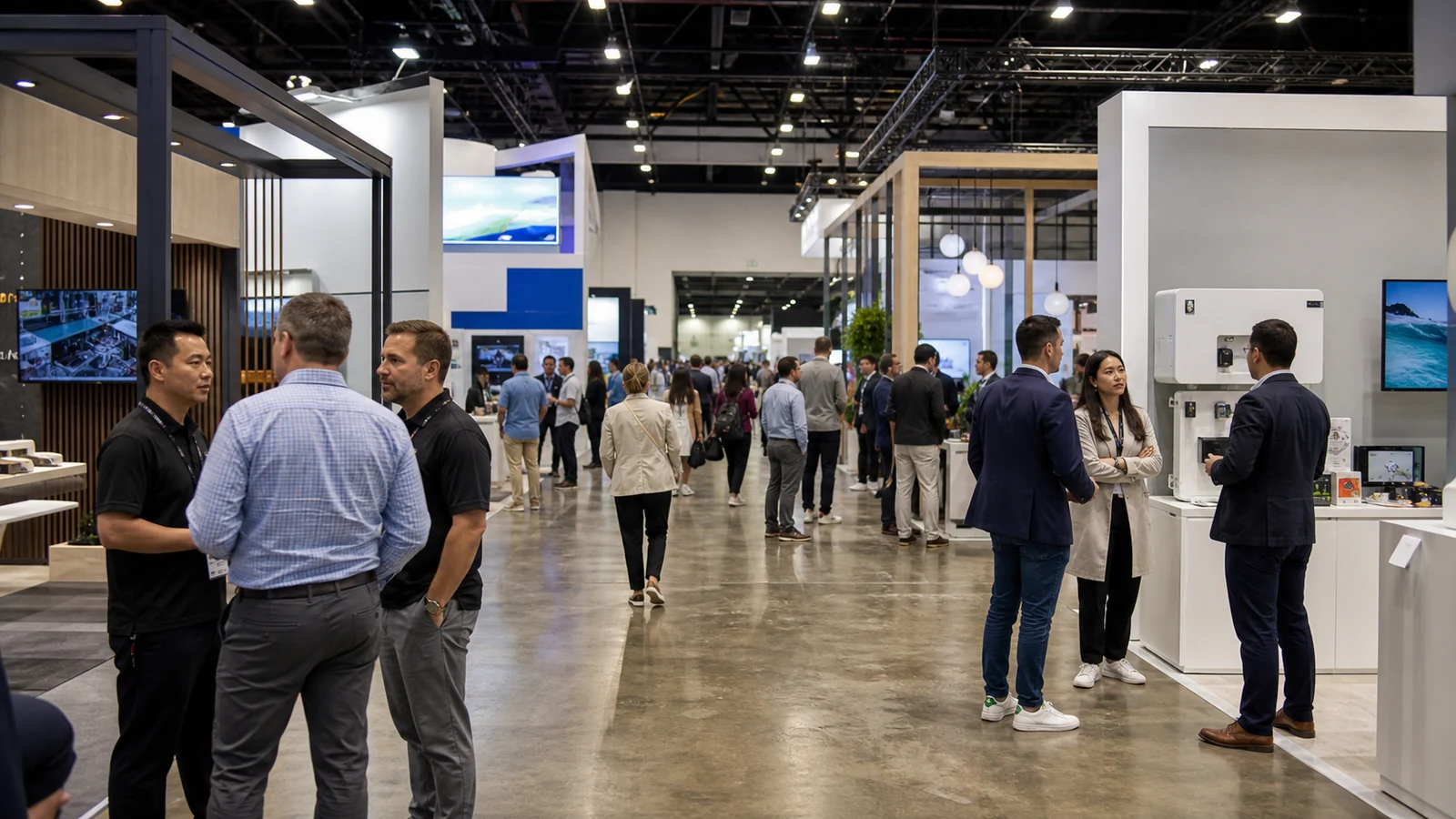
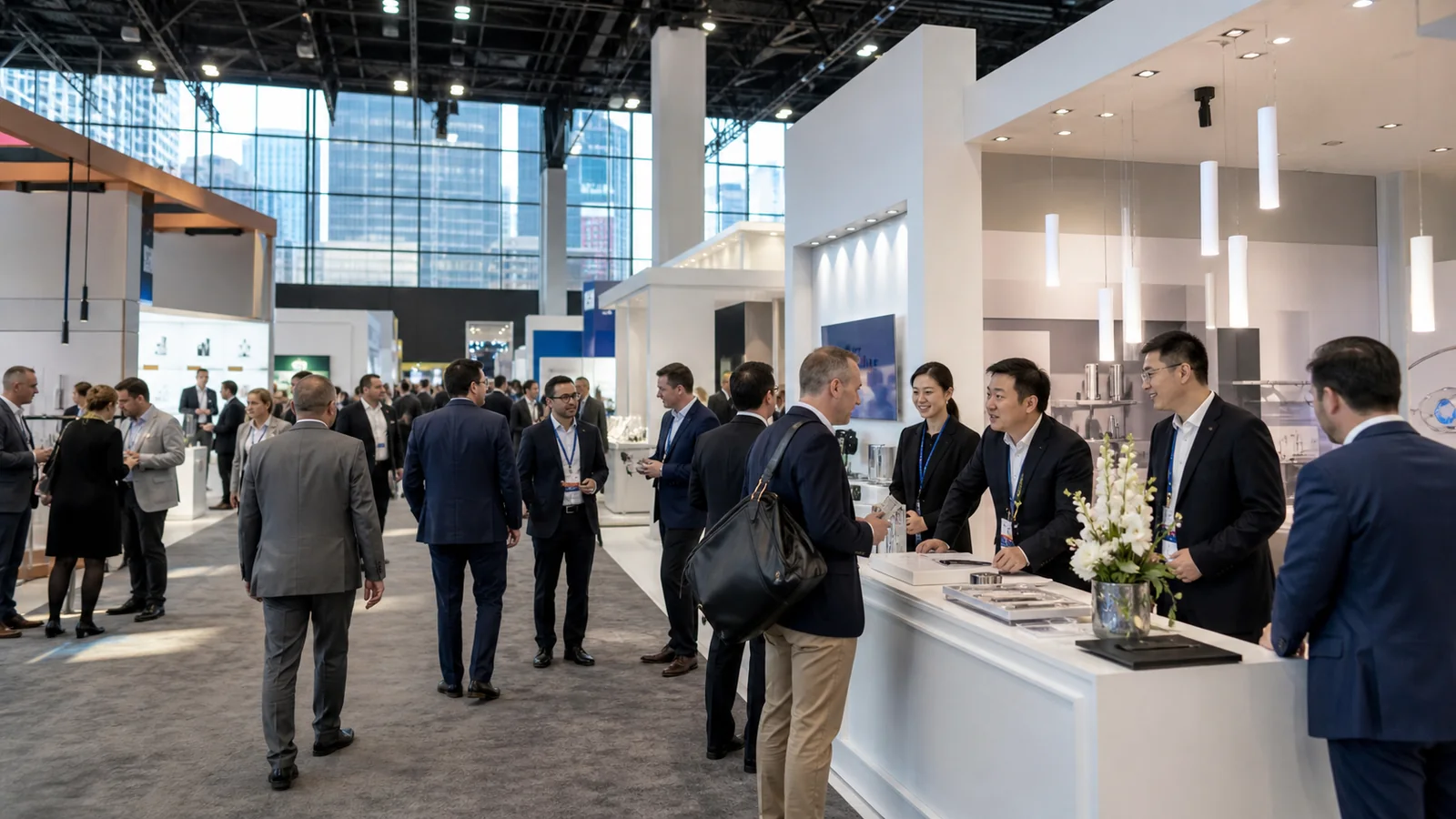
Experienced salespeople can still look unprepared in a booth. One person waits behind a counter, another takes over every conversation, and a promising visitor leaves without a clear owner. The problem is rarely a lack of product knowledge. Your team has not practiced how a visitor moves from the aisle to a useful conversation and then into follow-up.
This guide helps you train that movement. It gives you roles, exercises, floor rules and a practical session plan you can use before a U.S. trade show.
Define What the Booth Team Must Accomplish
Do not begin training with a company presentation. Begin with the job of the booth.

Write one primary outcome for the event. It might be to identify distributors in a new market, schedule product evaluations with qualified buyers, introduce a new machine to existing accounts, or collect technical requirements for later engineering review. A booth cannot treat every passerby as if they need the same conversation.
Then define what a successful visitor path looks like. For example:
- A staff member acknowledges the visitor without blocking the aisle.
- Two or three questions reveal why the person stopped.
- The visitor sees the most relevant product, proof point or demonstration.
- A specialist joins only when the conversation needs that expertise.
- The team records the reason for follow-up, the promised action and its owner.
- The visitor leaves knowing what happens next.
This path is more useful than a target such as “scan as many badges as possible.” A scan confirms that someone was present. It does not tell the next person why the contact matters or what your team promised.
Assign Floor Roles Before You Write Talking Points
A booth role is not the same as a job title. The vice president and a new account manager may both need to open conversations. An engineer may answer deep questions but should not automatically become the first person every visitor meets.
Use roles that describe the next action:
| Floor role | Main responsibility | Failure to prevent |
|---|---|---|
| Greeter/opener | Notice an approaching visitor and begin a relevant, low-pressure exchange | Visitors pass while staff talk to each other or look at phones |
| Qualifier | Learn the visitor's application, role, timing and reason for stopping | The team gives the same long pitch to everyone |
| Product or demo lead | Show the right product and control the demonstration | Every staff member tells a different product story or runs the equipment unsafely |
| Technical specialist | Join when the question needs deeper expertise | Engineers are trapped in early conversations that another person could handle |
| Meeting host | Protect and manage scheduled customer meetings | Appointments begin late, lack seats or are interrupted by walk-up traffic |
| Lead recorder | Capture the business issue, next action and owner | A badge scan arrives in the CRM with no usable context |
| Floor captain | Watch coverage, breaks, congestion and handoffs | Everyone assumes someone else is managing the booth |
One person can hold more than one role in a small booth, but each active conversation still needs a clear owner. On a larger stand, define zones as well as roles. The person responsible for a live demonstration should know who covers that zone when the demonstration ends or the operator takes a break.
Write the role plan by shift. “Sales team” is not a staffing plan. Names, times, positions and backup coverage are.
Teach Openings That Respond to the Visitor
Staff often receive one of two bad instructions: wait until someone asks a question, or stop everyone with a rehearsed pitch. Both ignore what the visitor is doing.

Train several short openings tied to visible behavior:
- If the visitor is studying a product: “What part of the system are you comparing?”
- If the visitor is reading a graphic: “Is that issue part of a project you are working on now?”
- If the visitor has watched part of a demonstration: “Would it help to see the changeover or the finished result?”
- If an existing contact arrives: use the person's name and the known reason for meeting rather than starting the standard introduction.
The exact words are less important than the pattern: observe, ask, listen. Do not make staff memorize a paragraph. Give them the product language and several ways to begin, then let them speak like themselves.
Also practice a respectful exit. Not every visitor fits the event goal, and not every conversation should continue while qualified buyers wait. A staff member should be able to answer a basic question, offer the appropriate public resource and close the exchange without making the person feel dismissed.
Qualify Only Enough to Choose the Next Action
Qualification on the show floor is not a full discovery call. The booth is noisy, people are standing, and another group may be waiting. The purpose is to decide what should happen next.
Choose four or five questions that reveal useful differences. Depending on your business, they may cover:
- the product, process or application involved;
- the visitor's role in evaluation or purchasing;
- the current solution and the problem that triggered the search;
- the expected project or buying window;
- the market, facility or region involved;
- the kind of proof or follow-up the visitor needs.
Do not fire all questions in a fixed order. Train the team to ask the next question because of the previous answer. A distributor exploring a new category, an engineer solving a performance problem and an existing customer asking for support should not be pushed through the same checklist.
Define simple routing categories before the show. For example: product demonstration now, technical specialist now, scheduled follow-up, distributor review, existing-account service, press or partner inquiry, and not a current fit. These categories should control an action, not become labels that disappear into a spreadsheet.
Rehearse the Demonstration and Its Handoffs
A booth demonstration is not a product training class. It must have a clear start, a visible result and a controlled finish.

Train the operator to answer four questions:
- What visitor problem makes this demonstration relevant?
- What should the visitor watch first?
- What proof can be seen, measured or compared?
- What is the next conversation after the demonstration?
Practice with realistic noise and interruptions. One team member should act as a visitor who arrives halfway through. Another should ask a technical question the operator cannot answer. The operator must be able to bring the late visitor into context without restarting everything and hand a deep question to the right specialist without abandoning the rest of the group.
Agree on a handoff sentence. “Let me introduce Maya, who works with this application” is better than pointing across the booth or saying, “She knows more than I do.” The first staff member should briefly state what has already been learned so the visitor does not repeat the whole story.
If equipment moves, heats, cuts, sprays, lifts, produces fumes or needs a safety boundary, training must use the approved operating procedure and the show's current demonstration rules. Do not improvise a safety method during booth rehearsal.
Decide What Makes a Lead Record Useful
Badge technology does not decide what your team needs to remember. Before training, define the minimum useful record.
At a minimum, the next person should be able to see:
- why the visitor stopped;
- the product or application discussed;
- one relevant condition, need or constraint;
- what your team promised to send or do;
- who owns the next action;
- when that action is due;
- any requested contact channel or communication permission that your process requires.
Avoid notes such as “hot lead,” “interested” or “send info.” They force the follow-up owner to reconstruct the conversation. “Plant engineer comparing washdown enclosures for a Q1 line upgrade; send material options and schedule a 30-minute technical call; owner: Luis; due Thursday” is actionable.
During practice, let one person conduct the conversation and another review the saved record. If the reviewer cannot draft a relevant follow-up without asking what happened, the record is incomplete.
Set Floor Rules That Remove Avoidable Friction
Most poor booth behavior is predictable. Make the rules explicit instead of hoping professional adults will interpret etiquette the same way.

Cover these points before travel:
- personal phones remain out of sight except for approved work use or emergencies;
- food, drinks, bags, coats and shipping materials go in the planned locations;
- staff do not form a closed circle or hold internal meetings at the aisle edge;
- one person does not interrupt and restart another person's conversation;
- handoffs include the visitor's name and the reason for the introduction;
- scheduled breaks happen before fatigue removes someone from the conversation mentally;
- no one makes pricing, delivery, technical or compliance promises outside their authority;
- photos, recordings, samples, giveaways and demonstrations follow the current show and company rules;
- the floor captain can move people or pause an activity when a zone becomes blocked.
Executives need the same rules. If a senior leader is present only for selected meetings, put those times and responsibilities in the shift plan. An important title does not make an unplanned person useful in a crowded 10×10.
Train in the Space You Will Actually Have
A conference-room briefing hides floor problems. Mark the booth footprint on the floor with tape, or use the assembled exhibit if it is available.
Place the real or representative counter, product, screen and demo positions. Mark open aisle sides, storage doors and areas that must remain clear. Then rehearse with the number of staff expected in that shift.
Run at least these scenarios:
- One qualified visitor arrives while the booth is empty.
- A second visitor arrives during a demonstration.
- A scheduled customer arrives while the meeting host is occupied.
- A technical question requires a specialist who is already speaking with someone.
- A visitor is friendly but not relevant to the event goal.
- A high-value conversation must be recorded while another group approaches.
- The lead scanner or network is unavailable.
- A staff member needs an unscheduled break.
Stop each scenario only when the visitor has a next step and the booth has returned to coverage. That last part matters. A good conversation can still leave the entrance unattended or the demo zone in disorder.
Use a Working Session, Not a Slide Marathon
A practical pre-show training session can follow this structure:

| Session block | What the team must produce |
|---|---|
| Event purpose and audience | One shared event outcome and the priority visitor groups |
| Booth walk-through | Agreement on entrances, zones, storage, demos and scheduled-meeting space |
| Role and shift review | Named owners, backup coverage and floor captain for each period |
| Product story | A short problem-to-proof explanation for each priority visitor type |
| Opening and qualifying practice | Natural questions and a clear routing decision |
| Demo and specialist handoff | A controlled demo plus a handoff that preserves context |
| Lead-record practice | A complete note, next action, owner and due time |
| Scenario rehearsal | Team performance under overlap, interruption and missing-resource conditions |
| Final rule check | Confirmed conduct, safety and organizer-specific boundaries |
Send product facts and event background before the session. Use shared time for decisions and practice. If the team spends the whole meeting listening to information that could have been read earlier, you have not tested whether they can work on the floor.
Coach Observable Behavior
Feedback such as “be more engaging” is too vague to use. Coach what another person can see or hear.
Useful feedback sounds like this:
- “You asked three questions without responding to the first answer. Use that answer to choose the next question.”
- “You stood between the visitor and the product result. Move to the side before the cycle begins.”
- “The handoff lost the application and timeline. Give the specialist those two facts before you leave.”
- “The note says ‘send brochure.’ Record which comparison the visitor asked for and who will send it.”
- “Four staff members remained at the counter while the open side was uncovered.”
Do not demand one personality. A quiet technical specialist can be excellent when the role and timing fit. Train consistent actions and accurate language, not identical performance styles.
Run a Short Daily Debrief
At the end of each show day, ask a small set of questions:

- Which opening led to useful conversations?
- Where did visitors become confused or leave?
- Which product question could the team not answer accurately?
- Did any zone, object or staff position block the next conversation?
- Are lead records complete and assigned before the team leaves?
- What one behavior or floor change will be tested tomorrow?
Fix missing facts, broken equipment, unclear ownership and repeated congestion immediately. Do not redesign the whole approach based on one unusual visitor. The best daily change is small enough for every shift to understand and execute the next morning.
Frequently Asked Questions
How long should trade show booth staff training take?
It depends on the product, team and booth program, but completion is a better standard than a fixed number of hours. The team is not ready until it can run the priority visitor scenarios, perform approved demonstrations, make clean handoffs and save usable lead records. Send background reading in advance and protect live time for rehearsal. A short session with repeated practice can be more useful than a long presentation.
Should every booth staff member know every product detail?
No. Everyone should know the event story, priority visitor groups, basic product boundaries and how to reach the right specialist. Deep expertise can be assigned. The important rule is that a staff member never invents an answer or abandons a visitor while looking for help. Practice the handoff and define how unanswered questions will be recorded.
How many people should staff a trade show booth?
Do not use one universal ratio. Count simultaneous activities and coverage positions: open aisle approaches, demonstrations, scheduled meetings, technical support, lead capture and breaks. Test that number in the actual footprint. If staff block the product and each other, reduce or rotate them. If one conversation leaves the entrance uncovered, add backup coverage or simplify the program.
Should booth staff use a script?
Use agreed product language, approved claims and several opening or handoff patterns, but do not force everyone to recite a paragraph. A rigid script makes it harder to listen and respond. Rehearse the same visitor situations with different wording and judge whether the staff member reaches the right next action accurately.
Who should own post-show follow-up?
Name the owner before the show and record that person on each qualified lead. The owner may be the booth contact, an account manager, a distributor manager or a technical specialist, depending on the promised action. Also define a due time and escalation route. “Sales will follow up” is not ownership.
Finish Training With a Floor-Ready Team Sheet
Your final staff sheet should fit the work people must do on-site. Include the event outcome, priority visitor groups, shift and role assignments, zone coverage, approved product claims, demo boundaries, specialist contacts, lead-record fields, break plan, daily debrief time and organizer rules that affect behavior.
The test is simple: when two visitors arrive and the planned specialist is busy, does everyone know what happens next? If the answer depends on improvisation, training is not finished. A strong booth team does not sound identical. It transfers attention, information and responsibility without making the visitor carry the conversation from one employee to another.