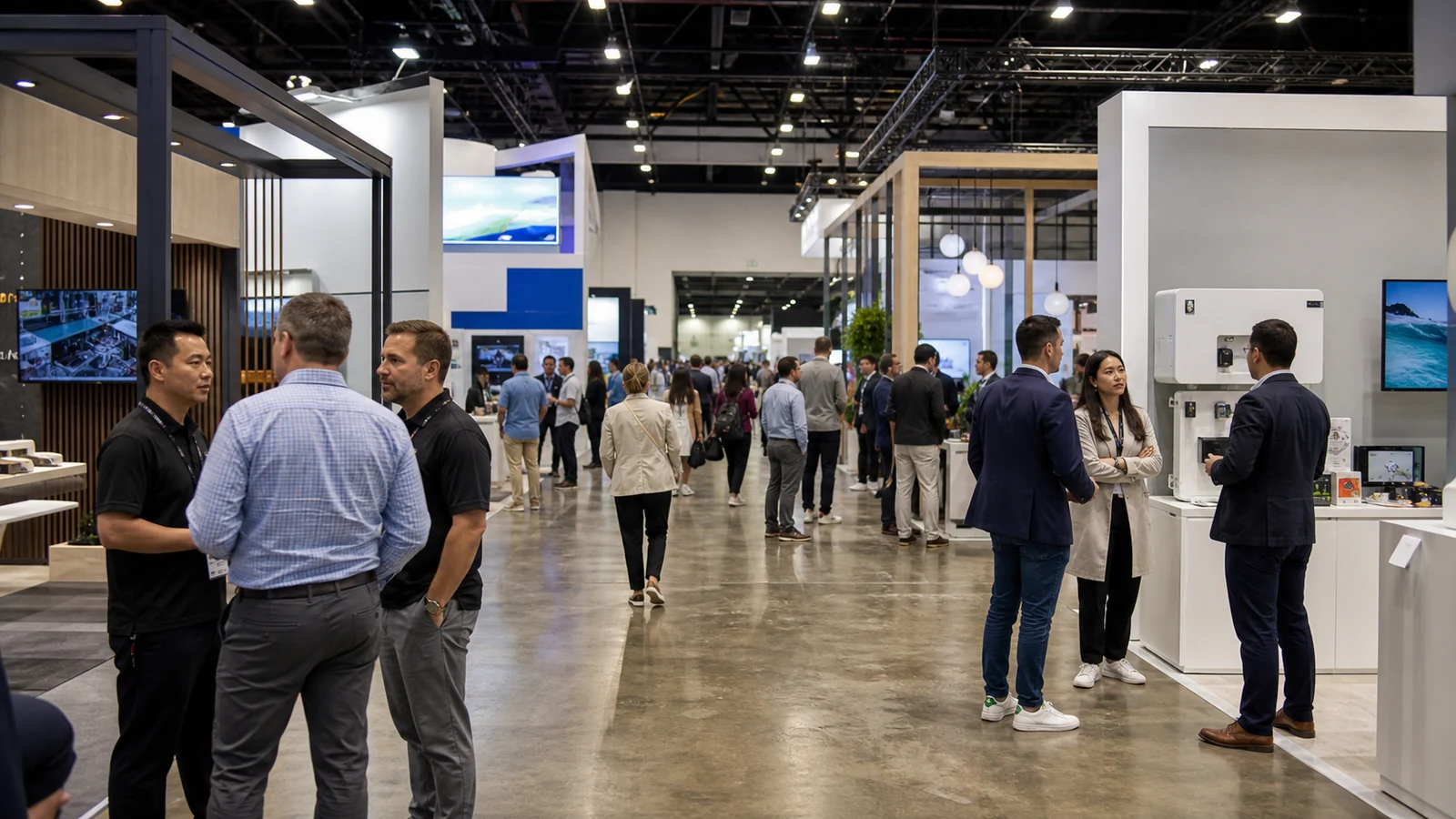
If you own a gift-ready consumer brand and are considering one 10-by-10 space, your immediate risk is not weak holiday décor. It is committing to five public selling days before you know whether your margin, stock, and team can recover the show's complete cost.
The Christmas Gift + Hobby Show is an Indianapolis consumer marketplace, not a wholesale gift trade show. This guide gives you the confirmed 2026 dates, rates, and operating rules, plus a practical go, pause, or skip test before you pay for space or commission a booth.
The event facts and vendor rules below were checked on September 8, 2026. Dates, rates, space availability, and operating instructions can change, so reopen the organizer's current pages and contract before paying or approving a booth build.

What Is Confirmed for the 2026 Show?
The official event website and the Indiana State Fairgrounds event page confirm the 2026 edition. Use the published information for initial screening, then obtain a current written quote and contract before you commit.
| Planning item | Confirmed 2026 edition |
|---|---|
| Dates | November 11–15, 2026 |
| City and venue | Indianapolis; Indiana State Fairgrounds & Event Center, West Pavilion |
| Published 10-by-10 space rate | $1,079 before required and conditional charges |
| Vendor rules | 2026 vendor kit is available |
| Planning use | Can support a go/pause/skip decision after a current written quote |
Prioritize the 2026 show only when your category, written total, inventory, staffing, and production window are workable. If any of those inputs remain unresolved, choose PAUSE until you have enough written evidence to make a responsible commitment.
What Is the Christmas Gift + Hobby Show?
The 2026 Indianapolis Christmas Gift + Hobby Show runs from Wednesday, November 11 through Sunday, November 15, at the Indiana State Fairgrounds & Event Center. The fairgrounds' event page places it in the West Pavilion. The organizer, Marketplace Events, lists it among its consumer shows, and the official event website is built around tickets, shopping features, a vendor list, and exhibitor information.
Those signals matter more than the word “show.” This is a public retail environment where shoppers compare products, make purchases, and look for holiday ideas. It is not a restricted business-to-business sourcing floor. If your goal is to collect wholesale appointments, meet national retail chains, or demonstrate an industrial product to technical buyers, the audience model is probably wrong even if your booth looks polished.
Public hours span five days:
| Day | Public hours |
|---|---|
| Wednesday, November 11 | 10:00 a.m.–7:00 p.m. |
| Thursday, November 12 | 10:00 a.m.–7:00 p.m. |
| Friday, November 13 | 10:00 a.m.–8:00 p.m. |
| Saturday, November 14 | 10:00 a.m.–8:00 p.m. |
| Sunday, November 15 | 10:00 a.m.–5:00 p.m. |
That is 45 public selling hours before setup, replenishment, and teardown. A one-person business should not treat this like a weekend craft market. You need a staffing plan that covers breaks, checkout, product questions, stock resets, and closing procedures without leaving the booth unattended.
Is This Show a Good Fit for Your Business?
Start with the transaction you expect to happen at the booth. A suitable exhibitor can explain the product quickly, show a clear retail price, take payment on the spot, and hand over the item or arrange a simple delivery. The product also needs enough contribution margin to absorb the event-specific cost.

The official vendor list shows a broad retail mix. It covers fashion and beauty; art, books, food, children's and pet items; gifts, gadgets, jewelry, and home or holiday décor; plus services. These categories describe the marketplace, but they do not guarantee acceptance or sales for another brand. Ask the show team whether your exact product category is currently being accepted and how similar products are handled.
Your fit is stronger when:
- you already sell directly to consumers and know your retail margins;
- a shopper can understand the product and its gift value within a few seconds;
- you can carry or replenish enough stock for five days;
- your price points support quick purchases or a clear order process;
- your team can staff the full schedule and maintain the display each day.
Pause when the product needs a long technical consultation, custom engineering, wholesale negotiation, or a large installation before a buyer can commit. Those businesses may still gain awareness, but the show has not published evidence that it will deliver the business buyers they need. Do not use a consumer crowd as a substitute for verified buyer fit.
What Does a 10-by-10 Booth Cost Before Travel and Inventory?
The official 2026 booth-rate page lists vendor space at $10.79 per square foot, or $1,079 for a 10-by-10 space. It also lists a required $25 charge for one 500-watt outlet and a required $149 vendor listing. Adding those published line items produces a $1,253 starting floor. If the listed $100 new-vendor charge applies to you, that floor becomes $1,353.

This is a calculation from the public rate sheet, not a quote. It does not include every cost. The same page lists a $200 corner charge, a $425 island premium, and a $150 direct-sale/demo fee, plus separate crafter, bulk, and storage rates. Ask which charges apply to your product and selling method, then obtain a written total.
Build your decision from a full cost sheet:
| Cost group | What to confirm |
|---|---|
| Contracted show charges | Space, location premium, vendor listing, power, direct-sale/demo fee, storage, badges, parking, and taxes |
| Required presentation | Flooring, properly skirted tables, holiday décor, lighting, signage, fixtures, and hidden stock storage |
| Operations | Staff pay, hotel, meals, local transport, internet, and daily replenishment |
| Product movement | Freight or vehicle cost, material handling, packaging, returns, damage, and unsold inventory transport |
| Risk protection | Insurance, permits, food or alcohol approvals, fire-safe materials, and a contingency for replacement items |
The decision number is not gross sales. Define total show-specific cost as the fixed and incremental event cost on your budget, excluding product cost and expenses that vary with sales. Calculate the contribution-margin rate after product cost, transaction fees, and other sales-related variable costs. Then divide total show-specific cost by that rate, counting each cost only once.
Required event sales = total show-specific cost ÷ contribution-margin rate
Use your own verified margin. If you cannot state the sales threshold and the number of units needed to reach it, you are not ready to call the event worthwhile.
Which Show Rules Change the Booth Plan?
The 2026 vendor kit contains several requirements that directly affect design and cost.

First, flooring is mandatory and must cover the full booth. It is not included with the exhibit space. The kit also requires properly skirted tables, with inventory and personal items stored out of sight. A plan based on bare concrete, an uncovered folding table, and visible cartons will not meet the published presentation standard.
Second, Christmas decorations are mandatory. Treat that as a design requirement, not permission to fill the booth with unrelated props. Your holiday layer should help shoppers see the product, price, and gift use. If the decoration hides merchandise, narrows the entrance, or makes the brand unreadable, it works against the sale.
Third, the kit describes an 8-foot draped back wall, 3-foot side rails, black drape, and green aisle carpet. Tables, chairs, and spotlights are not included. Measure every shelf, counter, sign, tree, stock bin, and staff position inside the assigned footprint. A fixture that projects into the aisle or blocks the checkout position needs to be changed before arrival.
Finally, the listed 500-watt outlet is not a blank check for lighting and equipment. Write down the rated load for each light, display, charger, checkout device, heater, or demo unit. Ask the official electrical contact what must be ordered when the total exceeds the included arrangement. Do not ask a booth builder to guess what the venue will approve.
Can Your Team Handle the Move-In and Five-Day Schedule?
The 2026 kit provides move-in windows from Sunday, November 8 through Tuesday, November 10. It states that move-in must be complete by 8:00 p.m. Tuesday and that Wednesday-morning setup is not allowed. Large items also need to be inside before the point when driving on the show floor is prohibited.
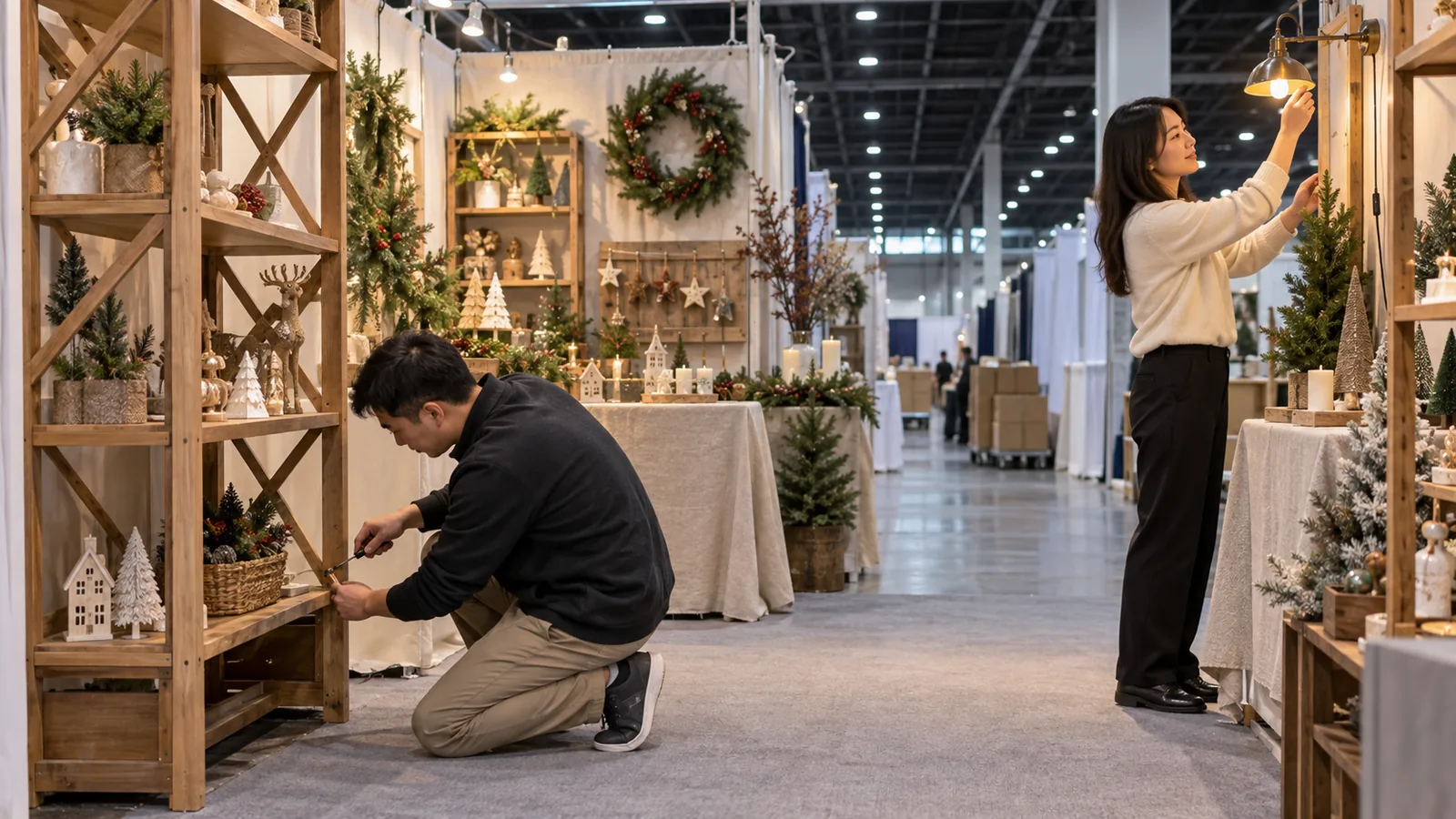
This timeline favors a booth that can be assembled, stocked, tested, and corrected before Tuesday night. Build a setup sequence rather than arriving with a collection of fixtures:
- Mark the footprint and install the required floor covering.
- Set the backwall, counters, shelves, and approved decorations.
- Route power without creating a customer or restocking hazard.
- Place the lead products, then hidden replenishment stock.
- Test pricing visibility, checkout, lighting, and the approach from the aisle.
- Photograph the finished booth so each shift can reset it to the same standard.
Move-out begins only after the Sunday show closes and management authorizes removal. The kit also provides a Monday move-out window. Decide who remains responsible for sales, cash and devices, packing, and load-out. The people who have worked the public floor all week may not be the safest team for a rushed teardown.
What Should You Confirm Before Signing?
The public pages provide enough information for a first screen, but not enough for a final commitment. Contact the official show team and put the answers in writing.
Confirm:
- whether your exact product category and selling method are accepted;
- the available booth sizes and locations;
- every mandatory and conditional charge;
- what the contracted package includes;
- insurance, permit, sampling, demonstration, and electrical requirements;
- move-in access for your vehicle, freight, or oversized pieces;
- cancellation, payment, and renewal terms;
- any current rule that is not yet reflected in the public vendor kit.
Do not approve custom booth production from a marketing page alone. The signed contract, assigned footprint, current vendor kit, and written approvals should control the brief.
How Should a Consumer-Sales Booth Work Here?
This show asks the booth to sell, not just introduce the company. From the aisle, shoppers should be able to answer three questions: what is it, who is it for, and what does it cost?

Choose one product group to carry the main visual message. Give it enough space to be understood, then organize supporting products by gift recipient, use, or price in a way your customers already recognize. Avoid presenting every item at the same visual weight. A crowded wall can make a large inventory look smaller because no product earns attention.
Keep the checkout point visible but out of the main browsing path. Small, high-value products need controlled placement. Fragile products need a handoff area. Food or live demonstrations need the organizer's current approval and enough space to prevent a queue from closing the booth entrance.
The five-day format also changes storage. Put daily replenishment within reach without exposing cartons, bags, coats, or personal items. Use a simple stock record so the team knows what sold, what needs to be brought back, and which product earned attention without converting. That record is more useful for a renewal decision than a general impression that the floor felt busy.
Make a Go, Pause, or Skip Decision
Choose GO when the audience model fits your direct-to-consumer channel, the organizer confirms your category and total charges, your required sales threshold is credible, and your team can deliver the inventory and 45 public hours.
Choose PAUSE when you still need written answers about eligibility, total price, food or demo rules, power, insurance, freight access, or staffing. A pause is cheaper than designing around an assumed booth package.
Choose SKIP when your real objective is wholesale sourcing, distributor recruitment, or enterprise lead generation, or when the unit economics require an unsupported attendance or sales forecast. A famous local event can still be the wrong sales channel for your business.
Frequently Asked Questions
How can you use the online vendor listing before the show opens?
The vendor kit says contracted vendors receive an online listing that can be updated and enhanced. Use it to show current products, prices or ranges, contact details, and the booth location once assigned. Match those details to the physical display, and use the organizer's current marketing assets when inviting your own customers instead of creating an unofficial Facebook event.
What should an international vendor confirm before applying?
Confirm with the organizer and qualified advisers who may sell, collect payment, import stock, handle sales tax, and carry required insurance. Product labeling, food, cosmetics, electrical items, and other regulated goods may create additional obligations. A booth contractor can plan around written requirements, but cannot decide your legal or product-compliance status.
Can a vehicle or oversized holiday display be part of the booth?
The vendor kit says vehicles used in an exhibit require show-management approval and advance placement on the floor plan for fire-marshal review. Oversized scenic or holiday elements may also affect egress, materials, power, and installation. Submit dimensions, materials, weight, fuel or battery details, and the intended position before production.
Do you need to collect Indiana sales tax at the show?
The current vendor kit lists local Indiana sales tax as 7% and links vendors to retail-merchant and tax forms. Your actual registration, collection, filing, and product-taxability duties depend on your business and goods. Confirm them with the Indiana Department of Revenue or a qualified tax adviser; neither the organizer nor a booth contractor should make that decision for you.
What should you confirm if the organizer changes your booth location?
Ask whether the revised location changes your footprint, open sides, neighboring categories, utilities, visibility, move-in access, service deadlines, or charges. Obtain the new assignment and floor plan in writing. Do not approve graphics, freight, electrical orders, or custom fixtures until you have checked the updated location against your layout and contract.
Final Thoughts
The Christmas Gift + Hobby Show is worth a closer look when you are ready for five days of direct consumer selling and can justify the complete cost with your own retail economics. Confirm the category, contract, footprint, and operating rules before you treat the event as a booth-design project.
KingExhibits is a U.S. trade show booth design and rental company, not the show organizer or venue. If the event passes your commercial screen, send the team your confirmed show documents, assigned booth size and location, product range, display or demonstration needs, staffing plan, and budget boundary; ask for a planning discussion around those inputs, then compare the proposed layout with the current organizer and venue rules before approving production.