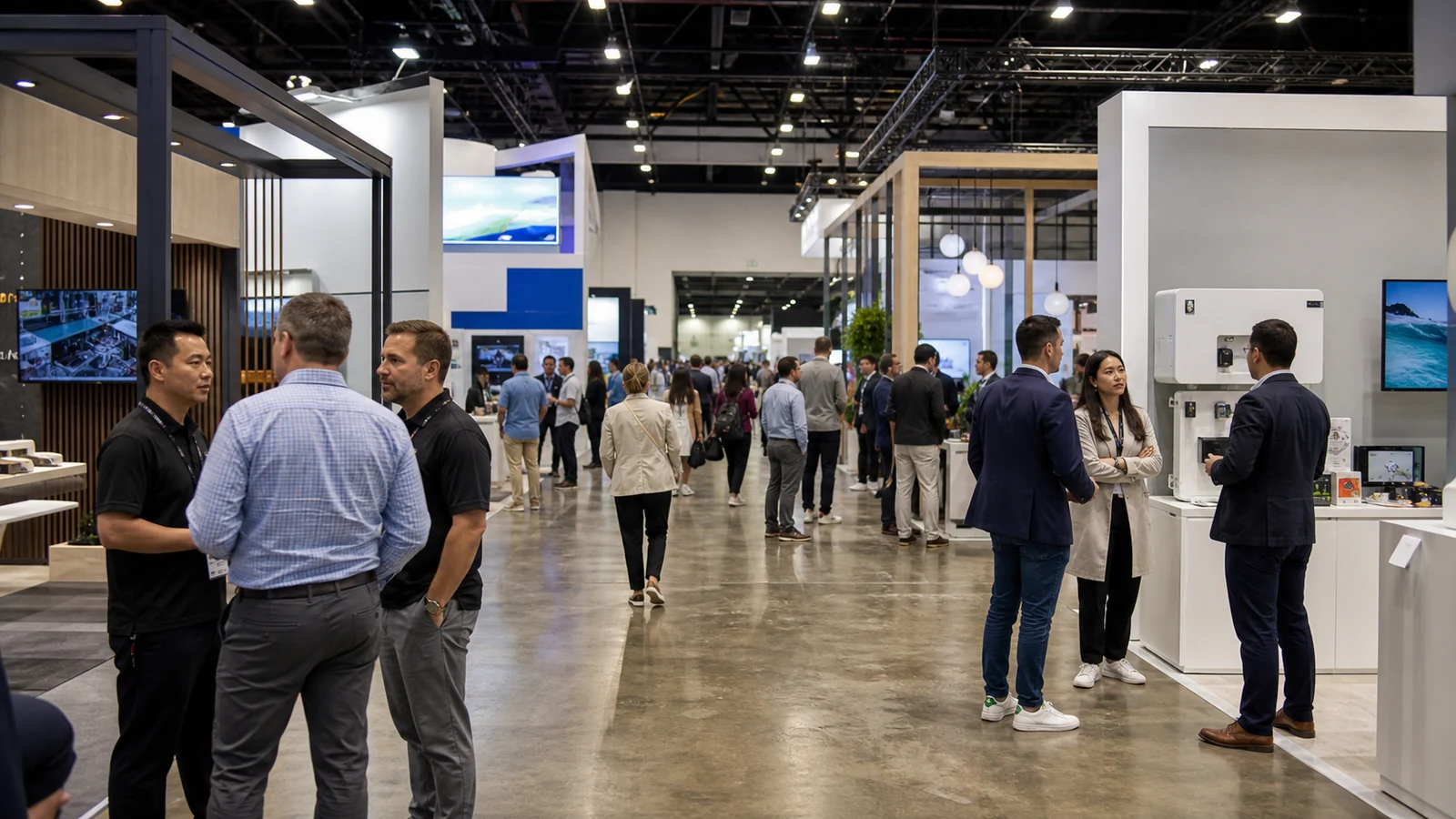
If you are considering Affordable Art Fair for your gallery, the first decision is not how your stand should look. It is whether you are choosing a future fair or producing a stand for an edition where your gallery has already been accepted. Those are two different jobs, with different information and deadlines.
As of September 7, 2026, the next U.S. edition is Affordable Art Fair New York Fall, September 16–20. Houston follows October 15–18, and Boston October 22–25. Austin is set to return in May 2027, with exact dates still to be announced. This timing gives accepted 2026 exhibitors a short production window, while galleries considering a first application can use the same calendar to choose a more realistic edition.
This guide explains what the fair currently publishes about its U.S. editions, who can express interest, and what your gallery needs to settle before committing artists, budget, and stand production.
What Affordable Art Fair Is—and What “Affordable” Means for an Exhibitor
Affordable Art Fair is an international series of contemporary art fairs. Its public message is aimed largely at collectors: visitors can discover original work from local, national, and international galleries in a more approachable buying environment. For an exhibitor, however, the important point is that this is a curated, gallery-led fair rather than an open vendor market.
The organizer’s current exhibiting criteria say its fairs are open to galleries and established artist collectives. Artists must be living and over 18. Works must be original, or fall within the published edition limits for sculpture, prints, and photography; reproductions are not allowed. Each fair also applies a price ceiling. The current U.S. fair pages for New York, Houston, and Boston advertise work from $100 to $12,000, but you should confirm the exact ceiling and any display requirements for the edition in your application or exhibitor documents.
Meeting these basic criteria does not guarantee acceptance. The official process starts with an expression of interest. If the gallery appears to meet the criteria, it may be invited to apply, after which a selection committee reviews the submission. The organizer also says that a work or presentation accepted at one fair may not be accepted at another because the curatorial mix differs by edition.
That distinction should shape your planning. Before acceptance, prepare a credible gallery and artist submission. After acceptance, develop the physical presentation around the approved artists, current stand allocation, and current organizer rules.
The U.S. Affordable Art Fair Calendar After September 7, 2026
| U.S. edition | Current official date | Venue | Status on September 7, 2026 | What the status means for a gallery |
|---|---|---|---|---|
| New York – Fall | September 16–20, 2026 | Starrett-Lehigh Building, 3rd Floor, 601 West 26th Street, New York, NY | Announced and less than two weeks away | Practical planning is now mainly for accepted exhibitors. A new applicant must ask the fair team whether any opportunity remains. |
| Houston | October 15–18, 2026 | George R. Brown Convention Center, 1001 Avenida De Las Americas, Houston, TX | Announced inaugural edition | There is no prior Houston edition to use as a performance baseline. Separate organizer promotion from evidence your own gallery can verify. |
| Boston | October 22–25, 2026 | SoWa Power Station, Harrison Avenue, Boston, MA | Announced second edition | A returning event has some prior operating history, but your decision still needs current application, stand, and audience information. |
| Austin | Coming May 2027 | Exact 2027 venue and dates not shown on the current global fairs page | Return announced; exact dates pending | Treat it as a future planning option, not a confirmed travel or production booking. Register for updates or contact the fair team before reserving around assumed dates. |
The organizer operates fairs outside the United States as well, but this guide focuses on the U.S. editions. If your gallery is comparing London, Hong Kong, Singapore, or another international edition, use that fair’s local criteria, price ceiling, tax, shipping, and stand documents rather than applying U.S. assumptions.
Which U.S. Edition Fits Your Gallery?
Based on what is publicly confirmed as of September 7, the choice can be narrowed. If your gallery is not yet accepted, Austin 2027 is the clearest announced U.S. edition with a useful planning runway, although its exact dates remain pending. The three remaining 2026 fairs are now practical choices mainly for galleries already in the organizer’s process. If you are choosing among editions, use this decision rule:
| Edition | Best fit now | Poor fit now | Practical decision |
|---|---|---|---|
| New York Fall 2026 | An accepted gallery with its artwork, stand, delivery, and staffing already under control—and a presentation that can remain distinct among more than 90 galleries | A new applicant or a gallery still changing its roster and production plan | Treat it as an execution choice, not a speculative late application. |
| Houston 2026 | A gallery with a real Texas outreach plan that is willing to test an inaugural edition without same-fair history | A gallery that needs prior exhibitor results before entering a market | Choose it as a higher-uncertainty market test, supported by your own contacts and follow-up. |
| Boston 2026 | A gallery that wants at least one prior edition to inspect before committing, and can still justify the trip from its own roster and client plan | A gallery that requires mature, multi-year attendance or sales evidence | It offers more evidence to review than Houston, but remains an early-stage fair. |
| Austin 2027 | A not-yet-accepted gallery that needs time to build its application, curatorial proposal, budget, and U.S. logistics | A gallery that must lock exact travel, freight, or installation dates now | It is the clearest future planning choice, but not yet a fixed production booking. |
This is a timing-and-evidence decision, not a prediction of sales. The public fair pages do not provide comparable gallery results across the four cities.

Affordable Art Fair NYC 2026: for accepted, production-ready galleries
The current New York Fall page lists more than 90 local, national, and international galleries and two annual New York editions. That gives an accepted gallery a current exhibitor list it can review before finalizing its wall story. Look for overlap in medium, price band, scale, and artist positioning. The goal is not to imitate another stand. It is to see whether your presentation has a clear reason to stop when visitors have many galleries to compare.
With the public opening only days away on September 7, an accepted gallery should now be working from one production pack: the approved artwork list, final stand drawing, organizer’s wall and lighting specifications, label files, storage plan, delivery booking, installation schedule, and move-out instructions. Mark which fixtures and services the organizer supplies, then assign the remaining items to named owners. If your gallery is not part of the 2026 edition, ask the New York team about a later application before committing to stand production.
Houston: for galleries comfortable testing an inaugural edition
Houston is scheduled to launch at the George R. Brown Convention Center in October 2026. A first edition can offer a gallery a new market entry, but it also removes one source of evidence: there is no earlier Affordable Art Fair Houston exhibitor list, on-site operation, or exhibitor result to study.
The organizer’s Houston exhibitor guide describes the city and audience in favorable terms. Treat that as the organizer’s market positioning, not proof of how your own artists will perform. Ask what current applicant mix, promotional plan, visitor acquisition, collector programming, stand options, and included services can be shared. Houston fits best when your gallery already has a credible Texas outreach and follow-up plan and is willing to judge a first edition as a controlled market test. If your approval depends on previous exhibitor results from the same fair, choose a later edition instead.
Boston: for galleries that want some prior-edition evidence
Boston returns to SoWa Power Station after its 2025 launch. The official page presents local, national, and international galleries and a mix of emerging and established artists. For a gallery, the practical advantage over a launch edition is that you can inspect the previous fair’s exhibitor list, public programming, and visible stand environment before making assumptions about fit.
That history is still limited. Do not turn “second edition” into a guarantee of stable attendance or sales. Choose Boston over Houston when your gallery requires at least one previous edition to review, but do not choose it if your approval depends on mature, multi-year performance data. The final case must come from your roster, price range, client list, staffing, and current organizer package.
Austin 2027: for galleries that need a longer planning runway
The organizer currently says Austin will return in May 2027. It does not publish exact 2027 dates on the global fairs page. This makes Austin useful for an early pipeline decision—whether to express interest and begin curatorial planning—but not for locking travel, freight, or installation dates.
For a gallery that has not entered a 2026 edition, Austin is the clearest announced U.S. option to plan toward. Use the waiting period to decide which artists and works could form a coherent presentation, gather recent images and dimensions, and identify what you need to learn from the organizer. Keep travel and the physical stand flexible until exact dates, the official allocation, and the exhibitor manual arrive.
Understand the Affordable Art Fair Application Before You Design the Stand
The official expression-of-interest process asks which fairs interest you and collects information about your organization, how you currently sell art, previous art-fair participation, and the art you represent. It is not the final application. If the organizer considers the gallery eligible, it will invite a formal submission for committee review.
Your first package should therefore make the curatorial proposal easy to understand. Show the artists you actually intend to bring, representative works, dimensions, media, editions, and price bands. Explain how those artists form one gallery presentation rather than a loose inventory. The official exhibitor FAQ recommends at least three images per artist and says the number of artists should make sense for the requested stand size. Use the current application instructions as the authority if they differ.
Do not design around an assumed booth before you know the stand size, wall system, included lighting, and accepted roster. A beautiful concept can become unusable if it depends on unsupported wall loads, prohibited fixings, extra power, or storage the package does not include.
Turn an Accepted Curatorial Plan Into a Workable Stand
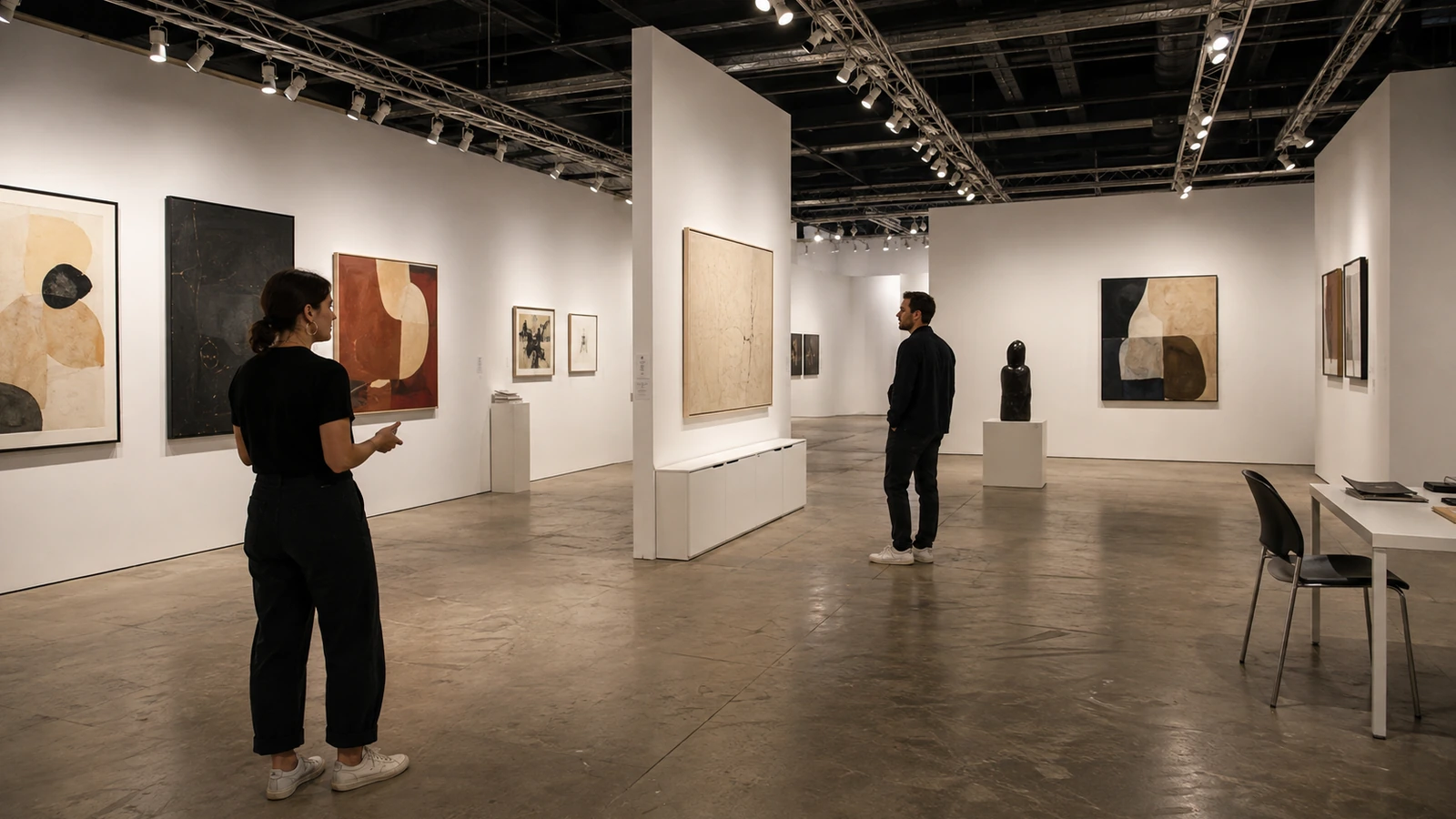
Once accepted, treat art fair booth design as the translation of your curatorial plan into a physical visitor sequence. Art-fair visitors may enter from either side of an aisle and make quick comparisons. Your stand needs a visible opening idea, a reason to step closer, and enough calm space to discuss a work without blocking the entrance.
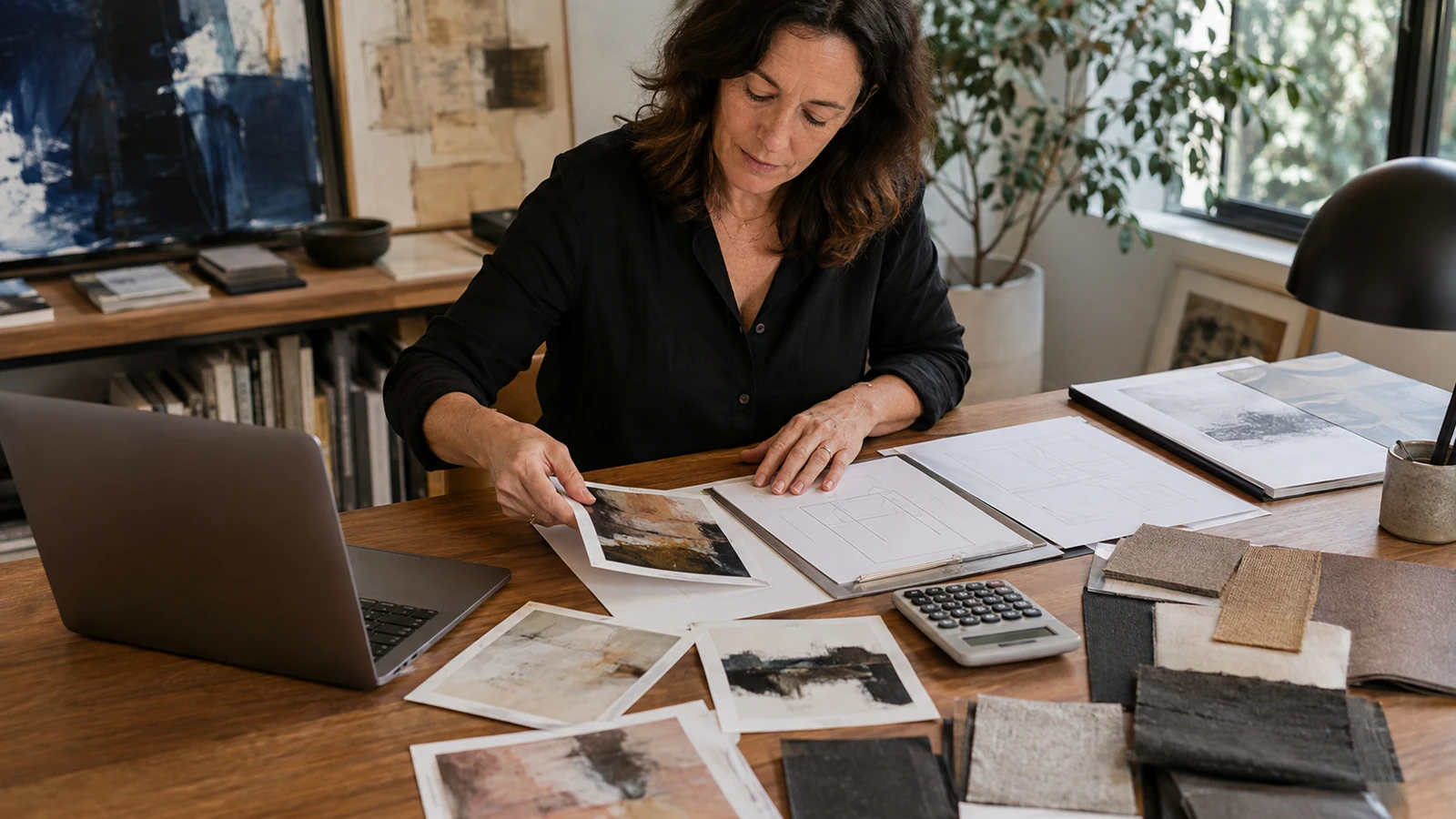
Start with the exact stand plan and an artwork schedule. For every piece, record the artist, title, medium, framed size, weight, price, edition information where relevant, wall or plinth location, packing method, and replacement plan if the work sells. This is more useful than a mood board alone because it connects curation to wall capacity, labels, lighting, storage, and replenishment.
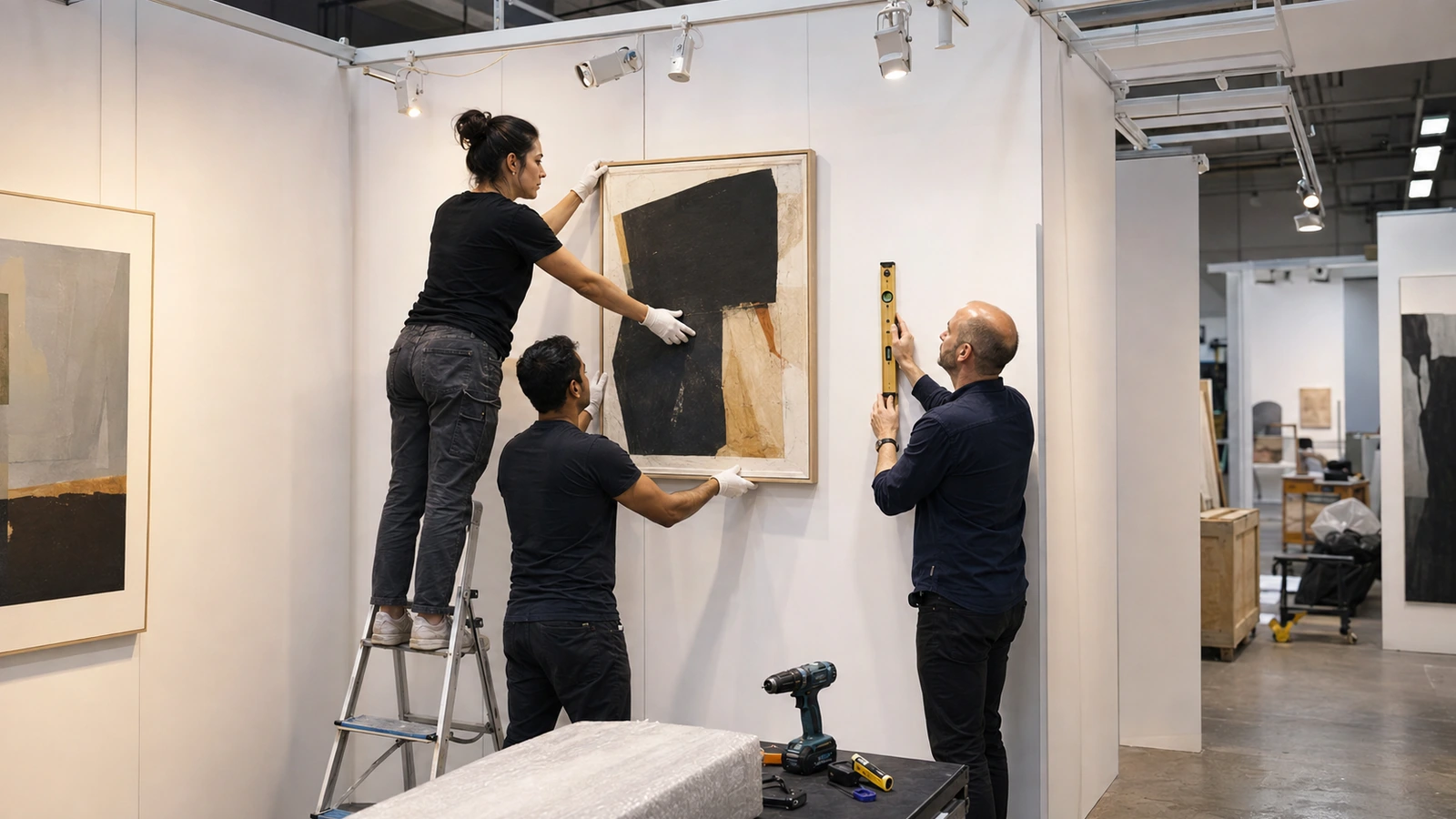
Then test the presentation at actual scale. A stand can look balanced on a laptop while labels collide, small works disappear, or a desk interrupts the best viewing distance. Mark the wall widths and major work sizes in elevation drawings. Confirm heavy or projecting works with the organizer before specifying fixings. If sculpture is included, check the footprint, visitor clearance, stability, and whether a plinth is supplied or must be provided.
Lighting deserves the same discipline. Do not assume that a standard package gives every work the right beam angle, color quality, or power position. Ask for the supplied fixture schedule and electrical rules, then map each key work to an actual fixture. Any supplemental lighting or AV element should be approved before production.
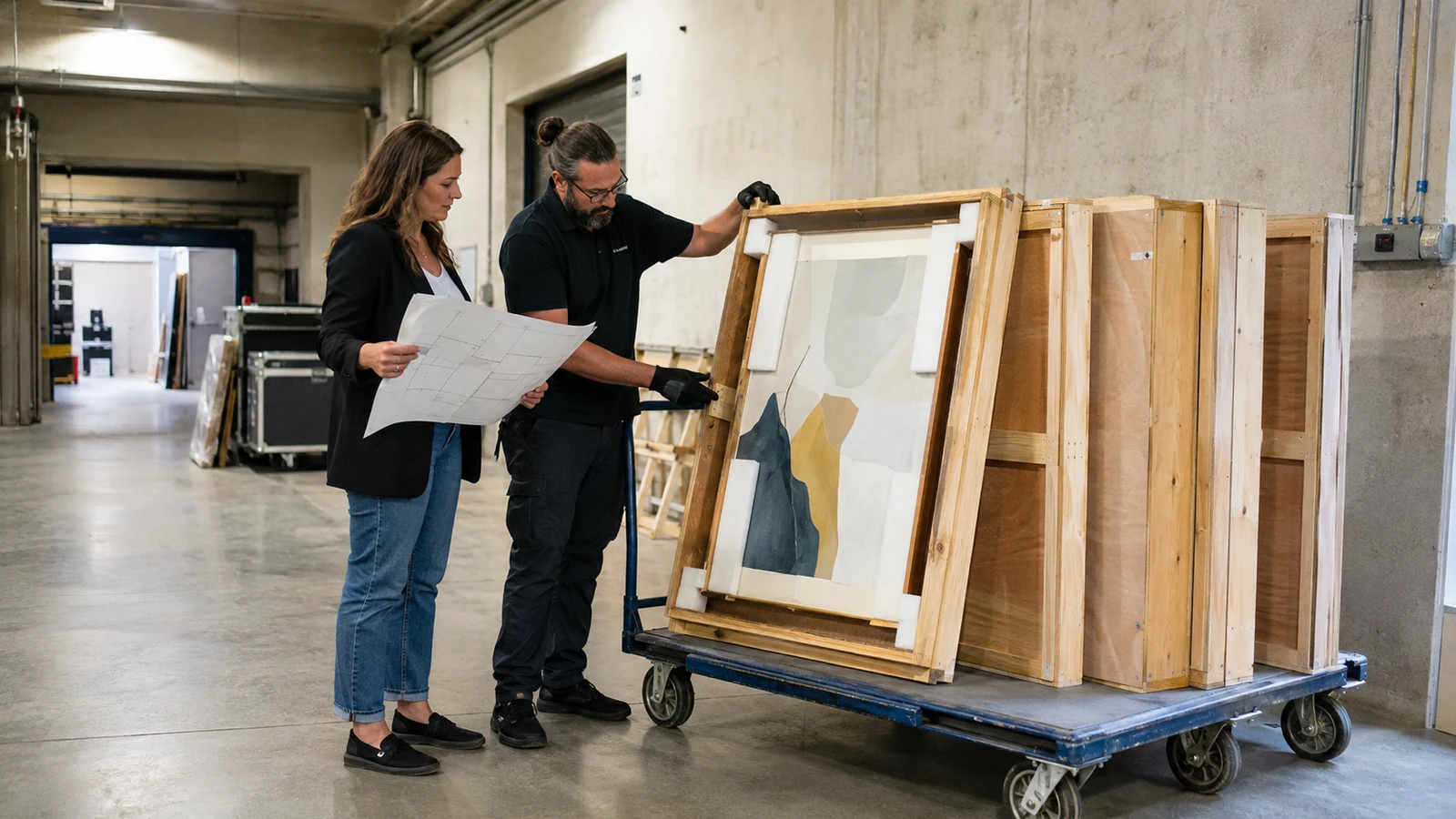
Finally, plan the working layer visitors should barely notice: secure storage for packing and personal items, access to sales materials, card-processing needs, sold-work labeling, wrapping or collection procedure, and a replenishment route. Confirm who may handle artwork, when replacement stock can enter, and what must happen at close each day. These details belong in the current exhibitor manual or a written organizer answer.
Questions to Resolve Before You Commit
Ask the Affordable Art Fair team for the edition-specific answer to each of these questions:
- Is the gallery eligible, and is the relevant application window still open?
- Which artists and works are accepted, and what changes require renewed approval?
- What stand sizes and locations are available, and what is included in the fee?
- What are the wall construction, finish, height, load, and fixing rules?
- Which lighting, electrical, furniture, signage, Wi-Fi, cleaning, and storage services are included or optional?
- Who controls artwork delivery, material handling, installation, replenishment, packing, collection, and move-out?
- What insurance, tax, accessibility, and sales-operation documents must the gallery provide?
- Which deadlines appear in the current exhibitor portal, and who can approve an exception?
If these questions are unanswered, your stand plan is not ready for production. Keep every unknown item visibly unresolved until the current exhibitor manual or the organizer gives you a written answer.
FAQ
Can an individual artist apply without a gallery?
The organizer says its fairs primarily accept galleries, dealers, and established collectives. Some editions may consider solo-artist presentations, but the policy differs by fair. Ask the specific fair team rather than assuming a rule from another city.
Is the stand fee published online?
The public expression-of-interest page says the fair team will provide stand costs and application details to eligible prospects. Because fees, sizes, and inclusions can change by edition, obtain the current written package directly from the organizer.
Does Affordable Art Fair insure a gallery’s artwork?
The public exhibiting pages reviewed for this guide do not establish blanket insurance for a gallery’s property. Obtain the current exhibitor terms, identify who carries risk during delivery, installation, show days, packing, and collection, and confirm the required transit and exhibition cover with your insurer. Venue security should not be treated as artwork insurance.
Can a gallery use its own contractor to install the stand?
Do not assume it can. The organizer, venue, or appointed suppliers may control particular services or require contractor registration, insurance, work passes, labor coordination, or advance approval. Ask the fair team to identify exactly which work your contractor may perform before you sign a build or installation agreement.
Does an overseas gallery need a U.S. display partner?
Not in every case. If the organizer’s stand package already covers the physical display you need, the gallery may only need local help with approved additions, artwork delivery, or on-site coordination. A U.S. partner becomes more useful when you need fabrication, supplemental fixtures, storage, multiple suppliers, or a local party to control production and installation details. Confirm organizer permissions first.
Final Thoughts
If you are already accepted for a 2026 U.S. edition, bring the current stand drawing, approved artwork list, supplied-service schedule, deadlines, and handling rules into one working plan. If you are still evaluating participation, choose the city you can support with the right artists, client outreach, shipping, staffing, and follow-up before beginning the organizer’s application process.
A coherent art-fair stand starts with the curatorial plan and the organizer’s rules, not a decorative concept. If you need help turning those approved inputs into a buildable U.S. display, KingExhibits can review the stand package with you and identify the design, production, and on-site scope that still needs to be resolved.