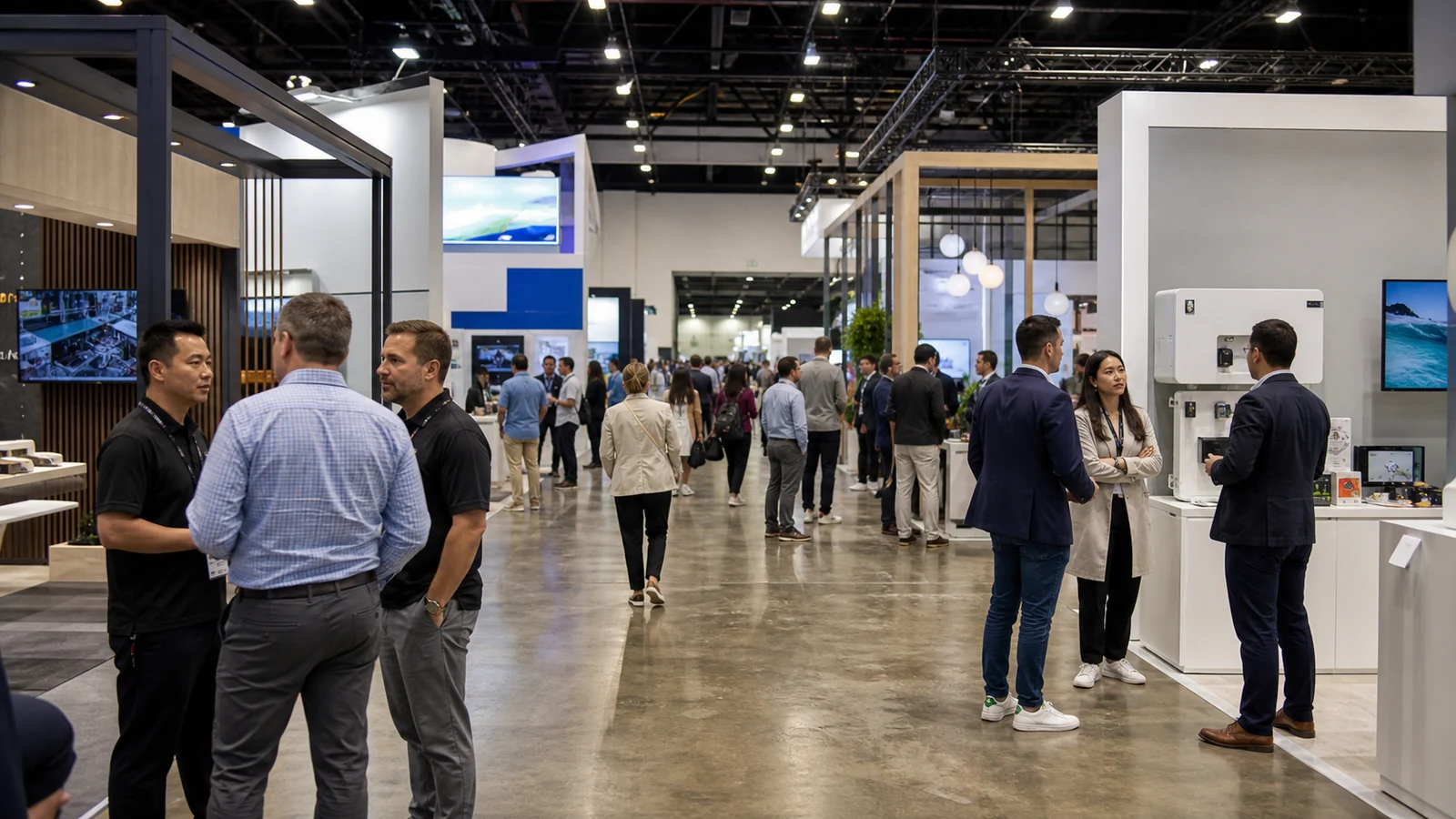
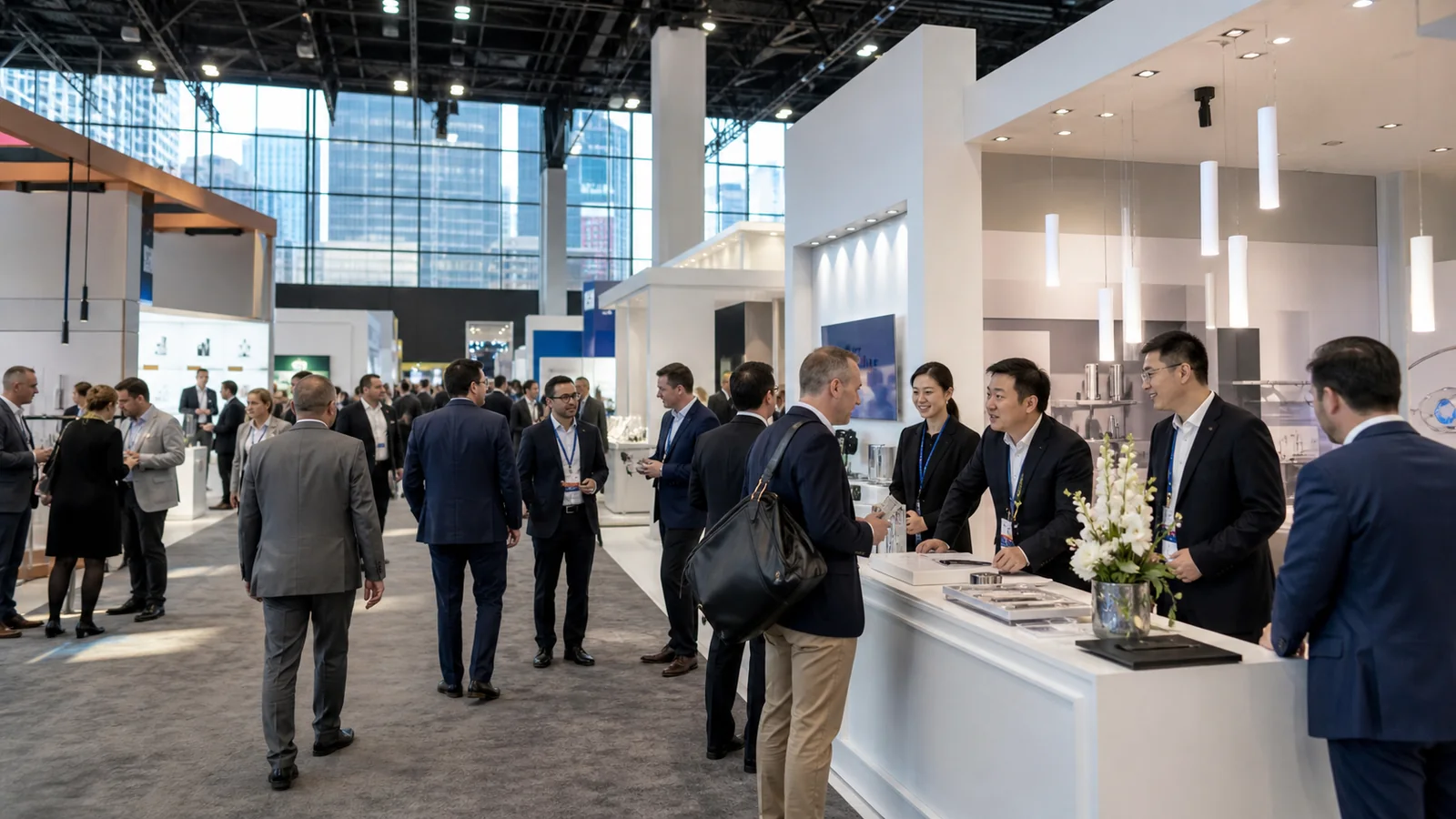
Event marketing and experiential marketing are often treated as two names for the same work. That becomes a practical problem when one team thinks it is planning invitations, sponsorships, and lead follow-up while another thinks it is designing what visitors will do at the booth.
For a B2B trade show, the simplest distinction is this: event marketing treats the event as a campaign and sales channel; experiential marketing designs a participatory moment inside or around that campaign. You may need one or both. The right choice depends on the buyer decision you need to move, not on which term sounds more current.
The difference in one trade show example
Imagine a manufacturer exhibiting at an industry show.

Its event marketing work includes choosing the show, defining target accounts, setting objectives, booking space, promoting attendance, arranging meetings, coordinating the booth, briefing staff, capturing leads, following up, and measuring sales progress.
Its experiential marketing work may be one part of that program: buyers bring a material sample, choose a test condition, watch the result, discuss the limit with an engineer, and leave with an agreed validation step.
The trade show is the event. The planned sample test is the experience. The sample test cannot replace invitations, logistics, staff scheduling, lead routing, or follow-up. The wider event campaign does not automatically tell the design team how that test should work.
Event marketing manages the campaign around the occasion
Event marketing answers questions such as:
- Why are we participating in this event?
- Which buyers, customers, partners, or accounts should attend?
- What should they know or do before, during, and after the show?
- Which channels will invite and remind them?
- What booth, sponsorship, session, meeting, or hospitality assets are required?
- How will staff, leads, content, and follow-up be coordinated?
- Which business result will determine whether the event was worthwhile?
The work can include hosted events, conferences, webinars, roadshows, customer meetings, dealer meetings, and trade shows. Participation may be deep or simple. A private executive dinner is event marketing even if guests do not interact with a branded installation.
At a trade show, event marketing should create a connected plan. The email invitation promises a relevant reason to visit. The booth delivers that reason. Staff recognize the invited account. The lead record preserves the conversation. The follow-up continues the agreed action. If those pieces are owned separately without one campaign logic, the event becomes a set of deadlines rather than a sales program.
Experiential marketing designs what the participant does and learns
Experiential marketing answers a different set of questions:
- What will the participant do rather than only watch?
- How does their input change the activity or result?
- What will they understand, feel, compare, create, or decide?
- What physical, digital, human, or sensory elements make that possible?
- What evidence or context will remain after the interaction?
- How does the experience move into the next useful conversation?
The experience can be part of a trade show, pop-up, product launch, training program, customer center, roadshow, or other campaign. Its defining feature is not the event format. It is meaningful participation.
For B2B buyers, participation does not need to be entertainment. Configuring a system, testing a material, diagnosing a workflow, handling a product, comparing output, or working through an implementation scenario can be experiential when the buyer's action matters.
Side-by-side comparison
| Decision area | Event marketing | Experiential marketing |
|---|---|---|
| Primary scope | The event or event-based campaign | A designed participant interaction |
| Main question | How will this event reach and advance the right audience? | What will the participant do and understand? |
| Typical B2B trade show output | Show plan, invitations, meetings, booth program, staffing, lead process, follow-up | Demo, comparison, configuration, simulation, workshop, guided diagnostic, participatory installation |
| Time span | Often before, during, and after the event | The live interaction plus its preparation and continuation |
| Audience role | Invitee, attendee, prospect, customer, partner, speaker, or host | Active participant whose choices or actions affect the moment |
| Main owners | Event marketing, field marketing, sales, operations, communications | Experience design, creative, exhibit, product, technical, production, trained staff |
| Budget focus | Space, travel, promotion, sponsorship, booth, operations, staff, lead and follow-up systems | Design, content, interface, equipment, technology, specialist staff, testing, consumables, reset and capture |
| Measurement | Attendance quality, account meetings, qualified leads, sales progression, campaign response, cost and outcome | Relevant participation, completion, evidence created, questions resolved, next actions, failure and abandonment |
| Common failure | The event runs, but the campaign pieces do not connect | The activity attracts attention, but teaches nothing or creates no next step |
The categories overlap. The experiential program has to be marketed, staffed, and followed up. The event campaign may depend on the experience as its main reason to attend. Keep the relationship clear without forcing every cost into only one label.

When event marketing is enough
You may not need a separate experiential build when the buyer value already comes from access and conversation.
Examples include:
- prearranged meetings with senior buyers;
- a small relationship-focused industry conference;
- a hosted customer briefing with valuable experts;
- a distributor meeting centered on commercial planning;
- a trade show presence whose main goal is account coverage, not product explanation;
- a launch where the product can be understood clearly through a short presentation and direct discussion.
In these cases, spend first on audience quality, appointment setting, content, staff preparation, and follow-up. Adding a complicated activity can consume time that customers wanted to spend with the right people.
“No separate experience” does not mean the event should feel careless. Arrival, message, hospitality, conversation, and follow-up still shape how participants judge the company. It means you are not building a participatory mechanism as a distinct program.
When to add an experiential layer
Add an experience when participation can remove a barrier that ordinary communication cannot remove efficiently.
Strong reasons include:
- buyers do not understand the product until they use or configure it;
- a performance difference becomes credible only through fair comparison;
- the physical scale, movement, sound, finish, or handling matters;
- a complex service becomes clear when the buyer maps their own process;
- a new category needs a familiar, low-risk way to be explored;
- several stakeholders need to see how different decisions affect the same result;
- the team needs application context that a generic lead form will not collect.
Write the experiential layer as a buyer action and result: “The plant manager selects the current changeover steps and leaves with a map of which steps require validation.” That is more useful than “Create an immersive journey around efficiency.”
Do not add the layer because competitors have screens or because a stakeholder asks for a “wow factor.” If the activity does not change buyer understanding or next action, it is an expense inside the event plan, not a strategy.
How the two plans should connect
The event-marketing plan should create demand for the experience, and the experience should create context for the event follow-up.

Before the event
Event marketing identifies target accounts and sends a reason to participate. The experience team defines capacity, duration, inputs, safety, and what the participant receives. Together they decide whether people need an appointment, sample, app, document, or preparation.
Do not promote “an exclusive interactive experience” without explaining the business value. Tell the invitee what they can test, compare, bring, or leave with.
At the event
Event staff recognize who has an appointment, manage arrivals, and keep the rest of the booth operating. Experience staff guide participation, interpret the result, reset equipment, and record context. Sales or account owners take the resulting conversation forward.
One person may cover several roles in a small program, but the handoffs must still be defined. Otherwise a participant finishes the activity and stands alone while everyone assumes somebody else will continue.
After the event
Event marketing routes the record, triggers the promised communication, and tracks the campaign outcome. The experiential record provides the relevant content: selected condition, observed result, unresolved question, configuration, or promised validation.
The first message should refer to what the participant actually did. If the follow-up ignores it, the company has paid for personalization and then thrown it away.
Give each layer its own objective
Do not use one vague goal such as “increase engagement.” Write a linked pair.
Example:
- Event-marketing objective: secure meetings with 20 named food-manufacturing accounts and route accepted follow-up to the correct regional owners.
- Experiential objective: let qualified operations buyers compare two changeover sequences and identify the one site-specific condition that requires a technical review.
The first objective explains who should arrive and what happens to the account. The second explains what the right participant does and what useful evidence leaves the booth.
Numbers in a real objective must come from capacity, account coverage, past performance, and sales plans. Do not borrow a benchmark from another event and present it as a target.
Separate the budget without creating two disconnected projects
Create visible cost groups even if they roll into one total:

Event-marketing costs may include space, registration, travel, promotion, sponsorship, booth, freight, show services, hospitality, staff, lead retrieval, and follow-up operations.
Experiential costs may include concept development, interface or content, equipment, fabrication specific to the activity, software, network, specialist labor, training, consumables, data capture, testing, maintenance, and fallback materials.
Some costs are shared. Booth structure, power, internet, graphics, and staff may serve both layers. Assign them according to the budgeting method your team already uses, but keep the dependency visible. If the experience is cut, show which booth, utility, staffing, and promotion costs also change. If the event footprint shrinks, show whether the experience can still operate.
This prevents the familiar late-stage problem in which the activity is approved as a small creative line but quietly requires more floor area, rigging, power, network, rehearsal, and staff.
Assign one decision owner across the overlap
Separate specialists are useful; separate versions of the truth are not.
Name one program owner who can resolve conflicts across:
- audience and account priorities;
- message and invitation promise;
- booth layout and participant capacity;
- product accuracy and creative treatment;
- staff role and technical expertise;
- lead fields and privacy process;
- service orders and operating requirements;
- measurement and sales acceptance.
The owner does not need to create every deliverable. They need authority to say that the advertised experience exceeds capacity, the creative concept misstates the product, or the lead system cannot preserve the result.
Measure the two layers together and separately
Use a simple chain:
- target people invited;
- relevant people attended or visited;
- qualified people participated;
- useful evidence or context was created;
- a next action was mutually understood;
- the promised action was completed;
- sales accepted and progressed the record under normal definitions.
Event marketing is accountable for the wider path into and out of the occasion. Experiential marketing is accountable for whether the designed interaction worked for the right participant. Both teams should inspect where the chain breaks.
A large event audience cannot excuse an unusable experience. A highly rated experience cannot excuse weak invitations or missing follow-up. Do not combine all counts into one engagement number that hides the failure point.
Common planning mistakes
Calling the whole event experiential
A beautifully produced event is not necessarily experiential. Ask what participants can do that affects their understanding or the result. Attendance and atmosphere alone do not answer that question.

Treating the experience as a decoration package
Lighting, media, sound, and scenery can support participation, but they are not a substitute for a buyer action. Start with the activity and proof before choosing production layers.
Letting the experience team own no follow-up
If the activity creates a configuration or diagnostic result, someone must define how it enters the lead record and what sales receives. The experience is not finished when the visitor walks away.
Using event metrics to prove experience quality
Registrations, booth traffic, and badge scans may say nothing about whether participants understood the activity or received the expected result. Measure the designed step directly.
Using experiential metrics to justify the whole event
Participation and satisfaction do not include every travel, sponsorship, meeting, and opportunity outcome. Evaluate the full event program under its agreed business objective.
Frequently Asked Questions
Can a trade show sponsorship include experiential marketing?
Yes. A sponsored lounge, education area, charging point, or hosted feature can include a relevant participant action. First learn what the sponsorship package permits and which data, staffing, signage, service, and follow-up rights are actually included. Paying for a named space does not automatically give you control of the participant experience.
Does this distinction apply to employee or dealer events?
Yes. The event plan may cover attendance, agenda, travel, speakers, rooms, communication, and follow-through. A participatory workshop, product practice, role-play, or diagnostic exercise can be an experiential part of that internal event. The desired behavior may be adoption or competence rather than a sales lead.
Can one experiential format be used across several trade shows?
The core interaction can travel when the buyer problem remains relevant, but capacity, language, product mix, physical footprint, utilities, show rules, staffing, and follow-up may change. Budget a reusable core and show-specific adaptation instead of promising an identical installation everywhere.
What should a supplier proposal label separately?
Ask it to separate concept and content, exhibit structure, hardware, software, integration, show services, specialist labor, travel, rehearsal, operating staff, consumables, maintenance, data handling, and follow-up deliverables. Also list client-supplied items and assumptions. This makes gaps visible even if the supplier uses different marketing terminology.
Does a virtual event change the difference?
No, but the tools change. A webinar or virtual conference can be marketed as an event. A live configuration, collaborative exercise, guided simulation, or role-based decision path can create participation inside it. Clicking through slides or watching a stream does not become experiential merely because it happens online.
Decide the campaign first, then earn the experience
Write the event-marketing objective on one page: audience, reason to attend, event assets, sales path, owner, budget, and measure. Then identify the one buying barrier that direct conversation or content cannot remove. If a meaningful buyer action can remove it, design the experiential layer around that action and connect the result to follow-up.
If no such barrier exists, do not add an experience to satisfy the vocabulary. Put the money into audience, meetings, staff, proof, or follow-up instead. When an experience is justified, use the experiential marketing guide for trade shows to turn the chosen buyer action into a buildable booth program.