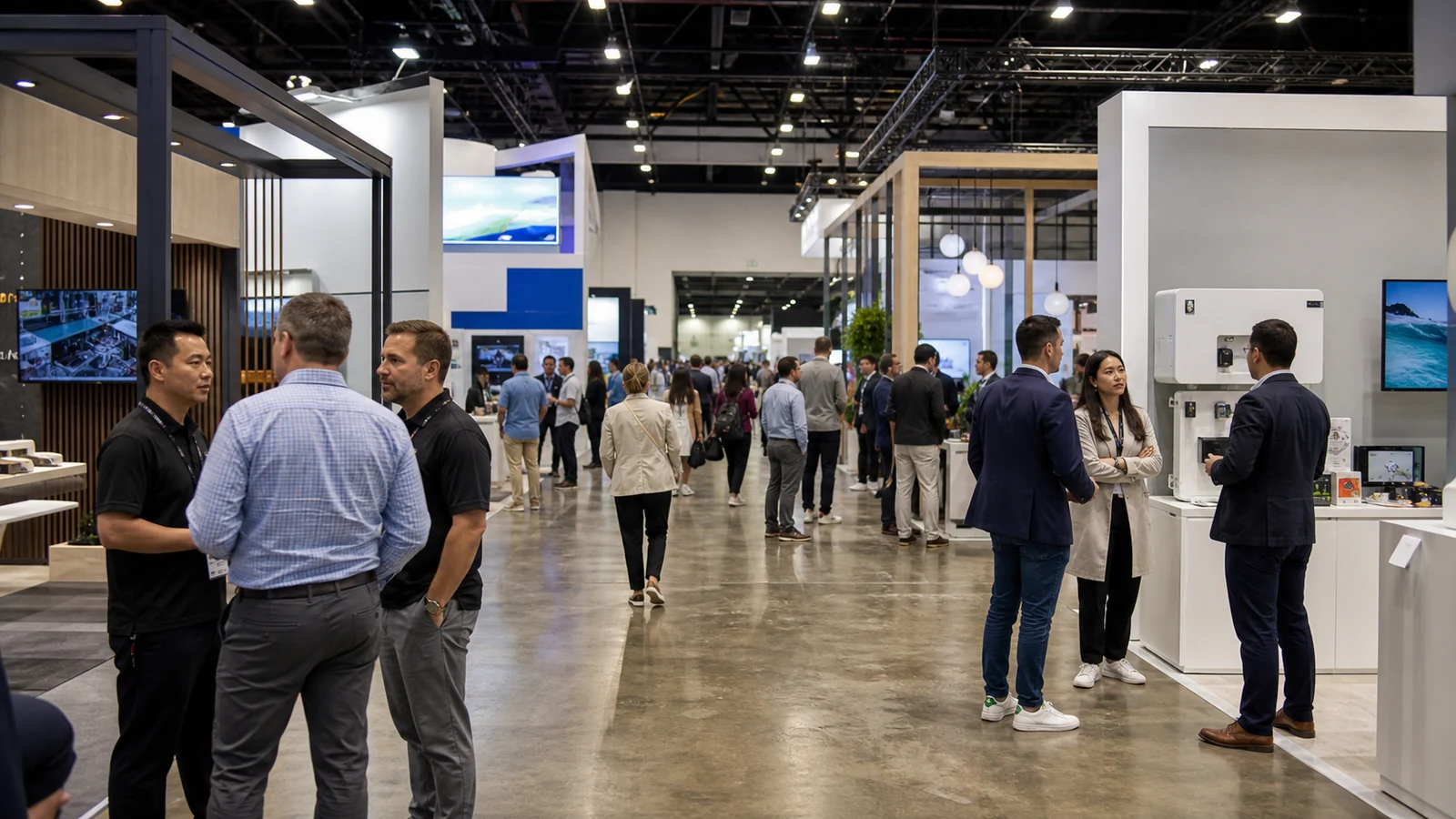
If you are deciding whether to exhibit at Space Tech Expo USA 2027, start with the buyer's decision, not the size of your hardware display. Technical visitors need to see where your product fits, which claim you can prove, and what should happen after the conversation. This guide gives you the event facts, a practical way to judge fit, booth choices, and rule checks needed to decide whether to exhibit in Anaheim or visit first.
The 2027 event at a glance
| Item | Current official information |
|---|---|
| Official event name | Space Tech Expo USA |
| Event dates | June 29–July 1, 2027 |
| Exhibition and conference | June 30–July 1, 2027 |
| Invite-only exhibitor and VIP reception | June 29, 2027, 5:00–7:00 p.m. |
| Exhibition hours | June 30, 9:00 a.m.–5:30 p.m.; July 1, 9:00 a.m.–4:00 p.m. |
| Venue | Hall A, Anaheim Convention Center |
| Address | 800 W Katella Ave, Anaheim, CA 92802 |
| Exhibition scope | Space-supply-chain technology, components, engineering, manufacturing, software, communications, ground systems, testing, optics, materials, and related services |
| 2027 move-in and move-out schedule | Not yet stated on the public 2027 pages checked on September 7, 2026 |
The official name remains Space Tech Expo USA. The 2027 date banner begins on June 29, but that evening is an invite-only reception for exhibitors and VIPs. The exhibition and conference open on June 30 and continue through July 1. Build your travel, booth staffing, and customer meetings around two show-floor days, not three.

The 2027 venue is Hall A at Anaheim Convention Center, not the former Long Beach location. Searches for “Space Tech Expo Long Beach” still appear, so check every freight label, contractor brief, hotel note, and calendar invitation for the old city before you release it.
Decide whether your offering belongs in this supply-chain show
The official site covers a broad part of the space supply chain, including components, materials, electronics manufacturing, engineering services, software, communications, ground systems, testing, and optics. Its visitor FAQ also mentions satellite technology, subsystems, launch services, and test and measurement. Your product may fit this scope, but a long capability list will not tell a visitor why it matters to a spacecraft, ground system, test program, or production line.
Write one sentence before you book the booth: “Our product helps the customer decide whether ___.” Mating reliability or assembly access can give a connector display its focus. Beside a thermal sample, show the heat path and test conditions. Place test equipment inside the qualification or production step where its measurement changes a decision. If you sell engineering work, show the input you need, the review you perform, and the document the customer receives.
| What you exhibit | The visitor's likely decision | Useful proof at the booth |
|---|---|---|
| Electronic or electromechanical component | Does it fit the program's electrical, mechanical, environmental, and supply needs? | Interface drawing, released specifications, test scope, traceability record, and change-notification process |
| Material or thermal solution | Does performance hold under the customer's actual geometry and environment? | Representative sample, test conditions, lot documentation, and the assumptions behind published properties |
| Test and measurement system | Can the team repeat the measurement without creating a new integration problem? | Live or recorded workflow, stated uncertainty or calibration limit, data output, and fixture needs |
| Ground or communications system | Can it connect with the customer's architecture and operating process? | System diagram, interface list, security and access assumptions, and a defined trial or technical review |
| Engineering or manufacturing service | Does the supplier define the work clearly enough to review and buy? | Required inputs, review points, sample deliverable, quality record, and division of responsibility |
Use this table to test relevance, not to predict demand. The official categories show what belongs at the event; they do not promise that a named agency, prime contractor, spacecraft company, or program will visit your booth. The public Space Tech Expo exhibitor list and floor plan available during this review still cover 2026. They can show you which categories appeared before, but your 2027 target list must come from the new directory, confirmed appointments, and current attendee tools when they are released.
Choose the first person and question your booth is built for
The organizer lists engineering, R&D, production, program management, purchasing, executive, government, and military functions among the audience. Several may influence the same purchase, but your booth cannot open with eight different messages.

Aim first at the person who can decide whether your product deserves a technical review. The job title will vary, so use the decision as your filter: this visitor understands the application, can question your evidence, and knows who should see the answer next. Purchasing can join later; it is difficult to discuss sourcing until someone can explain the technical fit.
Set a result that should be possible within five minutes. For example: “Visitors can check whether our unit fits the available space and interfaces, then request the relevant test report.” That sentence tells you which sample, drawing, screen, and technical colleague belong in the booth. “Show innovation” tells the team nothing.
Give the greeting staff one short qualifying question, then move a serious visitor to the colleague who can answer it. The same colleague or a nearby note taker should record what the visitor asked to see next. That simple handoff prevents the visitor from repeating the same program background to several employees.
Build the display around evidence, not hardware count
Important space hardware is often small or visually plain. Even a connector, coating sample, machined part, harness, sensor, or software screen may carry more program risk than a large mock-up. Your display must reveal why the item matters, not simply make it look bigger.
Arrange the display in the order a visitor would examine the product: where it connects, what it does, how you tested it, and which record the customer receives. Use a cutaway when assembly access matters, or two samples when the difference is easier to see than describe. If a screen shows test data, label the decision that value supports. Finish with one real traceability example that links the part or batch to its drawing revision and report.
Place the test condition next to the claim. “Space-grade” means little unless the visitor can see the applicable specification, configuration, test condition, and result. Do not say “flight proven” when your evidence covers only a prototype, a laboratory setup, or a different geometry. When a claim needs a long explanation, narrow the headline so it says exactly what the document proves.
Run a live demonstration only when it helps the visitor answer a real question. If the process is unsafe, restricted, slow, or impractical in the hall, show an honest recording beside the relevant part or fixture. Label simulated data and shortened sequences. Visitors should leave knowing what to review next, not merely remembering an effect on a screen.
Decide what the booth team may show and send
Space and defense conversations can quickly reach drawings, customer data, proprietary processes, or export-sensitive details that do not belong on an open show floor. Before the event, mark each file and sample as one of three things: approved for the booth, approved only for a private follow-up, or not approved for this event. Name the person who can answer an access question.

Give booth staff only material that has already been cleared, such as released specifications, generic interface examples, published test methods, and quality records with customer names removed. Keep restricted drawings and customer files off the booth laptop and shared drives. After the show, use your company's approved process to verify the recipient and purpose before sending anything else.
This guide cannot decide export-control, security, or customer-confidentiality obligations for your product. Ask the responsible legal, compliance, security, or program owner to approve what may be shown and sent. Booth staff should follow that answer, not make a legal judgment while a visitor is waiting.
Use the two exhibition days for different work
The 2027 show floor is open for two days. June 30 runs from 9:00 a.m. to 5:30 p.m., and the networking reception begins at 4:00 p.m. July 1 ends at 4:00 p.m. Because the second day is shorter, finish the display and rehearse the opening question before the first morning begins.

Book the most important technical meetings early on June 30, when your specialist and the right samples, drawings, and reports are available. Keep some gaps for people you did not expect to meet. Use the late-afternoon reception to continue conversations that have already found a real fit. Reserve July 1 for unanswered questions, partner discussions, and meetings that need a second person from your team.
After each useful conversation, write down the visitor's application, the open technical question, the document or sample you promised, and the person who will send it. “Interested in our product” is not enough for the follow-up team to act on.
Confirm the 2027 booth rules before design and shipping
As of September 7, 2026, the public event pages confirm the 2027 dates, show hours, reception, and Anaheim venue. However, the public exhibitor FAQ still displays a 2026 move-in and move-out schedule. Do not copy those 2026 operating times into a 2027 freight plan.
The official site directs exhibitors to its portal for access, shipping, display rules, forms, and contractor orders. Before design approval, obtain the 2027 service manual and confirm the booth type, floor and rigging rules, utilities, and any demonstration approval. Before shipping, confirm the receiving address and dates, carrier check-in, material handling, move-in, and move-out. Put the organizer's written answers in the same brief you give the booth builder and freight team.
The public Better Stands page already gives one direction for 2027. It says space-only stands should use reusable elements and ideally reach at least Bronze level. The page includes the structure and walls, raised floor or platform, furniture, equipment, and lighting in that assessment. Use this to question any single-use booth proposal, but confirm the exact requirement for your booth type and contract in the portal.
Do not approve the final booth from an old manual or a contractor's memory of Long Beach. The venue has changed. Use the 2027 operations pack when it is issued, and get written approval for anything unusual before fabrication or shipping.
Decide whether to exhibit or visit first
Exhibit if your product fits the published supply-chain scope, you can describe the technical evaluator you want to meet, and your booth can prove one useful point in five minutes. You also need a technical colleague who can answer the next question and approved material that can be shared without hesitation.

Visit first if the target is still only “space companies,” the team cannot explain which customer decision the product supports, or the booth would contain nothing beyond a brochure. Use the visit to listen for buyer language, compare category fit, and identify potential partners. Do not treat a visitor pass as a substitute sales floor; the current visitor policy prohibits non-exhibiting companies from soliciting people on the show floor or distributing unauthorized literature.
If you visit, choose three questions in advance: How do relevant exhibitors explain where their product fits? What proof do visitors ask to see? Which sessions attract the people you need? Your trip should end with a go or no-go decision and a first booth concept, not just a folder of photographs.
Frequently asked questions
Is Space Tech Expo USA the same event as Space Tech Expo Europe?
No. Space Tech Expo USA is the U.S. event in Anaheim, California. Space Tech Expo Europe is a separate sister event in Bremen, Germany. Use the U.S. event's own contract, portal, schedule, floor plan, and exhibitor instructions; do not transfer operational details from the European edition.
What if the main technical specialist cannot stay in the booth all day?
Schedule that person for your priority meetings and give the booth team a short escalation path for unscheduled visitors. When a remote call is needed, use a screen and headset in a quiet part of the booth, and test the connection and screen-sharing permissions before the show. If no qualified person can answer or arrange a technical follow-up, reduce the booth promise instead of letting sales staff guess.
Can a company use a visitor pass to sell on the show floor?
The current official visitor policy says non-exhibiting companies may not solicit attendees, exhibitors, or speakers on the show floor, including unauthorized literature distribution. If you attend rather than exhibit, use the visit for research and permitted networking. Describe any planned meeting or promotional activity to the organizer and ask for a written answer if the policy could apply.
Should an international exhibitor ship the real product or use a local display sample?
Choose after you know what the visitor must inspect. Ship the real unit only when its weight, interface, finish, movement, or test result is central to the conversation and the 2027 handling route is confirmed. When the real unit is fragile, restricted, difficult to import, or expensive to handle, use a nonfunctional sample, cutaway, or locally produced model instead. Label any substitute clearly so visitors do not mistake it for a tested product.
When should the team stop pursuing a show lead?
Close or pause the lead when the application does not fit, the contact cannot identify a relevant technical owner, or repeated follow-up produces no specific question or next step. Keep the reason in the record. This prevents the sales team from treating every badge scan as pipeline while preserving a clear path to reopen the contact if a real project appears.
Final thoughts
Choose an exhibit only when you can name the buyer decision, show credible proof, and staff the next technical question. Then confirm the 2027 Anaheim operating rules before you approve the booth or ship anything. If product fit or evidence is still vague, visit first and use what you learn to make a specific go or no-go decision for the next show.