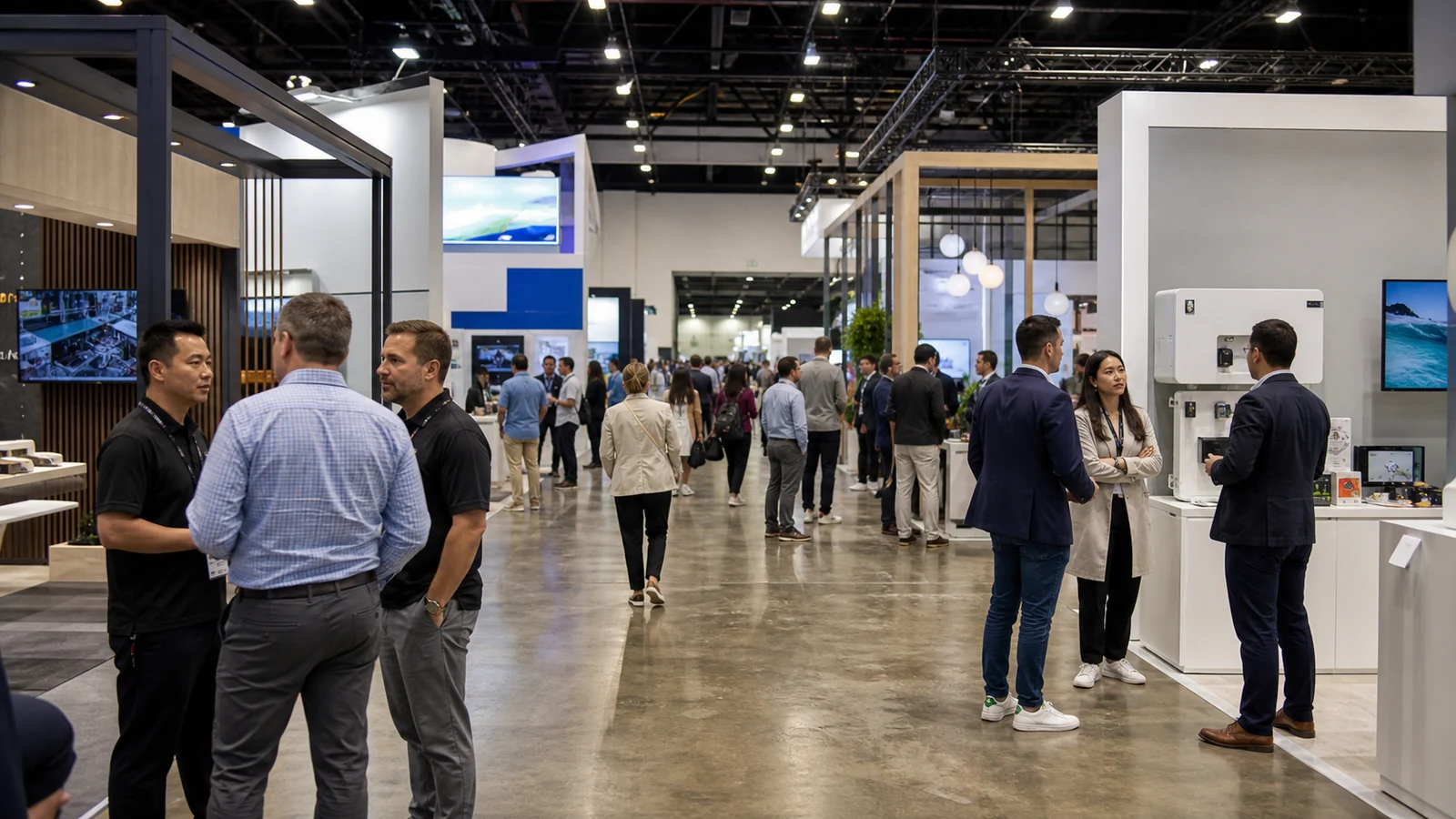
An AV demo can work perfectly in your lab and still fail on a trade show floor. The network may be unsuitable, the sound may cross into the aisle, or the rigging plan may not fit your booth type. This InfoComm exhibitor guide separates what is confirmed for Orlando from the details your team still needs to obtain before shipping.
InfoComm 2027 has two different calendars. Education runs June 12–18, while the exhibits run June 16–18 at the Orange County Convention Center (OCCC) in Orlando, Florida. Your exhibit labor, product demonstrations, and customer meeting plan should be built around the exhibit dates, not the full education week.
What InfoComm is—and whether your product belongs there
InfoComm is the professional audiovisual show owned and produced by AVIXA, the Audiovisual and Integrated Experience Association. Its show-floor categories include audio, broadcast AV, conferencing and collaboration, digital signage, learning technology, performance and entertainment, and security, surveillance, and command-and-control systems.

That range does not mean every technology company is automatically a fit. The useful test is whether your product helps a professional team design, deploy, operate, or improve an audiovisual environment. A display manufacturer may meet integrators and enterprise technology teams. A collaboration platform may need to reach systems architects and workplace leaders. A lighting or staging brand may be more relevant to live-production professionals.
AVIXA's exhibitor page describes an audience that includes enterprise end users and pro AV channel professionals, with roles such as CTO, systems architect, design engineer, and vice president of operations. It also displays recent show figures of 28,130 verified attendees, 16,693 buyers, 807 exhibitors, and participants from 92 countries. These are organizer-reported recent-show figures, not attendance guarantees for 2027 and not a forecast of the leads any one booth will receive.
Before contracting space, write down the one group you must meet and the one product decision you want that group to make. If your answer is only “get exposure,” the show may be relevant but your exhibit plan is not ready.
Sources: InfoComm About Us and Become an InfoComm Exhibitor.
Confirmed InfoComm dates and location
| Item | Confirmed information | How to use it |
|---|---|---|
| Education | June 12–18, 2027 | Plan courses, certification, and training separately from show-floor staffing. |
| Exhibits | June 16–18, 2027 | Use these dates for visitor meetings and the operating plan for your booth. |
| Venue | Orange County Convention Center, Orlando, Florida | Do not use the venue's street address as a freight label unless the 2027 service manual tells you to. |
| Booth-complete deadline | 5:00 p.m. on June 15, 2027 | Work backward from this deadline when booking labor, product installation, testing, and cleaning. |
| Earliest permitted dismantling | After 4:00 p.m. on June 18, 2027 | Keep staff and outbound freight plans in place through the official close. |
The main InfoComm website also says RESIDE and Lightapalooza will be co-located at OCCC during the same week. They are separate events and buyer communities. Do not assume that a co-location announcement changes your contracted InfoComm space, badge access, hall assignment, or product category. Check those points in your own contract and exhibitor account.

One caution is worth recording now. The official 2027 Rules and Regulations PDF contains a before-show-hours clause that refers to June 17–19 as show days, while the official About Us and Become an Exhibitor pages both state that the 2027 exhibits run June 16–18. Use June 16–18 as the published exhibit dates, but obtain written confirmation from InfoComm Show Management before scheduling an early-morning press event or product briefing.
Sources: InfoComm future dates, One Week, Three Shows, and the InfoComm 2027 Rules and Regulations.
How to become an InfoComm exhibitor
New exhibitors can start on the official Become an Exhibitor page. InfoComm assigns Expositions Account Managers by company-name range and also lists international sales contacts. Existing exhibitors use the priority-space process, in which accumulated priority points influence the order of space-selection appointments. Space remains subject to AVIXA's approval and the executed exhibit-space agreement.
The organizer currently publishes 2027 raw-space rates of $50 per square foot for AVIXA members and $55 per square foot for non-members. Member pricing also depends on the membership level required for the booth size. Treat this as space rent only. Your working budget still needs separate lines for the exhibit, flooring, freight, material handling, labor, electrical service, internet, rigging where permitted, cleaning, insurance, travel, and product-specific support.
Follow this order:
- Submit the official exhibitor inquiry or contact the assigned account manager.
- Confirm that your company and products are eligible, then review the available floor plan.
- Read the exhibit-space agreement, contract terms, and 2027 Rules and Regulations before paying on assumptions about height, rigging, sound, or shared brands.
- After contracting, enter the 2027 Exhibitor Resource Center and download the current deadline checklist and service manual.
- Record the booth number, booth type, target move-in slot, official service providers, order deadlines, and shipping labels in one project sheet.
The public Current Exhibitor Information page points contracted exhibitors to a login-protected resource center for deadline checklists and other show resources. A deadline copied from a prior year is not an acceptable substitute.
Sources: Become an InfoComm Exhibitor, 2027 Priority Space Selection, and Current Exhibitor Information.
Build the booth around one demonstrable result
InfoComm visitors can compare many products that look similar on a specification sheet. A useful exhibit therefore starts with a result they can see, hear, control, or test. Define one main demonstration before your team develops the structure around it.

A conferencing manufacturer, for example, may need a stable wired connection, controlled room acoustics, a camera sightline, a realistic display distance, and a short reset between groups. Those needs determine where the rack sits, how cables reach the equipment, where visitors wait, and whether an open booth can deliver the experience. The structure is a consequence of the demo, not the starting point.
Write a demonstration sheet with the following fields:
- visitor role and the problem being demonstrated;
- equipment list, dimensions, individual weights, and total shipment count;
- power draw, connector type, and whether equipment must run continuously;
- wired internet, static IP, or other network requirements;
- expected sound level and the direction of speakers;
- rigging points or suspended loads, if any;
- the number of people in each demonstration and where they will stand;
- setup, calibration, reset, and shutdown steps;
- backup content or hardware if the live system cannot run.
This sheet should go to the exhibit designer, product engineer, logistics lead, and on-site operator. It also gives official providers enough detail to quote the correct services. A vague request for “power and Wi-Fi” is not sufficient for a live AV demonstration.
Rules that can change the design
The 2027 Rules and Regulations are part of the exposition contract. They are not a final design checklist by themselves; your team must also use the OCCC rules, the height-restrictions floor plan, and the 2027 Exhibitor Service Manual. Several published rules already affect the first drawing.

| Published 2027 rule | Design or operating consequence |
|---|---|
| The entire contracted booth must have an approved floor covering. | Include flooring in the design and budget; bare concrete is not a fallback. |
| Inline and corner booths under 400 square feet have an 8-foot maximum height. Perimeter spaces may reach 12 feet. | Confirm the booth classification before approving walls, towers, or signs. |
| Rigging is not permitted in inline or linear booths. | Do not sell an overhead-sign concept for a 10-by-10, 10-by-20, 10-by-30, or 10-by-40 inline space. |
| Island booths require at least 400 net square feet; hard walls may generally reach 24 feet, subject to ceiling and facility limits. | Check the booth-specific height plan and approval route before engineering tall structures. |
| Demonstrations, equipment, queues, and doors must remain inside the contracted footprint. | Draw the queue and door swing, not just the product display. |
| Sound leaving a booth must remain below 85 dB. | Aim speakers inward and use an audio demo room or suitable sound room for louder tests. |
| Deviations from the approved booth types require written clearance before May 5, 2027. | Freeze exception-dependent concepts early; do not wait for fabrication to request a variance. |
| If required, structural-integrity certification must be submitted 60 days before the exhibit opening. | Ask Show Management whether your walls, suspended elements, or multi-level plan trigger this requirement. |
The rules also require flame-retardant construction and decorative materials, keep promotional distribution within the booth, and prohibit structures or signs from extending into an aisle. A correction ordered on site is paid for by the exhibitor, so these are drawing-stage decisions.
Source: InfoComm 2027 Rules and Regulations.
Utilities, internet, and rigging at OCCC
OCCC's planning guide states that its Exhibitor Services team is the exclusive agent for exhibitor utilities and rigging. The venue also identifies Smart City Networks as its exclusive internet and telecommunications provider. Your product team can specify the technical need, but the show kit determines the order route, rate, and service deadline for this event.
Place every connection on a scaled plan. Mark power drops, data lines, floor ports, hanging points, control positions, and equipment racks. For a networked demo, state the number of devices, expected traffic, security restrictions, remote endpoints, and whether a wired connection or dedicated network is necessary. For a suspended product, provide dimensions, weight, desired height, and a drawing suitable for the required review.
Do not assume that complimentary public Wi-Fi is appropriate for a sales demonstration. It may be useful for ordinary attendee access, but a product that depends on low latency, fixed addressing, controlled bandwidth, or device isolation needs a service specified for that purpose.
Sources: the OCCC Event Planning Guide and OCCC Service Partners.
Plan freight and move-in from the current service manual
The public rules give one firm installation boundary: the booth must be complete by 5:00 p.m. on June 15. They do not provide the booth-specific target move-in schedule, advance-warehouse address, direct-to-show shipping window, material-handling rates, or carrier check-in instructions.

Wait for the 2027 manual before producing shipping labels. Then decide which items go to the advance warehouse and which should arrive directly at the show. Separate the structural shipment from sensitive demo equipment when their handling needs differ. Each crate should have a packing list, booth number, piece count, return plan, and a named owner who can identify missing items.
Your inbound plan is incomplete until it has an outbound plan. Record who will prepare return labels, who will release packed freight, which carrier is booked, and what happens if that carrier misses the pickup window. No dismantling or packing may start before 4:00 p.m. on June 18, so a flight schedule is not a reason to close the booth early.
For an international shipment, let the appointed customs broker classify the goods and define the entry method. Demonstration equipment, samples, giveaways, and items that will remain in the United States may require different treatment. The InfoComm service manual and your broker's written instructions should agree before the shipment leaves its origin.
Confirmed deadlines and details still pending
As checked on September 7, 2026, the following public deadlines are specific enough to enter in the project schedule:

- April 30, 2027: upload the required certificate of insurance. The rules require at least $1 million in comprehensive general liability coverage and name AVIXA, OCCC, and The Freeman Companies as additional insureds.
- May 5, 2027: deadline stated for written clearance of a deviation from the approved exhibit types.
- June 15, 2027, 5:00 p.m.: all exhibits must be complete and in place.
- June 18, 2027, 4:00 p.m.: the final close stated in the rules; dismantling or packing may not begin earlier.
Do not fill the rest of the schedule with 2026 dates. The public pages checked for this guide did not provide the 2027 target move-in schedule, detailed freight windows, exhibitor-appointed contractor deadlines, badge deadlines, or event-specific early-order dates for electrical, internet, rigging, plumbing, and material handling. Contracted exhibitors should retrieve those items from the 2027 Exhibitor Resource Center and confirm any ambiguity with Show Management or the named provider.
Questions exhibitors still ask
Can several product brands appear under one exhibiting company?
The 2027 rules allow an exhibitor to add up to ten additional brands to the digital directory at $300 per brand, subject to Show Management approval. That listing does not place the additional brand on the floor plan. Sharing contracted space with another company is a different arrangement and requires written permission plus a separate share contract, so confirm the legal relationship and fee before promoting a partner as a co-exhibitor.
Can we sell and hand over products in the booth?
The rules allow exhibitors to show, explain, and demonstrate their products or services. They prohibit sales that result in merchandise delivery or an exchange of money in the exhibit halls. Build lead capture, quotation, and post-show fulfillment into the sales process instead of treating the booth as a retail counter.
Can we serve food or alcohol during a demonstration or reception?
Food and non-alcoholic beverages distributed from the booth must be purchased from the official convention-center food service provider. Alcohol must also be arranged through the official caterer, and the exhibitor accepts the related responsibility, liability, and cost. Obtain Show Management approval for any reception held outside normal show hours.
May our video crew film neighboring booths or visitors?
Commercial photography or video of another booth requires permission from that exhibitor and from the people who appear in the footage. A neighboring exhibitor may also refuse photography inside its own space. Prepare releases and a shot plan rather than assuming a show badge is blanket filming permission.
Can we hold a private product briefing before or after show hours?
The rules describe approval routes for certain pre-show and after-hours functions, including advance notice, guest control, security, and official catering. However, one pre-show clause contains dates that conflict with the published 2027 exhibit calendar. Ask Show Management to confirm the permitted date, time, entrance, and security plan in writing before inviting guests.
Does the show's general security cover our demo equipment?
No. The rules say exhibitors remain responsible for their exhibit materials and products from delivery through move-out. The show provides general security as a courtesy, but exhibitors must arrange their own insurance and any extra guard service or locked storage they need. Assign custody for portable devices before the crates arrive.
FAQ source: InfoComm 2027 Rules and Regulations.
Final planning handoff
An InfoComm exhibit becomes controllable when the booth drawing, demonstration sheet, service orders, and freight plan describe the same project. Before releasing fabrication, hold one review with the contracted booth number and type, the main demo, equipment weights, power and network needs, sound plan, rigging status, queue capacity, shipping route, official deadlines, and named owners on the table.
Keep unconfirmed service dates out of the drawing notes and production promises. Replace them only when the 2027 Exhibitor Resource Center or InfoComm Show Management provides the current instruction. That discipline is more valuable than an ambitious booth concept that has to be redesigned during move-in.